
Marcus Aurelius Meditations: 7 Inspiring Lessons
Discover 7 inspiring lessons in Marcus Aurelius Meditations — control what you can, accept your fate, and live each day as if it were your last.
This post may contain affiliate links. We only recommend products we personally use and love (please see our full affiliate disclosure). If you click through and make a purchase, we may earn a small commission at no extra cost to you. Your support helps keep this blog running. Thank you so much!
An Emperor’s Private Notebook
What readers now call Marcus Aurelius Meditations was never meant to be a book at all. Marcus Aurelius, emperor of Rome from 161 to 180 AD, wrote it in Greek as private notes to himself, mostly while on military campaign along the Danube frontier in the 170s. He was reminding himself how to live, not teaching anyone else.
That is exactly why the book still works nearly two thousand years later. There is no performance in it, no audience to impress, only a powerful man arguing with his own impatience, fear, and pride. A reader gets to sit beside him and borrow the arguments.
Table of Contents
What the Book Is About
Inside Marcus Aurelius Meditations are twelve books of short reflections, written in the Stoic tradition Marcus studied from Epictetus and Seneca. The same themes return again and again: the mind is the one thing a person truly controls, the body and reputation are not, and death is always close enough to make today matter.
Marcus writes about difficult people, about duty he would rather avoid, and about the temptation to chase praise. His answers are always practical: look at what is actually in your power, accept what is not, and act well in the time you have.
7 Inspiring Lessons from Marcus Aurelius Meditations
Each lesson comes from Marcus’s own words, written to steady himself on hard days. Together, they form a short manual for a calm mind and a useful life.
Lesson 1: Control What You Can
“You have power over your mind — not outside events. Realize this, and you will find strength.” This is the foundation of the whole book. Marcus returns to it constantly because it is the one distinction that changes everything: thoughts and choices are yours, while reputation, weather, and other people are not.
A reader who practices this stops spending energy on what cannot be moved. The mind becomes the workplace, and outside events become weather — noticed, but not obeyed. Strength, in this book, is not force; it is the refusal to hand the mind over to things it cannot control.
Lesson 2: Guard the Quality of Your Thoughts
“The happiness of your life depends upon the quality of your thoughts.” Marcus believed that a person’s inner life is not a side project — it is the life itself. Thoughts repeated daily become character, and character decides how every event feels.
This is why he watches his own mind so closely throughout the book. The practice is simple and daily: notice the thought, ask whether it is true and useful, and replace it if it is not. A reader who guards the gate of the mind finds that happiness stops depending on luck.
Lesson 3: Remember That You Will Die
“Do not act as if you were going to live ten thousand years. Death hangs over you. While you live, while it is in your power, be good.” Marcus uses mortality the way other writers use a deadline: not to frighten, but to focus. A life that might end soon has no room for petty quarrels or postponed goodness.
The lesson is not to rush, but to stop wasting. Every hour spent on resentment or vanity is an hour that will not come back. A reader who keeps death in view finds it easier to forgive quickly and to do the good thing now instead of someday.
Lesson 4: Accept Your Fate, Love Your People
“Accept the things to which fate binds you, and love the people with whom fate brings you together, but do so with all your heart.” Marcus was an emperor, yet he had no more control over his circumstances than anyone else. His answer was acceptance with warmth rather than resignation.
This lesson covers both the hard and the tender parts of life. The difficult assignment, the difficult person, the body that ages — all are to be accepted, and the people fate places beside a reader are to be loved fully. Acceptance, in his hands, is not giving up; it is the start of doing the work well.
Lesson 5: Greet the Morning with Gratitude
“When you arise in the morning think of what a privilege it is to be alive, to think, to enjoy, to love…” Marcus began his days by counting what most people rush past. The morning reminder turns an ordinary day into something given, not owed.
The practice costs nothing and takes a minute. A reader who starts the day this way meets the day’s annoyances from a different place, because the day itself has already been received as a gift. Gratitude, for Marcus, is not a mood; it is a morning habit.
Lesson 6: Stop Arguing About Goodness — Be Good
“Waste no more time arguing about what a good man should be. Be one.” Marcus had no patience for philosophy as a debating sport. The point of reading about virtue, in his view, is to practice it, and the practice is always available in the next small choice.
This lesson cuts through perfectionism. A reader does not need a perfect understanding of goodness before acting well; the next honest word or kind act is already the lesson. Goodness is not a theory to be settled first — it is the thing to do now.
Lesson 7: Do Right, Speak True
“If it is not right do not do it; if it is not true do not say it.” Marcus closes the circle with a rule simple enough to carry anywhere. Every action and every sentence passes the same two tests: is it right, and is it true?
A reader who lives by this rule needs no complex system for hard decisions. The tests work at work, at home, and in a heated conversation, and they work the same day they are learned. Right action and true speech, repeated daily, become a reputation no one can take away.
Why It’s a Must-Read
The book is short, plain, and built to be reread in small pieces. Its lessons can be stated in a single sentence each, yet each one opens into a lifetime of practice. Few books offer wisdom this direct that can be tested the same day it is read.
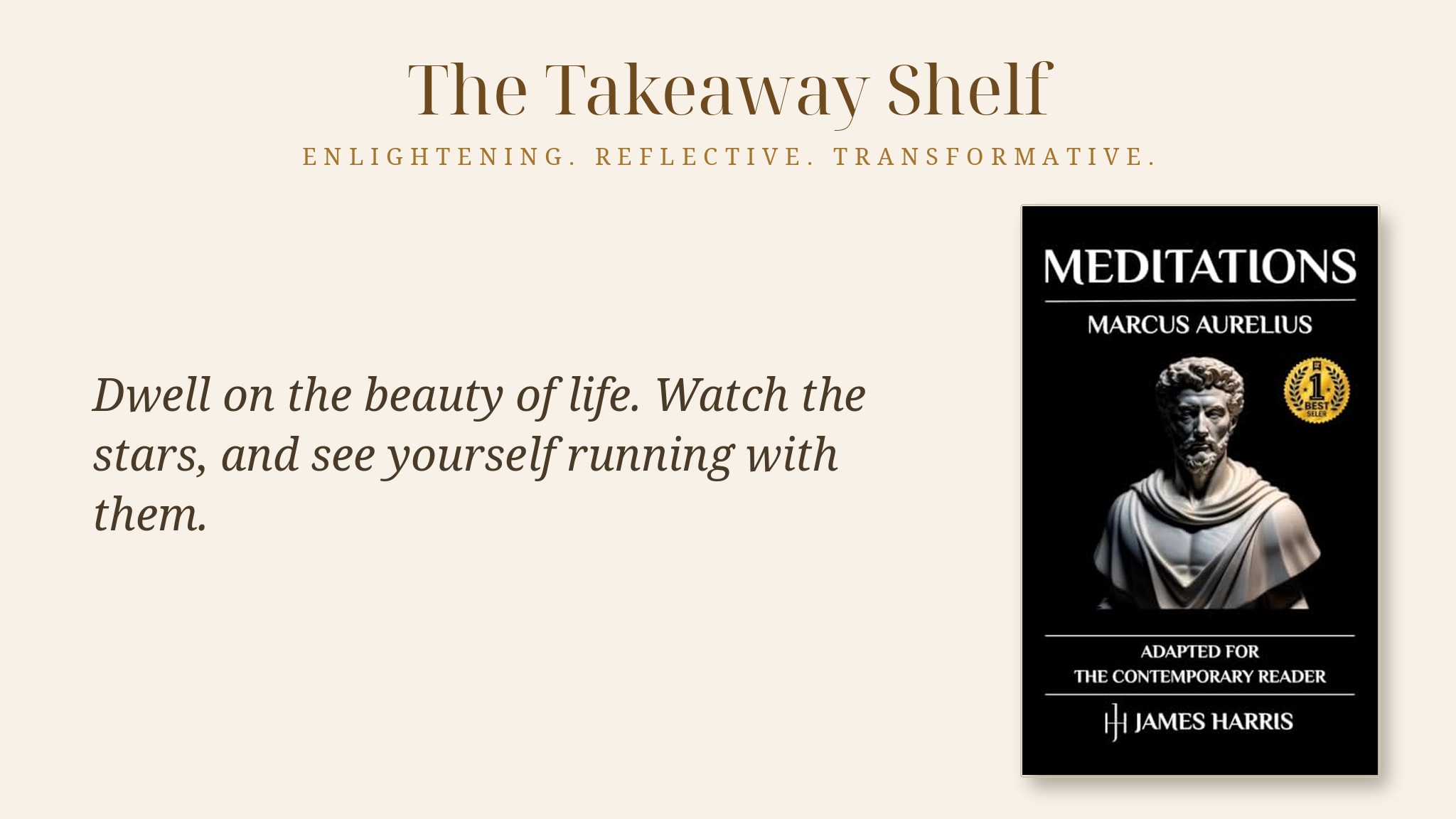
It is also remarkably quotable without ever sounding like a poster. Lines like “The best revenge is to be unlike him who performed the injury” and “Dwell on the beauty of life. Watch the stars, and see yourself running with them” land because they come from a man arguing with himself, not performing for a crowd. That honesty is why readers keep returning to Marcus Aurelius Meditations almost two thousand years later.
Who This Book Is For
This book is for readers who feel pulled in every direction by other people’s opinions, bad news, and their own restless thoughts. It is for anyone who wants a calmer mind without a complicated system, and for readers who like their wisdom short, plain, and usable the same day.
It may feel too spare for readers who want stories, research, or step-by-step programs. Marcus Aurelius Meditations is a notebook of reminders, not a course, and it asks the reader to do the applying. Readers who enjoy thinking slowly, one idea at a time, will get the most from it.
The Notebook Is Still Open
Marcus never finished Meditations, because a private notebook is never really finished. He kept writing to himself until the end of his life, and the pages simply stop. A reader today can pick up where he left off, with the same questions and the same small daily practices.
Start with one lesson — control what you can, or greet the morning with gratitude — and watch what changes by evening. The notebook is still open, and the next entry is yours to write.
Keep reading on The Takeaway Shelf: 8 Timeless Lessons from Letters from a Stoic by Seneca — the Stoic letters Marcus himself studied, on the same questions of time, anger, and a life well lived.