4 Life-Changing Lessons from The Four Agreements by Don Miguel Ruiz
Discover 4 life-changing lessons from The Four Agreements by Don Miguel Ruiz — simple Toltec agreements that end suffering and bring personal freedom.
This post may contain affiliate links. We only recommend products we personally use and love (please see our full affiliate disclosure). If you click through and make a purchase, we may earn a small commission at no extra cost to you. Your support helps keep this blog running. Thank you so much!
A Small Book Built on Four Promises
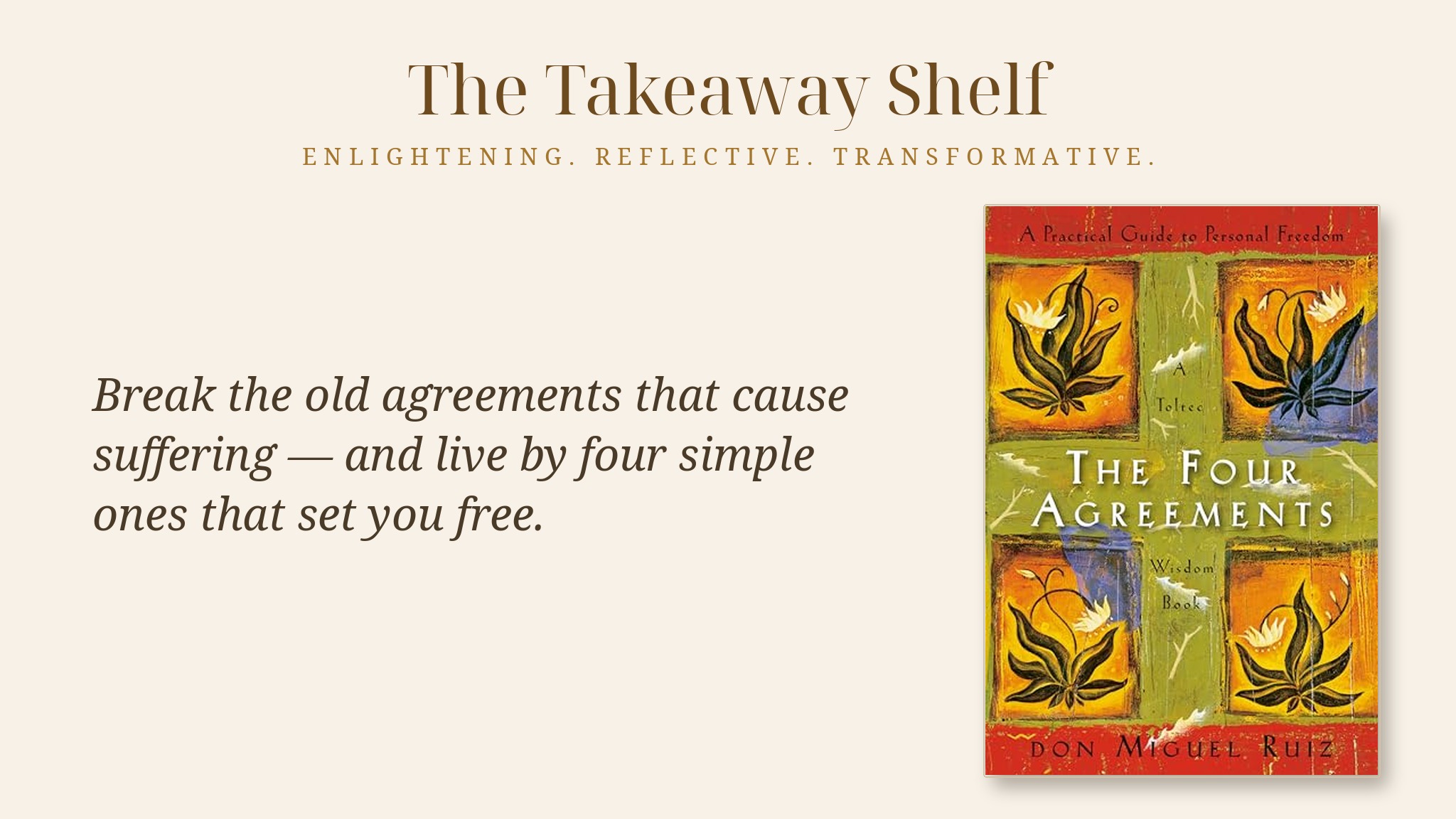
Some books ask for a whole new system, a new planner, and a new personality by Monday. The Four Agreements asks for something much smaller: four promises a person makes with themselves. First published in 1997, Don Miguel Ruiz’s short book has stayed in print ever since because those promises are simple to understand and hard to forget.
The catch is that the promises are not easy to keep. Old habits pull in the opposite direction every day, often without anyone noticing. That tension — between the agreements people live by now and the four that could replace them — is the heart of the book.
Table of Contents
What the Book Is About
Don Miguel Ruiz writes from the Toltec tradition, a path of wisdom he traces to the spiritual teachers of ancient Mexico. In his telling, every child goes through what he calls domestication: through praise, punishment, and repetition, children learn a “Book of Law” for how to behave. Over time, that law moves inside, where an inner Judge condemns every mistake and an inner Victim carries the blame.
Those learned rules become agreements — beliefs a person never chose but lives by anyway, such as needing everyone’s approval or fearing what others think. Ruiz argues that many of those agreements create needless suffering. His answer is to break the fear-based agreements and replace them with four new ones built on personal freedom.
4 Life-Changing Lessons from The Four Agreements
Each agreement stands on its own, and each one is a complete practice by itself. Together, they form a code of conduct meant to be lived daily, not just read once. Here is what each one asks — and what it gives back.
Lesson 1: Be Impeccable with Your Word
Ruiz calls this the first and most important agreement, and also the most difficult one to honor. To be impeccable with your word means speaking with integrity: say only what you mean, and do not use the word to speak against yourself or to gossip about others. Used well, he says, the word should move in the direction of truth and love.
The reason it matters so much is that words create. Through the word, people express intent, repeat old beliefs, and pass judgments on to everyone around them — including themselves. A reader who keeps only this one agreement, Ruiz says, will already begin to feel the level of self-love rise, because the quality of the word and the level of self-love rise together.
Lesson 2: Don’t Take Anything Personally
The second agreement rests on one freeing idea: nothing others do is because of you. What other people say and do is a projection of their own reality and their own dream, shaped by the agreements they made long before. Their opinions say more about their inner world than about the person receiving them.
When a reader becomes immune to the opinions and actions of others, the book argues, they stop being the victim of needless suffering. Insults lose their sting and praise loses its power to control. Life gets quieter, because other people’s moods no longer get to decide the reader’s worth.
Lesson 3: Don’t Make Assumptions
Assumptions fill every gap that clear communication leaves behind. People assume they know what others think, then believe the assumption and react as if it were true — and when others stay silent, new assumptions rush in to replace the need to communicate. Ruiz traces a great deal of misunderstanding, sadness, and drama to exactly that habit.
The way out is courage: find the courage to ask questions and to express what you really want. Communicate with others as clearly as possible, even when the question feels awkward. With just this one agreement, Ruiz says, a reader can completely transform their life.
Lesson 4: Always Do Your Best
The fourth agreement is the one that keeps the other three alive. A person’s best is not a fixed standard — it changes from moment to moment, and it looks different when someone is healthy than when they are sick or exhausted. The promise is simply to do that best, whatever it happens to be on a given day.
Judged by that standard, there is nothing to regret. Doing one’s best under any circumstance, the book says, is how a reader avoids self-judgment, self-abuse, and regret. It also makes the other agreements sustainable, because a hard day no longer counts as failure.
Why It’s a Must-Read
The book is short, plain-spoken, and built to be reread. Its four agreements can be stated in a single sentence each, yet each one opens into a chapter of examples that show how deeply the old agreements run. Few personal-growth books offer a code of conduct this simple that can be tested the same day it is read.
It is also honest about where suffering comes from. Instead of blaming circumstances or other people, it points to the beliefs a person agreed to without knowing — and beliefs, unlike circumstances, can be changed. That is why readers keep returning to it years later: the agreements stay relevant because the Judge and the Victim do too.
Who This Book Is For
This book is for readers who replay conversations for days and take other people’s moods personally. It is for anyone caught in gossip, self-criticism, or the exhausting work of guessing what others mean instead of asking. It also suits readers who prefer their personal growth short and practical — one clear practice at a time.
It may move too slowly for readers who want research studies and data behind every claim. The book teaches through Toltec story and principle rather than evidence, and it asks to be judged by practice. Readers comfortable with a spiritual frame will get the most from it.
Freedom Begins with the Next Agreement
Ruiz never asks for all four agreements at once, and the book is kinder for it. A reader can start with a single one — speaking impeccably for one day, or refusing to take one comment personally — and watch what changes. Freedom, in his telling, is not a personality transplant; it is one better agreement at a time.
Keep reading on The Takeaway Shelf: 8 Powerful Lessons from The Let Them Theory by Mel Robbins — another gentle guide to letting go of what other people think.