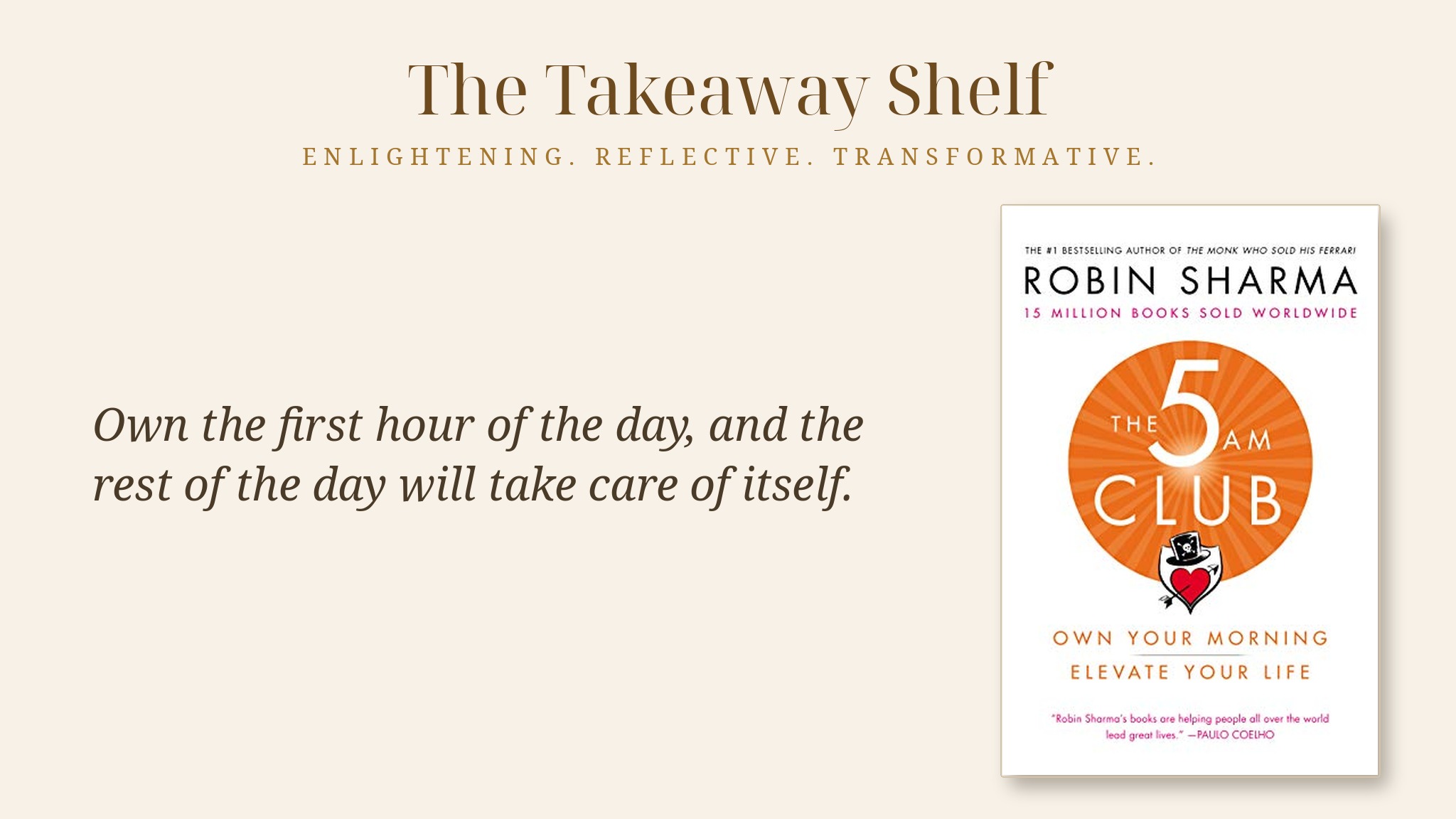
7 Powerful Lessons from The 5 AM Club by Robin Sharma
Discover 7 powerful lessons from The 5 AM Club by Robin Sharma — the 20/20/20 Victory Hour, 66-day habits, and the Twin Cycles of Elite Performance.
This post may contain affiliate links. We only recommend products we personally use and love (please see our full affiliate disclosure). If you click through and make a purchase, we may earn a small commission at no extra cost to you. Your support helps keep this blog running. Thank you so much! 💕
Some books hand over a system. Others wrap the system inside a story, so the lessons arrive attached to people worth rooting for.
The 5 AM Club does the second thing, and it does it at full volume. A struggling entrepreneur and a frustrated artist cross paths with an eccentric billionaire, and the mornings that follow change everything they believed about discipline, focus, and rest.
Table of Contents
What the Book Is About
The 5 AM Club by Robin Sharma opens at a personal mastery conference, where the legendary speaker known as The Spellbinder collapses on stage. In the confusion that follows, an Entrepreneur facing professional ruin and an Artist battling creative block meet a disheveled stranger who speaks with unusual authority.
The stranger turns out to be Stone Riley, a billionaire industrialist who credits his fortune to the morning method The Spellbinder taught him. He invites the two of them on a journey — from Mauritius to Rome, Agra, and São Paulo — and teaches them the system lesson by lesson.
Underneath the fable sits a complete operating system for the first hour of the day. Its core promise is simple: take excellent care of the front end of the day, and the rest of the day largely takes care of itself.
7 Powerful Lessons from The 5 AM Club
1. Own the Victory Hour
Sharma calls the hour from 5:00 to 6:00 AM the Victory Hour. It is the one stretch of the day that arrives before meetings, messages, and everyone else’s priorities.
The point is not suffering for its own sake. The point is solitude and focus at the exact moment the mind is freshest, spent on the person rather than on the inbox.
2. Run the 20/20/20 Formula Inside The 5 AM Club Victory Hour
The Victory Hour is split into three equal pockets. The first 20 minutes are for Move: vigorous exercise that lowers cortisol and wakes up the brain.
The second 20 minutes are for Reflect: journaling, meditation, prayer, or planning in quiet. The final 20 minutes are for Grow: reading, studying, or learning a skill while the knowledge can actually sink in.
3. Build the Four Interior Empires
Sharma argues that mindset is only one of four empires. The others are Heartset (emotional health), Healthset (physical vitality), and Soulset (connection to purpose).
Neglecting any one of them caps the rest. A sharp mind in an exhausted body, or a driven heart with no sense of meaning, eventually stalls — the book treats all four as daily training, not occasional inspiration.
4. Give a Habit 66 Days to Install
The Habit Installation Protocol says a new routine takes about 66 days to reach the Automaticity Point. The process runs through three stages: Destruction (days 1–22), Installation (days 23–44), and Integration (days 45–66).
That framing changes how the hard weeks feel. The messy middle is not proof the habit is failing; according to Sharma, it is the stage where the new pattern is actually being built.
5. Honor the Twin Cycles of Elite Performance
Elite performance, in the book’s model, oscillates. High Excellence Cycles of intense, focused output must alternate with Deep Refueling Cycles of rest, sleep, nature, and play.
Recovery is not the reward for the work — it is half of the system that makes the work possible. Pushing without refueling is presented as the fastest route to burnout, not to mastery.
6. Steal Back Focus with 90/90/1 and 60/10
Among the book’s 10 Tactics of Lifelong Genius, two are pure scheduling. The 90/90/1 Rule gives the first 90 minutes of the workday, for 90 days, to the single most important project.
The 60/10 Method works in shorter loops: 60 minutes of focused work followed by 10 minutes of genuine recovery. Both tactics protect attention by deciding in advance where it will go.
7. Work with Granularity, Not Superficiality
The 3 Step Success Formula runs Better Awareness → Better Choices → Better Results. Riley calls the achiever’s version of that awareness a mentality of granularity: rigorous attention to the small details most people skim past.
It is also the heart of the Four Focuses of History-Makers, beginning with Capitalization IQ — making the most of the talents already present. In the book’s terms, depth is a competitive advantage anyone can choose.
Why It’s a Must-Read
Most morning books offer a wake-up time and a pep talk. This one offers a full architecture: an hour with a structure, a habit timeline with honest stages, and a recovery model that keeps the system sustainable.
The fable format will not suit every reader, and the book takes its time getting to the frameworks. But the 20/20/20 Formula alone is concrete enough to test tomorrow morning, and that testability is rare in the genre.
Who This Book Is For
This book is for founders, creatives, and professionals who feel their days are being spent reacting to other people’s priorities. It is also for anyone whose mornings currently begin with a phone and a rush.
Readers who prefer straight instruction over storytelling may find the parable slow going. Readers who remember lessons better when they arrive inside a story will likely find it sticks.
Tomorrow Morning Is the First Page
Every system in this book narrows down to one decision made the night before and kept at 5:00 AM. The alarm is unglamorous, and that is rather the point — the extraordinary results are built out of an ordinary hour, repeated.
For another Takeaway Shelf read about what disciplined endurance really costs, see 8 Timeless Lessons from Letters from a Stoic by Seneca.