
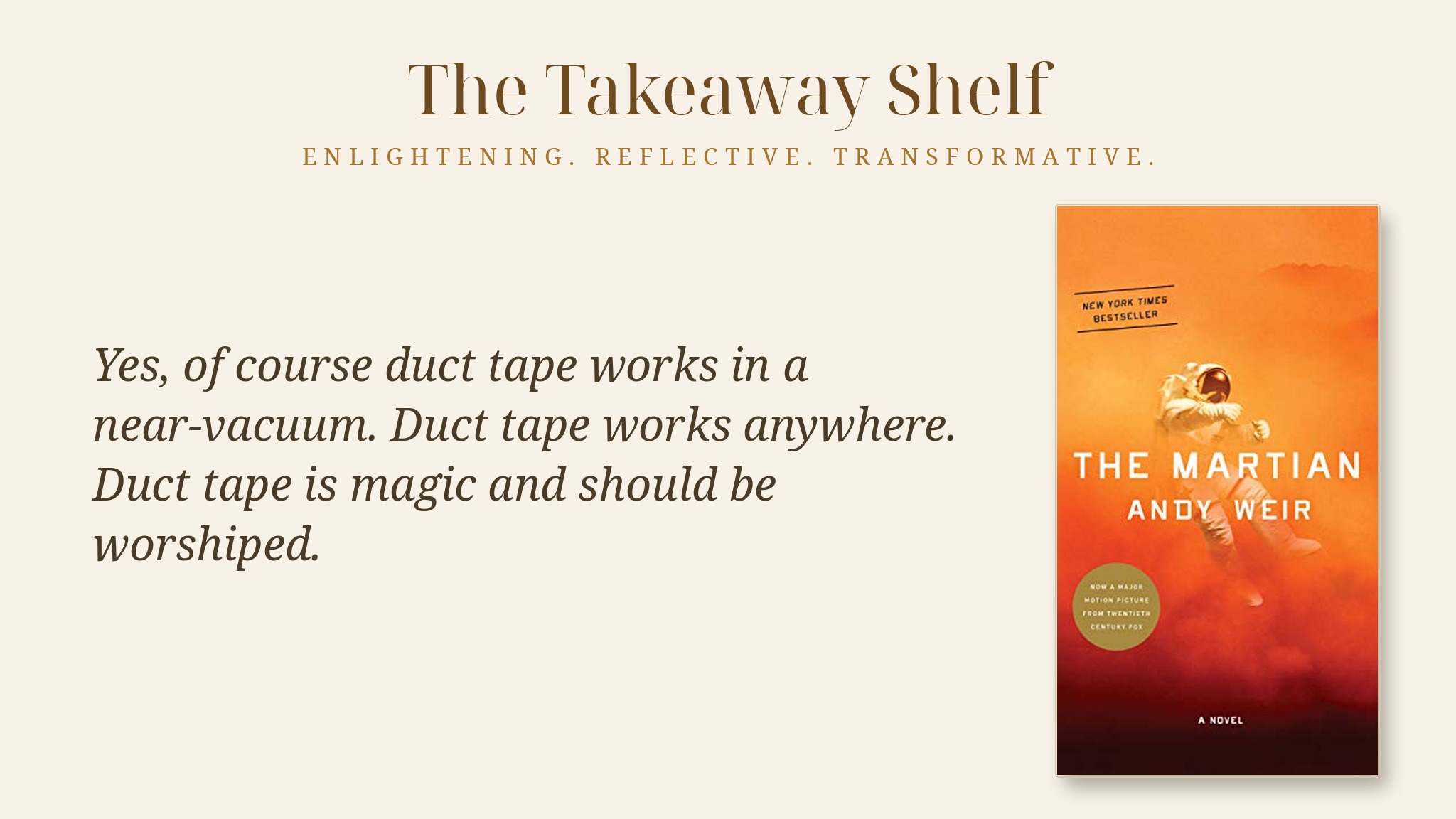
The Martian: 7 Inspiring Takeaways
Discover 7 inspiring takeaways from The Martian by Andy Weir — survival, humor, and problem-solving from an astronaut stranded alone on Mars.
This post may contain affiliate links. We only recommend products we personally use and love (please see our full affiliate disclosure). If you click through and make a
purchase, we may earn a small commission at no extra cost to you. Your support helps keep this blog running. Thank you so much!
Table of Contents
Left for Dead on Mars
The Martian opens with an astronaut already written off as dead. Mark Watney, the botanist and engineer of the Ares 3 crew, is struck by debris during a dust storm on Mars, and his crewmates — believing he was killed — leave the planet without him. He wakes up alone, injured, and stranded on a world with no air to breathe, no rescue coming, and no way to call home.
Watney does not panic, and he does not give up. He takes stock of what he has — a habitat, a rover, some food, and his own knowledge — and starts solving one problem at a time. The novel follows his log entries as he grows food, makes water, and finds a way to talk to Earth again, while NASA and his crew race to bring him home.
What the Book Is About
The Martian is a survival story told as a series of problems and solutions. Watney has enough food for about a year, and the next mission is not due for years — so his first task is to grow food on a planet where nothing grows. He turns Martian soil into a farm, and every potato he grows is another day of life.
The book is also about the people working to save him. NASA engineers, his crewmates aboard the Hermes, and a whole planet of strangers all refuse to accept that one man is lost. It is a novel about science, but its real subject is stubbornness: the refusal to quit when quitting would be easier.
7 Inspiring Takeaways from The Martian
Each lesson comes from Watney’s own log entries — the jokes, the calculations, and the decisions he makes when nobody is watching. Together, they form a manual for surviving the impossible, one problem at a time.
Lesson 1: Claim the Win — Grow Something Where Nothing Grows
“They say once you grow crops somewhere, you have officially ‘colonised’ it. So technically, I colonised Mars. In your face, Neil Armstrong!” Watney’s proudest moment is not an escape or a rescue — it is a harvest. The first potato he grows on Mars is proof that a dead world can be made to feed a living man, and he claims the victory out loud.
A reader who takes this lesson stops waiting for permission to celebrate small wins. Growing one potato on Mars is absurdly small and completely enormous at the same time, and Watney knows it. The habit of naming the win — even a small one — is what keeps a person going when the finish line is years away.
Lesson 2: Reframe Failure as a Learning Experience
“I guess you could call it a ‘failure’, but I prefer the term ‘learning experience’.” Watney says this after something blows up, and it is the attitude that saves his life more than once. Every plan he makes on Mars fails at least once, and the only difference between a dead astronaut and a living one is what he does with the failure.
The lesson is that failure is only final if a reader lets it be. Watney treats each explosion, each broken machine, and each dead crop as information: something that did not work, which means the next attempt will be smarter. A reader who renames failure as a learning experience gets the same freedom — to try again without shame.
Lesson 3: Humor Is a Survival Tool
“Maybe I’ll post a consumer review. ‘Brought product to surface of Mars. It stopped working. 0/10.'” Watney cracks jokes in the middle of genuine danger, and the humor is not a distraction from survival — it is part of it. The log entries stay funny even when the situation is grim, because laughing is how he keeps his mind working.
This is the book’s most practical lesson for ordinary life. A reader who can find something funny in a bad day is not ignoring the problem; they are keeping their head clear enough to solve it. Humor does not fix a broken oxygenator, but it does keep the person fixing it from falling apart.
Lesson 4: Think Bigger Than the Problem
“As with most of life’s problems, this one can be solved by a box of pure radiation.” Watney’s solutions are never timid. When he needs power, heat, or a way through an impossible obstacle, he reaches for the biggest tool available and figures out how to use it safely. The audacity is the point — small thinking would have killed him.
The lesson applies far beyond Mars. A reader facing a problem that looks unsolvable can ask Watney’s question: what is the biggest, boldest version of a fix, and what would it take to make it work? Most problems shrink once the reader stops assuming the answer has to be small and safe.
Lesson 5: Leadership Finds You When You Are the Only One Left
“Actually, I was the very lowest ranked member of the crew. I would only be ‘in command’ if I were the only remaining person. What do you know? I’m in command.” Watney was never supposed to lead anything — he was the lowest-ranked member of Ares 3. Then he became the only member, and command came with the situation, not the title.
The lesson is that leadership is rarely handed over in a ceremony. It arrives the moment a reader is the one left holding the problem, and the only choice is whether to step up or wait for someone who is not coming. Watney steps up, and a reader who does the same discovers they were more capable than their rank ever suggested.
Lesson 6: Say the Simple Truth Out Loud
“Problem is (follow me closely here, the science is pretty complicated), if I cut a hole in the Hab, the air won’t stay inside anymore.” Watney explains his problems in plain language, even when the science is complicated. Stating the obvious out loud is how he keeps himself honest — and how he finds the flaw in his own plans before the flaw finds him.
A reader who takes this lesson stops hiding behind complicated language. Saying “if I do this, that will happen” in the simplest possible words is often enough to see the answer, or the danger, clearly. The smartest move in the book is frequently the simplest sentence.
Lesson 7: Take the Calculated Risk
“I admit it’s fatally dangerous,” Watney said. “But consider this: I’d get to fly around like Iron Man.” Watney takes enormous risks, but they are never reckless — he names the danger, weighs it against the alternative, and chooses the risk because staying put is certain death. Courage, in this book, is arithmetic with the stakes made clear.
The lesson is that a brave choice is not a blind one. A reader who admits the danger out loud, counts the cost, and still moves forward is not being foolish — they are doing exactly what Watney does. The alternative to a calculated risk is often not safety, but a slower version of the same failure.
Why It’s a Must-Read
The Martian is a page-turner built out of log entries, checklists, and jokes, and it is nearly impossible to put down. The science is real enough to learn from and clear enough to follow, and the tension never lets up — every solution creates a new problem, and every problem has a clock on it.
It is also one of the funniest survival stories ever written. “Everything went great right up to the explosion” and “I started the day with some nothin’ tea. Nothin’ tea is easy to make. First, get some hot water, then add nothin'” are the kind of lines a reader quotes for weeks. That is why the book works as more than science fiction — it is a story about a man who refuses to die, told by a man who refuses to stop laughing.
Who This Book Is For
This book is for readers who love smart, funny science fiction and stories about solving impossible problems. It is for anyone who enjoys a hero who thinks his way out of trouble, and for readers who like their adventure grounded in real science without ever feeling like a lecture.
It may not suit readers who want a slow, literary novel or who dislike technical detail — Watney explains his chemistry and engineering in depth, and the book is proud of it. Readers who liked Project Hail Mary, or who enjoy stories of ingenuity under pressure, will feel right at home.
Work the Problem
Watney’s method is the whole book in three words: work the problem. He never solves Mars all at once — he solves the next thing, then the next, and the next after that. Food, water, air, contact, transport, rescue: each problem gets its turn, and each solved problem buys another day.
Start with one problem — the smallest one in front of a reader right now — and work it the way Watney would: state it plainly, find the biggest tool that fits, and take the risk that moves things forward. The potato, the joke, and the flight home all start the same way: with one problem, worked.
Keep reading on The Takeaway Shelf: 7 Epic Lessons from Dune by Frank Herbert — another desert-planet survival story, about politics, ecology, and destiny on a world even less forgiving than Mars.