Man’s Search for Meaning: 7 Powerful Takeaways
Discover 7 powerful takeaways from Man’s Search for Meaning by Viktor E. Frankl — find purpose in suffering, choose your attitude, and live with meaning.
This post may contain affiliate links. We only recommend products we personally use and love (please see our full affiliate disclosure). If you click through and make a purchase, we may earn a small commission at no extra cost to you. Your support helps keep this blog running. Thank you so much!
What Remains When Everything Is Taken
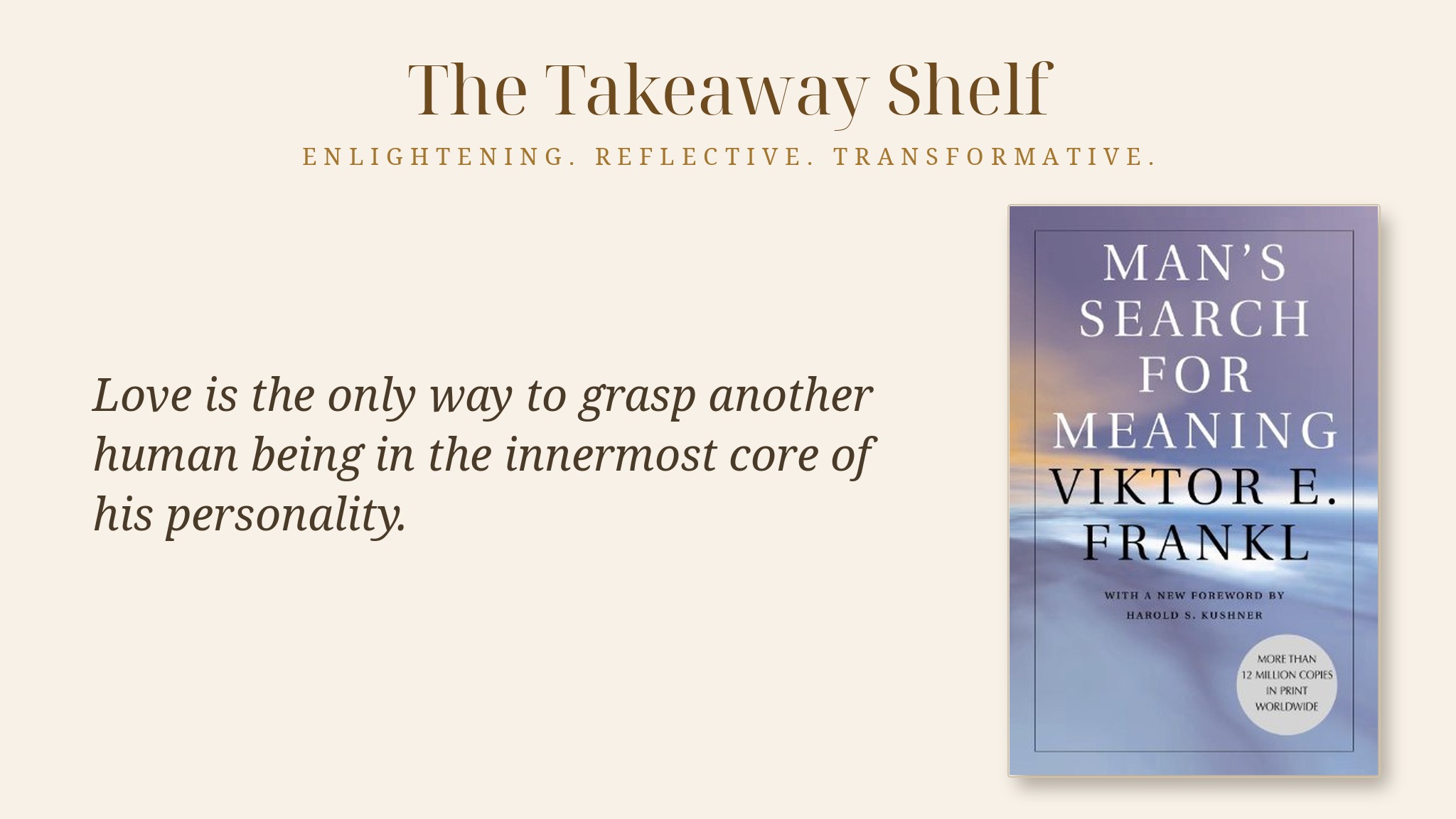
Man’s Search for Meaning begins in a place most books never go: inside the Nazi concentration camps, where Viktor Frankl — an Austrian psychiatrist — spent three years as a prisoner. Everything was taken from him and from the men around him: their families, their work, their possessions, their freedom, and for most, their lives. Frankl survived, and when he came home he wrote down what he had learned — not only about the camps, but about what makes a human life worth living under any circumstances.
Frankl’s central idea is simple and radical at once: a person cannot always choose what happens to them, but they can always choose their attitude toward it. That last freedom — the freedom to decide what a situation will mean — is the one thing no one can take away. The book is his testimony and his therapy, logotherapy, built on the conviction that the deepest human drive is not pleasure or power, but meaning.
Table of Contents
What the Book Is About
Man’s Search for Meaning has two parts. The first is Frankl’s account of camp life: the shock of arrival, the daily struggle for a crust of bread, the men who gave up and the men who kept going. He writes with a psychiatrist’s eye, observing how prisoners responded — who survived and why — and he does it plainly, without self-pity and without sparing the reader the truth of what happened there.
The second part is logotherapy, the school of psychotherapy Frankl founded. Its claim is that meaning can be found in three ways: through a deed or a work, through an experience or an encounter with another person, and through the attitude taken toward unavoidable suffering. The book is short, sober, and deeply hopeful — not because it pretends suffering is good, but because it shows that even suffering can hold meaning when a person chooses what it will mean.
7 Powerful Takeaways from Man’s Search for Meaning
Each lesson comes from Frankl’s own words — the observations he made in the camps and the principles he built from them. Together, they form a guide to finding meaning when life offers no easy answers.
Lesson 1: Love Is the Highest Goal
“The truth—that love is the ultimate and the highest goal to which man can aspire.” Frankl learned this in the camps, in the worst conditions a person can face. He writes of a moment marching to work in the cold, thinking of his wife — and realizing that love was not a comfort or a distraction, but the highest thing a human being can reach for. A man who has nothing left in this world may still know bliss, even briefly, in the contemplation of his beloved.
A reader who takes this lesson understands that love is not a reward for a good life; it is the goal itself. When everything else is stripped away — comfort, success, security — love remains, and it remains enough. The person a reader loves, and the love a reader carries, is a meaning that no circumstance can cancel.
Lesson 2: You Are Self-Determining
“Man is not fully conditioned and determined but rather determines himself whether he gives in to conditions or stands up to them. In other words, man is ultimately self-determining.” Frankl watched men in the camps become brutes and men in the camps become saints, under the same conditions. The conditions did not decide who they became — they did. A person always decides what their existence will be, what they will become in the next moment.
The lesson is that no situation, however crushing, removes the freedom to choose. A reader who takes this lesson stops saying “this made me who I am” and starts asking “who will I decide to be, given this?” The power is not in the circumstances. It is in the decision, made again and again, in every moment.
Lesson 3: Find Your Why
“He who has a why to live for can bear almost any how.” Frankl quotes this line from Nietzsche again and again in the book, because it was the truest thing he saw in the camps: the men who survived were the ones who had a why — a person waiting for them, an unfinished work, a faith, a task. The why did not remove the suffering. It gave the suffering something to be borne for.
A reader who takes this lesson looks for the why before the how. A hard season becomes bearable when there is a reason to bear it — someone to come home to, something to finish, someone to serve. The why does not have to be grand. It only has to be real, and it has to be theirs.
Lesson 4: Suffering Can Hold Meaning
“In some ways suffering ceases to be suffering at the moment it finds a meaning, such as the meaning of a sacrifice.” Frankl is careful here, and a reader should be too: he is not saying suffering is good, or that it should be sought. He is saying that when suffering cannot be avoided — and some suffering truly cannot — it can still be given a meaning, and that meaning changes what the suffering is. A sacrifice is suffering with a purpose, and a purpose transforms it.
The lesson is not to go looking for pain. It is that when pain arrives uninvited, a reader can ask what it might be for — whom it might serve, what it might protect, what it might teach. The question does not make the pain pleasant. It makes it bearable, because it is no longer meaningless.
Lesson 5: Change Yourself When You Cannot Change the Situation
“When we are no longer able to change a situation, we are challenged to change ourselves.” There are situations no effort can fix — a diagnosis, a loss, a closed door, a past that cannot be undone. Frankl’s counsel for those moments is not to keep pushing against the unchangeable, but to turn inward and ask what change is still possible: in attitude, in response, in the person a reader is becoming through it.
A reader who takes this lesson stops spending their strength on what cannot move, and starts spending it where it still counts — on themselves. The situation may stay exactly as it is. The person facing it does not have to.
Lesson 6: Happiness Must Ensue
“But happiness cannot be pursued; it must ensue. One must have a reason to ‘be happy.’ Once the reason is found, however, one becomes happy automatically.” Frankl warns against chasing happiness directly, because the chase itself is the trap: the more a person aims at happiness, the more it slips away. Happiness comes as a by-product — the unintended side effect of dedication to a cause greater than oneself, or of surrender to a person other than oneself.
The lesson is to stop aiming at the feeling and start aiming at the meaning. A reader who devotes themselves to something worth doing, or someone worth loving, will find the happiness arrives on its own, in the long run, precisely because they had forgotten to think about it.
Lesson 7: Three Ways to Find Meaning
“[There are] three possible ways to find meaning in life—even up to the last moment, the last breath…1) a deed we do, a work we create; 2) an experience, a human encounter, a love; and 3) when confronted with an unchangeable fate (such as an incurable disease), a change of attitude toward that fate.” This is logotherapy in one sentence, and it is the most practical passage in the book. Meaning is not one thing, found one way. It is three doors, and at least one of them is open to every person, in every circumstance, up to the very last breath.
A reader who takes this lesson has a map for any dark season: make something, love someone, or — when nothing else can be done — choose the attitude. The three ways cover a whole life. No one is ever left with nothing.
Why It’s a Must-Read
Man’s Search for Meaning is one of the most important books ever written, and one of the shortest — a reader can finish it in an evening and carry it for a lifetime. “there are two races of men in this world, but only these two—the ‘race’ of the decent man and the ‘race’ of the indecent man. Both are found everywhere; they penetrate into all groups of society. No group consists entirely of decent or indecent people.” Frankl wrote that after watching both kinds of men in the camps, and it is the kind of sentence that rearranges how a reader sees the world.
It is also a book of quiet, stubborn hope. “But there was no need to be ashamed of tears, for tears bore witness that a man had the greatest of courage, the courage to suffer.” And Frankl wrote it down for a reason he states plainly: “I therefore felt responsible for writing down what I had gone through, for I thought it might be helpful to people who are prone to despair.” That is why the book works as more than history — it is a hand extended to anyone who is suffering now, and a reminder that meaning is still there to be found.
Who This Book Is For
This book is for readers who are going through a hard season, or who love someone who is — and for anyone who wants to understand what gives a life meaning when everything easy has been taken away. It is for readers of faith, readers of philosophy, and readers who simply want a true story of human endurance told with honesty and grace.
It may not suit readers looking for light reading or a quick self-help fix — Frankl writes about the camps directly, and some passages are painful to read. Readers who liked Meditations, or who are drawn to questions of purpose, resilience, and the freedom of the human spirit, will find this book stays with them long after the last page.
Choose Your Attitude
Frankl’s whole book can be summed up in one sentence: everything can be taken from a person except the freedom to choose their attitude — and that freedom is enough to build a life on. The camps took his family, his work, and his freedom, and they could not take that. What remained was his, and it was enough.
Start with one choice — the smallest one in front of a reader right now — and make it the way Frankl would: name the meaning, hold the why, and choose the attitude that lets the meaning through. The work, the love, and the attitude are all still available, even now, even here. The meaning is yours to find.
Keep reading on The Takeaway Shelf: Marcus Aurelius Meditations: 7 Inspiring Lessons — another guide to what we control and what we don’t, about accepting fate and living each day as if it were the last.