The Untethered Soul: 7 Powerful Takeaways
Discover 7 powerful takeaways from The Untethered Soul by Michael A. Singer — watch the voice in your head, take the seat of consciousness, and let go.
This post may contain affiliate links. We only recommend products we personally use and love (please see our full affiliate disclosure). If you click through and make a purchase, we may earn a small commission at no extra cost to you. Your support helps keep this blog running. Thank you so much!
The Quietest Book on the Shelf
The Untethered Soul does not ask the reader to do more. It asks the reader to notice more — to notice the voice that never stops talking inside the head, and to notice who is listening to it. Michael A. Singer, a spiritual teacher who left a doctoral program after a deep inner awakening and founded the Temple of the Universe meditation center in 1975, wrote a short book — just 183 pages — that has quietly become a New York Times bestseller and a companion for millions of readers looking for a little more peace.
“The only permanent solution to your problems is to go inside and let go of the part of you that seems to have so many problems with reality.”
That one sentence holds the whole of The Untethered Soul. The problems are not the problem. The part of us that argues with reality is.
Table of Contents
What the Book Is About
The Untethered Soul is built in five parts — Awakening Consciousness, Experiencing Energy, Freeing Yourself, Going Beyond, and Living Life — nineteen short chapters that walk the reader, step by step, from the voice inside the head to a life lived from the seat of consciousness. The Untethered Soul begins with a simple observation: there is a voice talking inside you right now, and you are the one hearing it. From there it opens outward — into the energy that moves through the body, the heart that opens and closes, the old pains (The Untethered Soul calls them thorns) that run our lives from the inside, and finally into the freedom of letting go.
The Untethered Soul draws on traditions of meditation and mindfulness, and it is gentle about it. There is no program to follow, no streak to keep, no version of yourself to achieve. There is only the practice of watching — watching the thoughts pass, watching the heart open and close, watching the energy rise and fall — and discovering that the watcher was free all along.

7 Powerful Takeaways from The Untethered Soul
Each lesson comes from Singer’s own words — the questions he asks and the images he returns to again and again. Together, they form a quiet guide to inner freedom: not a louder life, but a lighter one.
Lesson 1: Most of Your Thoughts Have No Relevance
“If you’re willing to be objective and watch all your thoughts, you will see that the vast majority of them have no relevance.”
The voice inside the head talks all day — narrating, judging, rehearsing, worrying — and most of what it says is noise. It comments on the weather, replays a conversation from three days ago, worries about a meeting that has not happened yet. The Untethered Soul’s first invitation is simply to watch it, the way you would watch a stranger talking on a bus: with interest, but without believing every word.
“To be aware that you are watching the voice talk is to stand on the threshold of a fantastic inner journey.”
A reader who takes this lesson stops arguing with the voice and starts observing it. The thoughts do not have to stop. They only have to stop being mistaken for who you are.
Lesson 2: You Are the One Who Sees
“You are the one who sees. From back in here somewhere, I look out, and I am aware of the events, thoughts, and emotions that pass before me.”
If you can watch the voice, then you are not the voice. Singer asks the reader to follow that noticing inward: Who sees when I see? Who hears when I hear? Who knows that I am aware? The answer is not another thought. It is the awareness itself — the quiet seat behind everything, watching the thoughts and feelings pass like weather.
“Now you are in your center of consciousness. You are behind everything, just watching. That is your true home.”
A reader who takes this lesson finds a place to rest that no bad day can take away. The thoughts change, the feelings change, the circumstances change — but the one who watches them is always there, steady, and at home.
Lesson 3: Your Energy Is Blocked Only by Closing
“Every movement of your body, every emotion you have, and every thought that passes through your mind is an expenditure of energy.”
The Untethered Soul’s picture of inner life is a picture of energy: a current that wants to flow through the body, rising when the heart is open, falling away when it closes. When we feel tired, flat, or heavy for no clear reason, it is rarely because the energy is gone. It is because something in us has closed around it.
“The only reason you don’t feel this energy all the time is because you block it. You block it by closing your heart, by closing your mind.”
A reader who takes this lesson stops chasing energy from the outside — another coffee, another distraction — and starts noticing the closing itself. The energy was never missing. It was only waiting behind a closed door.
Lesson 4: Do Not Close Your Heart
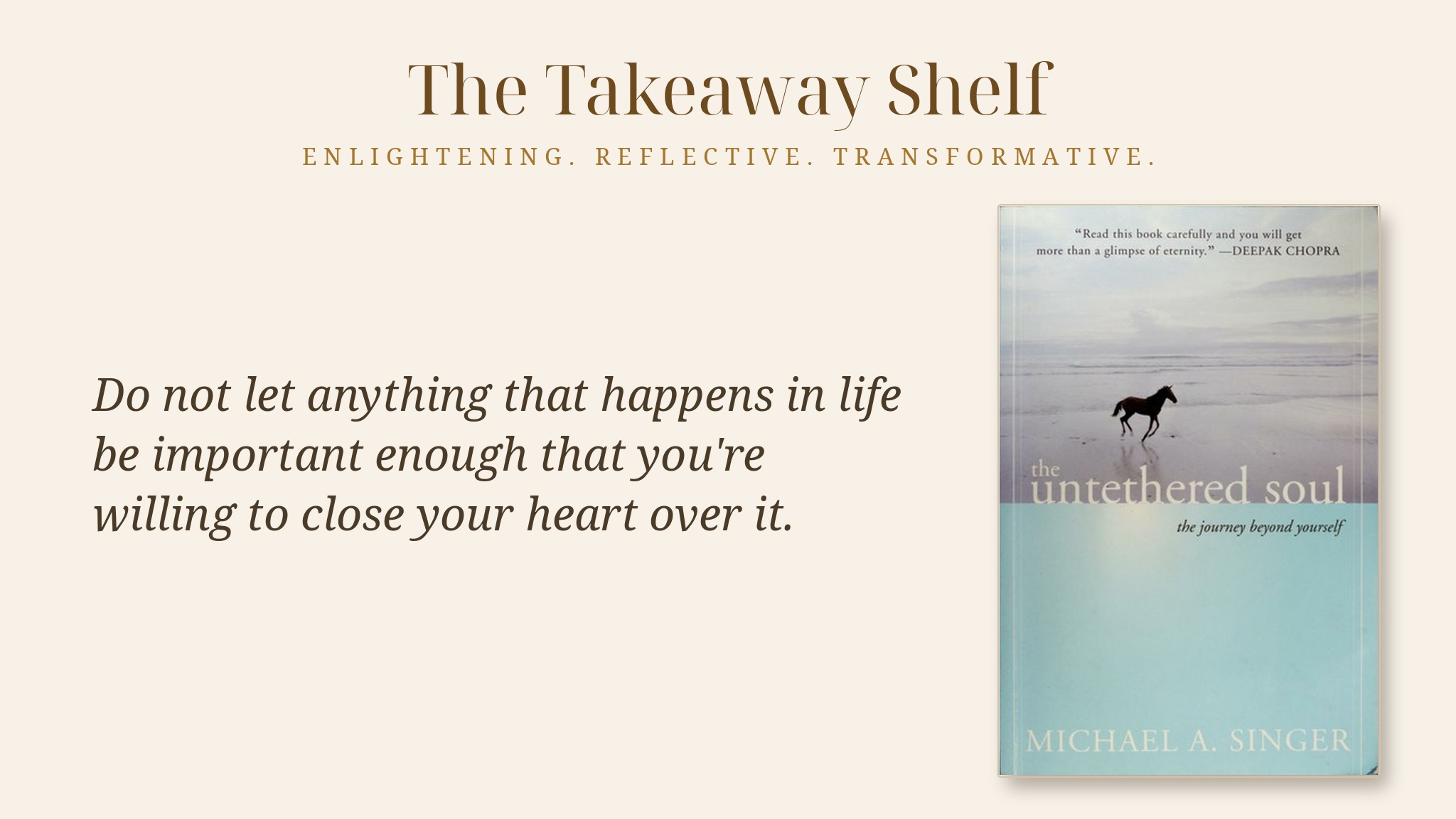
“Do not let anything that happens in life be important enough that you’re willing to close your heart over it.”
This is The Untethered Soul’s central practice, stated as plainly as Singer can state it. Something happens — a disappointment, a sharp word, a plan that falls apart — and the heart starts to close, the way a hand closes around something hot. The closing feels like protection. But a closed heart cannot feel love or enthusiasm either, and over time the protection becomes the prison.
“Nothing is worth closing your heart over.”
A reader who takes this lesson practices staying open in the small moments first: the traffic, the spilled coffee, the comment that stings. Each time the heart stays open, the energy keeps flowing — and the reader discovers that openness is not naivety. It is strength.
Lesson 5: Stop Playing With the Thorn
“To free yourself of your inner thorns, you simply stop playing with them.”
The Untethered Soul’s most memorable image is the thorn: a painful experience from the past that got stuck inside, like a thorn under the skin. Instead of pulling it out, we build our whole life around not touching it — avoiding certain people, certain places, certain conversations — until the thorn is quietly running everything.
“You are not the pain you feel, nor are you the part that periodically stresses out. None of these disturbances have anything to do with you. You are the one who notices these things.”
A reader who takes this lesson stops rearranging life around the thorn and starts noticing it instead. The pain can be felt, allowed to pass through the heart, and released — not by fighting it, and not by hiding from it, but by simply no longer playing with it.
Lesson 6: Let Go — Relax and Release
“When you let go, you are falling behind the energy that is trying to pull you into it.”
Letting go, in The Untethered Soul, is not giving up. It is falling back — stepping behind the pull of the disturbance instead of being dragged along by it. When a feeling surges up, the practice is to relax the shoulders, relax the heart, and let the energy pass through, the way wind passes through an open window.
“So don’t fall. Let go. No matter what it is, let it go.”
“Your opportunities to grow are endless. … When you feel the pull, like somebody pulling on your heart, you just let go. You fall behind it. You simply relax and release.”
A reader who takes this lesson learns that letting go is a practice, not a single decision — something done a hundred times a day, in small moments, until the habit of releasing replaces the habit of holding on.
Lesson 7: Choose Happiness — No Matter What Happens
“If you decide that you’re going to be happy from now on for the rest of your life, you will not only be happy, you will become enlightened.”
The Untethered Soul’s final turn is the boldest one in the book: happiness is not a reward for getting life right. It is a decision — made once, and then made again every time life pushes back. The decision is not to pretend everything is fine. It is to refuse to let anything, good or bad, have the power to close the heart.
“The real question is whether you want to be happy regardless of what happens.”
A reader who takes this lesson stops waiting for the circumstances to be right. The circumstances will never all be right. Happiness, Singer says, is the choice to stay open anyway — and that choice, kept daily, is the whole spiritual path.
Why It’s a Must-Read
The Untethered Soul is one of those rare books that asks almost nothing of the reader and gives back a great deal. The Untethered Soul does not demand a new routine or a new identity. It asks only for attention — a willingness to notice the voice, the closing, the thorn — and in return it offers a way of living that is lighter, quieter, and freer.
It is also a book that meets the reader exactly where they are. “If you want to be happy, you have to let go of the part of you that wants to create melodrama. This is the part that thinks there’s a reason not to be happy. You have to transcend the personal, and as you do, you will naturally awaken to the higher aspects of your being.” And it is honest about what life will not give us: “The truth is that most of life will unfold in accordance with forces far outside your control, regardless of what your mind says about it.”
And it ends where all honest spiritual books end — with death, not as a threat but as a teacher. “So death actually gives meaning to life. Death is your friend. Death is your liberator. … If you live each moment completely, you will have a fuller life and you will not have to fear death.” For a reader willing to hear it, that is not a frightening sentence. It is a freeing one.
Who This Book Is For
The Untethered Soul is for readers who feel tired in a way that sleep does not fix — the tiredness of a mind that never stops talking and a heart that keeps closing to protect itself. It is for anyone who has wondered whether there is a quieter way to live, and for readers who like their spirituality practical, plain-spoken, and free of jargon.
The Untethered Soul may not suit readers looking for a step-by-step program or a book that argues its case with studies and footnotes — Singer teaches by image and invitation, not by evidence. Readers who liked The Power of Now, or who are drawn to questions of awareness, letting go, and what it means to be free inside, will find this book stays with them long after the last page. “Your relationship with God is the same as your relationship with the sun. If you hid from the sun for years and then chose to come out of your darkness, the sun would still be shining as if you had never left.”
Let Go and Live
The Untethered Soul‘s whole book can be summed up in one practice: notice the voice, stay in the seat of the one who watches, keep the heart open, and let go — again and again, in the smallest moments of an ordinary day. The voice will keep talking. The thorns will keep aching. The energy will keep rising and falling.
What changes is the reader. No longer dragged along by every disturbance, no longer closed around every hurt, the reader is free to do the simplest thing of all: to live each moment completely, and to let that be enough.
Get The Untethered Soul — Kindle: https://link.amazon/B05GpDXnZ · Paperback: https://link.amazon/B04B0Q1j2
Keep reading on The Takeaway Shelf: The Gifts of Imperfection: 7 Powerful Takeaways — another guide to self-compassion and letting go of who you think you’re supposed to be.