The Silent Patient: 7 Powerful Takeaways
Discover 7 powerful takeaways from The Silent Patient by Alex Michaelides — a twisty thriller about silence, honesty, and the truths we bury.
This post may contain affiliate links. We only recommend products we personally use and love (please see our full affiliate disclosure). If you click through and make a purchase, we may earn a small commission at no extra cost to you. Your support helps keep this blog running. Thank you so much!
Table of Contents
The Woman Who Would Not Speak
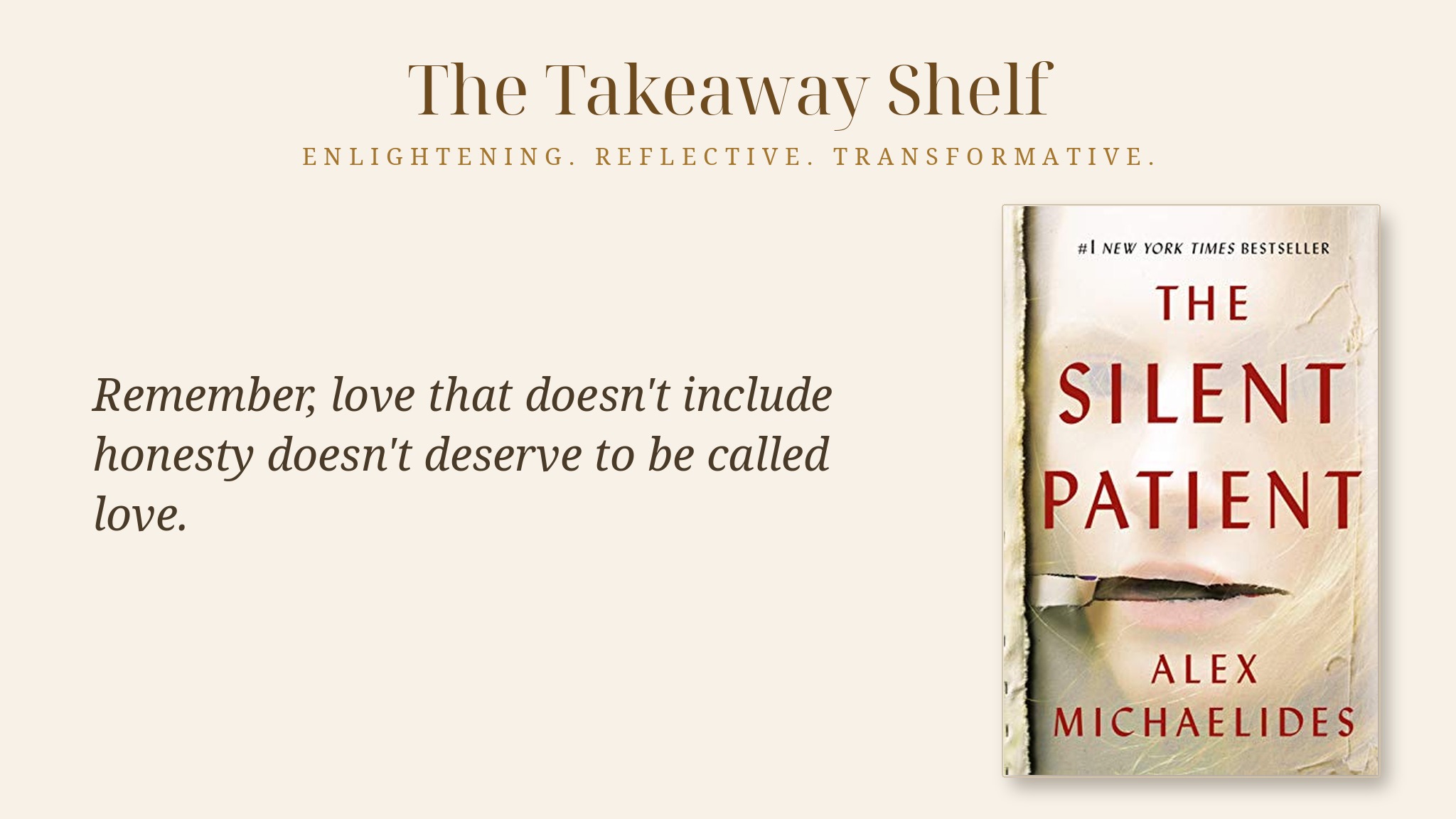
The Silent Patient opens with a crime that has no explanation. Alicia Berenson, a celebrated painter, shoots her husband Gabriel five times in the face — and then never speaks another word. No confession, no denial, no plea; only silence.
Theo Faber, a criminal psychotherapist, becomes obsessed with her case and takes a job at the Grove, the secure forensic unit where Alicia is held. He is convinced he can get her to talk, and that her silence is hiding something she cannot say. The novel follows his sessions with her, her diary entries, and the slow unravelling of two lives shaped by the same wounds.
What the Book Is About
The Silent Patient is a psychological thriller built around one question: why would a woman who had everything shoot the man she loved and then refuse to explain herself? Alicia’s diary, written in the months before the shooting, gives the reader her side in fragments — a marriage that looked perfect, a house full of unspoken tension, and a past that never stayed past.
Theo’s story runs alongside hers. He is a therapist with his own history of a difficult childhood and a marriage under strain, and his determination to help Alicia is tangled up with his need to fix himself. The book is as much about the therapist as the patient, and about how the people who help others are often the ones still hurting.
7 Powerful Takeaways from The Silent Patient
Each lesson comes from the characters’ own words — Alicia’s diary, Theo’s sessions, and the therapists around them. Together, they form a portrait of love, silence, and the truths people bury.
Lesson 1: Real Love Is Quiet
“Real love is very quiet, very still. It’s boring, if seen from the perspective of high drama. Love is deep and calm and constant.” This is the book’s clearest statement about love, and it cuts against everything the characters believe at the start. Alicia and Gabriel’s marriage looked like fireworks from the outside, yet the love that lasts in this story is the quiet kind — steady, honest, and unshowy.
A reader who takes this lesson stops chasing drama as proof of feeling. Real love does not need to be loud to be real; it needs to be honest, calm, and constant. The fireworks version is the one that burns out, while the quiet version is the one still standing at the end.
Lesson 2: Choose Someone Who Can Be Honest
“Choosing a lover is a lot like choosing a therapist. We need to ask ourselves, is this someone who will be honest with me, listen to criticism, admit making mistakes, and not promise the impossible?” Theo asks this question in the middle of his own failing marriage, and it is the book’s most practical test for any relationship. Honesty, listening, and owning mistakes matter more than charm or chemistry.
The lesson applies far beyond romance. Any person a reader trusts — partner, friend, therapist — should pass the same test: can they tell the truth, hear criticism, and admit when they are wrong? Someone who cannot do those things cannot be trusted with the real parts of a life.
Lesson 3: Buried Feelings Come Back Uglier
“Unexpressed emotions will never die. They are buried alive, and will come forth later, in uglier ways.” Sigmund Freud’s line, quoted in the novel, is the engine of the whole plot. Alicia’s silence is not emptiness; it is feeling buried so deep it has nowhere to go, and it comes back as something far worse than words.
This is the book’s warning to anyone who swallows their feelings to keep the peace. What is not said does not disappear — it waits, and it returns in uglier forms: resentment, illness, or an act that cannot be taken back. Saying the hard thing early is always cheaper than burying it.
Lesson 4: No One Is Born Evil
“No one is born evil. As Winnicott put it, ‘A baby cannot hate the mother, without the mother first hating the baby.'” The novel keeps returning to childhood: Alicia’s cold, distant upbringing, Theo’s violent father, and the way both of them learned early that love was conditional or dangerous. The book’s point is not to excuse anyone — it is to show how a child becomes an adult who hurts others.
A reader who takes this in stops asking whether people are simply good or bad. The better question is what they were taught, and what they never learned. Understanding where damage comes from does not remove responsibility, but it does explain why the same patterns repeat until someone breaks them.
Lesson 5: Admit When Love Was Missing
“You know, one of the hardest things to admit is that we weren’t loved when we needed it most. It’s a terrible feeling, the pain of not being loved.” This is the admission at the heart of the book, and the one both Alicia and Theo spend the novel avoiding. Naming the absence is painful, but it is also the first honest sentence either of them manages.
The lesson is that unacknowledged hurt does not heal on its own. A reader who can say “I was not loved when I needed it” has already done the hardest part — the rest, the grieving and the rebuilding, can only start after the truth is spoken. Silence protects the wound; honesty starts the treatment.
Lesson 6: We Are All Scared — We Just Hide It
“There’s so much pain everywhere, and we just close our eyes to it. The truth is we’re all scared. We’re terrified of each other.” Theo says this after sitting with patients whose fear wears a dozen different disguises — anger, silence, charm, control. The line strips away the idea that other people are confident while only the reader is afraid.
This lesson makes the book oddly comforting for a thriller. Everyone in it is scared, including the therapist, and admitting that shared fear is what finally lets two people see each other clearly. A reader who remembers this judges others less harshly — and forgives their own fear a little more.
Lesson 7: The Past Travels With You
“I didn’t know it then, but it was too late—I had internalized my father, introjected him, buried him deep in my unconscious. No matter how far I ran, I carried him with me wherever I went. I was pursued by an infernal, relentless chorus of furies, all with his voice—shrieking that I was worthless, shameful, a failure.” Theo’s description of his own childhood is the book’s darkest passage, and its most honest one. Running away from a parent does not leave the parent behind; the voice comes along, inside.
The lesson is that geography never fixes what history broke. Alicia and Theo both try to outrun their childhoods — through marriage, through work, through silence — and both discover the past was travelling with them all along. The only way out is through: to hear the voice, name it, and refuse to obey it anymore.
Why It’s a Must-Read
The book is a page-turner with a twist readers still talk about years later, but the twist is not the reason it stays with a reader. It stays because the psychology is real: the therapy sessions, the diary entries, and the portrait of two damaged people circling each other feel true even when the plot is at its most theatrical.
It is also full of lines that work outside the story. “Sometimes it takes courage, you know, and a long time, to be honest” and “We’re all crazy, I believe, just in different ways” are the kind of sentences a reader carries into their own life. That is why the book works as more than a thriller — it is a novel about honesty that happens to have a murder in it.
Who This Book Is For
This book is for readers who love a twisty psychological thriller and do not mind a dark, unsettling story. It is for anyone fascinated by therapy, silence, and the question of why people do what they do, and for readers who enjoy a book that can be finished in a weekend and discussed for weeks.
It may not suit readers who want a light read or who dislike stories built around trauma and unhappy marriages. The Silent Patient is tense and, at times, bleak — and its pleasures are the pleasures of a puzzle, not comfort. Readers who like Gone Girl and twisty domestic thrillers will feel right at home.
Silence Speaks Loudest
Alicia’s silence is the loudest thing in the book. It fills every room she enters, drives Theo to obsession, and forces everyone around her to confront what they would rather not say. In the end, the novel’s message is simple: silence never protects anyone for long, and the truth, spoken late, still costs less than the truth never spoken.
Start with one lesson — choose honesty, or admit what was missing — and watch what changes. The quietest love, the honest word, and the feeling finally named are the things that survive. Silence speaks loudest, but it is honesty that sets a person free.
Keep reading on The Takeaway Shelf: Inside We Are All Guilty Here by Karin Slaughter — another twisty thriller about secrets, a small town, and the past refusing to stay buried.