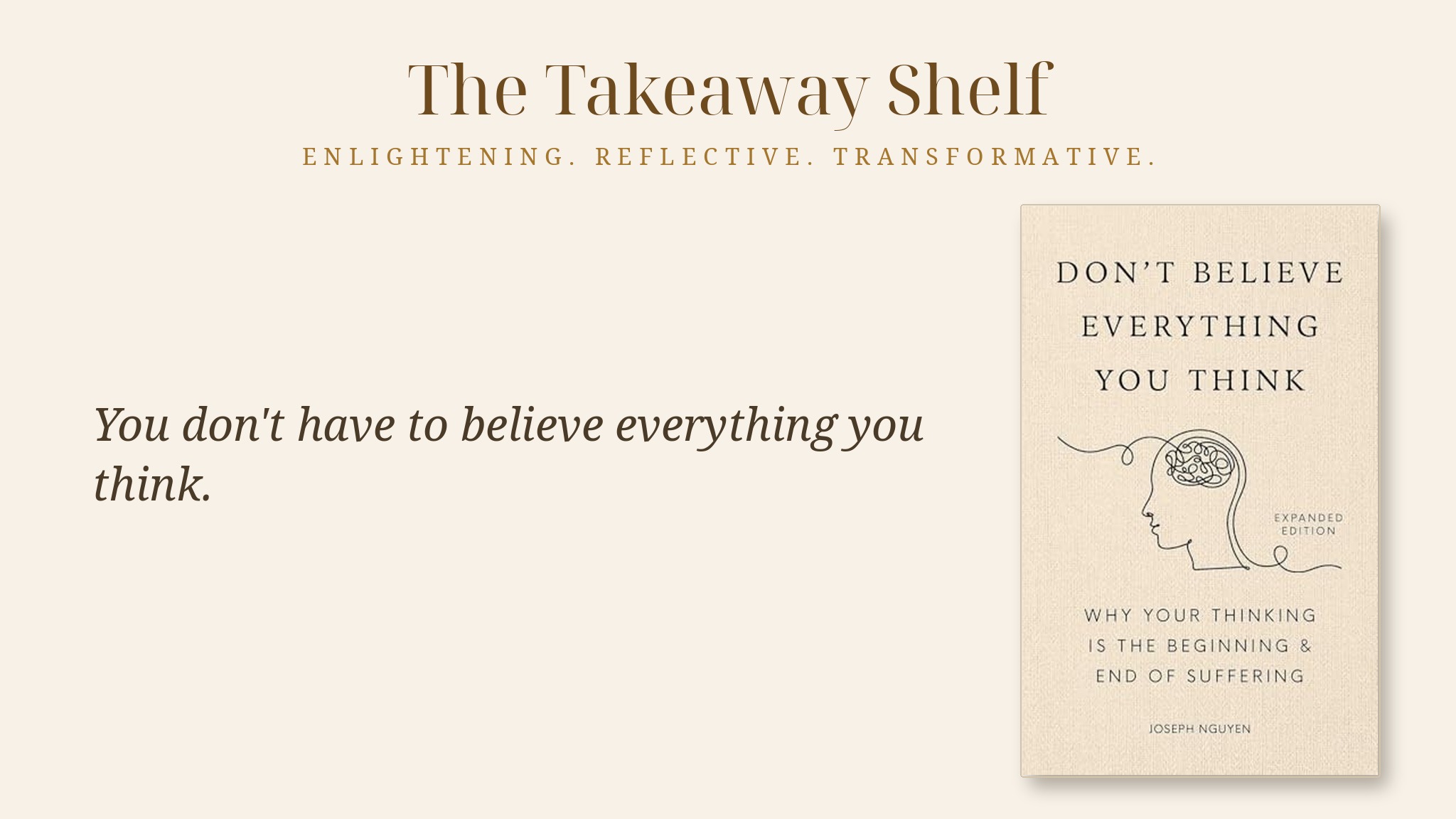
7 Quiet Lessons from Don’t Believe Everything You Think by Joseph Nguyen
There is a particular kind of tired that sleep does not fix. It comes from a mind that will not stop — replaying a conversation at 2 a.m., arguing with a future that has not happened yet, grading the day before it is even over.
Joseph Nguyen knows that tired. In Don’t Believe Everything You Think, he makes a claim that sounds too simple to matter: we do not suffer from our circumstances nearly as much as we suffer from our thinking about them — and thinking, unlike circumstance, is something we can learn to lay down.
The book has become a quiet phenomenon — a New York Times bestseller translated into more than forty languages — because it offers mindfulness without the cushion, the app, or the hour-long sit.
This post may contain affiliate links. We only recommend products we personally use and love (please see our full affiliate disclosure). If you click through and make a purchase, we may earn a small commission at no extra cost to you. Your support helps keep this blog running. Thank you so much! 💕
Table of Contents
What the Book Is About
Don’t Believe Everything You Think was first published in 2022 and grew by word of mouth into an international bestseller. The expanded edition (Authors Equity, 2024) adds new chapters answering readers’ questions, journaling prompts and contemplative exercises, and original poetry — more room to practice the idea, not just read it.
The idea itself fits in one sentence: our experience of life is created from the inside out. Events are neutral until thought gets hold of them; the same rainy day can ruin one person’s week and wash another’s clean. Nguyen draws on philosophy, spirituality, and psychology, but the book never reads like a lecture — it reads like a friend talking you down from a ledge your own mind built.
7 Quiet Lessons from Don’t Believe Everything You Think
1. A Thought Is Not the Same as Thinking
Thoughts arrive uninvited — thousands a day, most of them nonsense, weather rolled in from nowhere. Thinking is what we do next: grabbing a thought, turning it over, building a case around it. Nguyen’s distinction is the whole book in miniature. You cannot stop thoughts from arriving. You can stop furnishing them an apartment.
2. Suffering Begins When We Believe the Thought
A thought, by itself, is powerless — ink on a page. It gains weight only when we believe it. “I am falling behind” is just a sentence until belief turns it into a verdict. The book invites a gentler habit: notice the sentence, let it stay a sentence, and watch how much of its sting was only ever borrowed.
3. Feelings Come from Thought in the Moment
We like to say a situation made us anxious, but two people can stand in the same situation and feel opposite things. Nguyen’s explanation: we are always feeling our thinking in that moment, not the circumstance itself. That is quietly hopeful news — feelings change as thinking changes, and thinking always, eventually, changes.
4. You Are the Sky; Thoughts Are the Weather
The book returns often to a simple picture: you are the sky, and your thoughts are weather. Storms feel permanent from inside them, but no storm has ever stayed. Beneath the noise, Nguyen argues, the mind’s natural state is calm and clear — peace is not something we manufacture; it is what is left when the weather moves on.
5. Peace Lives in the Present Moment
Most thinking is time travel — reheating the past or pre-living the future. The present moment, by contrast, is usually survivable, often even kind. Nguyen treats presence not as a technique but as a home address: the only place peace has ever actually been found. When the mind wanders into its stories, the way back is simply to notice where you are.
6. Leave Space Between What Happens and What You Do
Between what happens and what we do next, there is a small space — and most regret lives in how quickly we cross it. Non-thinking widens that space. A breath before the reply, a pause before the spiral: not suppression, just room. In that room, we respond to the actual moment instead of to our loudest thought about it.
7. Quiet Minds Hear Intuition
Ask anyone where their best decisions came from and few will say “from three hours of anxious analysis.” Nguyen points to intuition — the quiet knowing that surfaces when the mind settles, the way sediment settles in water. We cannot hear it while we are shouting over it. The practice is not to think harder, but to get quiet enough to listen.
Why It’s a Must-Read
Most self-help hands us another project: fix the habits, rewire the brain, optimize the morning. This book does the opposite — it hands the work back. There is nothing to build and no past to rewrite; there is only a thought, arriving, that we are allowed not to believe. Readers allergic to forced positivity will find none here. What they will find is a short, humane argument that peace is closer than our thinking has been telling us.
Who This Book Is For
Overthinkers and 2 a.m. replay artists; anyone whose anxiety spikes in quiet rooms; readers who tried positive thinking and found it exhausting; anyone who suspects their worst critic might be a voice they are not required to obey.
It pairs well with our takeaways from The Let Them Theory by Mel Robbins — where Robbins teaches us to release other people, Nguyen teaches us to release our own thoughts.
The Quiet on the Other Side of Thought
The promise of Don’t Believe Everything You Think is not a silent mind — no such thing is on offer, and Nguyen never pretends otherwise. The promise is smaller and better: a thought can cross the sky without becoming the weather of your whole day. The next one is already forming. Let it pass through, unbelieved, and notice how much quieter the room gets.