Train to Busan: A Heart-Pounding Ride Through Humanity’s Best and Worst (Spoilers Ahead)
“Train to Busan” takes you on a heart-pounding journey, showcasing humanity’s best and worst in the face of a relentless zombie apocalypse. (Spoilers Ahead)
This Train to Busan review contains spoilers, so please stop here if you have not seen the film yet. Everyone else: welcome aboard.
Let me be honest: I had never cried over a zombie movie — until Train to Busan wrecked me. I went in expecting cheesy jump scares and generic gore. What I got was a masterclass in tension, tears, and the uncomfortable truth about how people behave when the world falls apart. Writing this Train to Busan review, I kept coming back to the people, not the gore.
Directed by Yeon Sang-ho and written by Park Joo-suk, this 2016 South Korean action horror film is not really about zombies. It is about fathers, sacrifice, and the ugly — and beautiful — choices people make to survive.
Train to Busan Review: The Premise — A Train Ride Straight to Hell
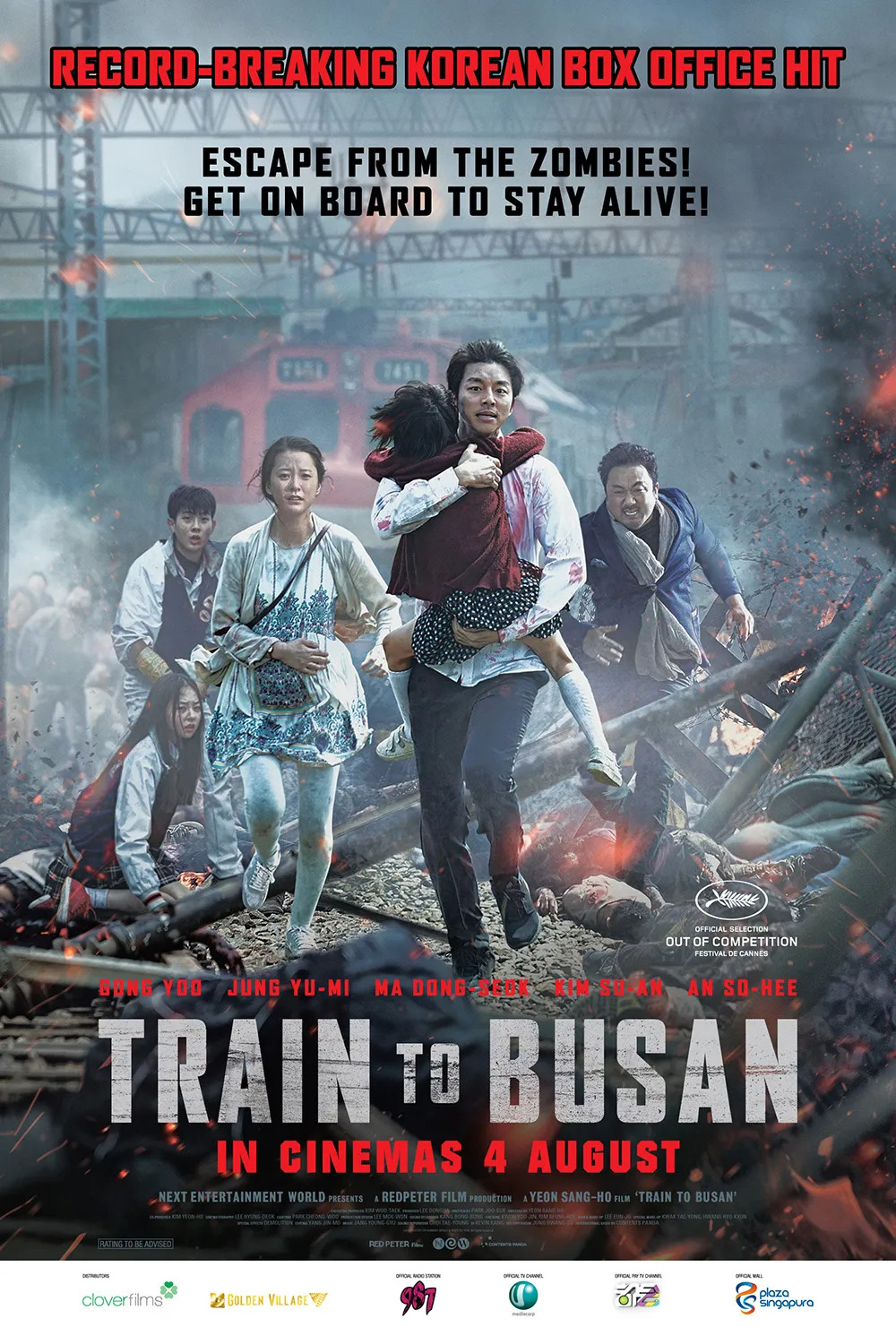
The story starts simply. Seok-woo (Gong Yoo), a workaholic, divorced fund manager in Seoul, has missed his young daughter Su-an’s (Kim Su-an) recital and botched her birthday present. To make it up to her, he boards a KTX train to take her to her mother in Busan. What should be a quiet father-daughter trip becomes a nightmare when an infected young woman slips aboard unnoticed and an outbreak erupts across South Korea.
The train becomes a claustrophobic battleground, and the survivors end up fighting each other as much as the infected. Think Snowpiercer meets 28 Days Later, but with far more heart. The setting does so much of the work: trains are cramped, orderly, and impossible to escape, so every stop, tunnel, and locked door ratchets up the dread. Simple, trapped, and terrifying — that setup is why a Train to Busan review can spend so long on a single train journey.
Characters You’ll Love, Hate, and Mourn
Seok-woo is the flawed hero we reluctantly root for. He is not a bad man, just a selfish one who has put work ahead of his daughter for too long. His arc — from advising Su-an to look out for herself first, to sacrificing himself for her — is gut-wrenching. But the supporting characters nearly steal the film. As any Train to Busan review will tell you, the ensemble is a huge part of why it works.
Take Sang-hwa (Ma Dong-seok), the brawny, big-hearted husband protecting his pregnant wife, Seong-kyeong (Jung Yu-mi). He is the first to put himself between strangers and danger. His death — holding back a carriage full of infected so Seong-kyeong can run — still gets me. Any honest Train to Busan review has to admit he is the film’s beating heart.
Then there is Yon-suk (Kim Eui-sung), the high-ranking executive who embodies humanity’s worst instincts. He lies, manipulates, and throws other people to the horde to save himself. His end — infected, terrified, and begging for his mother — is not satisfying karma. It is just sad, and that is the point. A Train to Busan review that only cheers his downfall misses that sadness.
Zombies That Actually Scare You
Almost every Train to Busan review leads with the sprinting infected, and I understand why. Forget slow, shuffling zombies: these sprint, twitch, and pile over each other in a terrifying tangle of limbs. The design is simple — milky eyes, dark veins, impossible contortions — but the movement is pure chaos.
The rules stay clear: a bite turns you, fast. In darkness, though, the infected lose their visual cues and react mainly to sound. That gives us the film’s most nerve-shredding sequence, as survivors creep through pitch-black carriages in a tunnel, freezing every time a phone threatens to ring. I have never been so stressed about a phone in my life. If one scene sums up this Train to Busan review, it is that silent creep through the tunnel.
The Themes: Sacrifice, Class, and Corporate Greed
Train to Busan is not subtle about its social commentary, and it does not need to be. The zombies are a backdrop for a story about class divides, selfishness, and corporate greed. Passengers with status and money expect to be saved first, while a homeless man, the train staff, and a high-school baseball team are treated as expendable.
The train itself mirrors that hierarchy: some passengers barricade themselves in safety and refuse to open the door for anyone else. The most haunting idea is not the outbreak — it is how quickly fear turns people against each other, and how official reassurance can lag far behind the truth. Sound familiar? Watching it now, it is hard not to think about who we trust when everything starts falling apart. That, more than the gore, is what this Train to Busan review keeps circling back to.
That Ending: Tears, Tears, and More Tears
Spoiler alert: almost everyone dies — Sang-hwa; Yong-guk (Choi Woo-shik) and Jin-hee (Ahn So-hee) from the baseball team; the homeless man who buys the others time; and finally Seok-woo himself.
After the chaos at Dongdaegu Station, Seok-woo, Su-an, and Seong-kyeong escape on a lone locomotive — but Yon-suk, already infected, attacks them on board, and Seok-woo is bitten while protecting the others.
Knowing he will turn, Seok-woo gets Su-an and Seong-kyeong safely inside, remembers holding his baby daughter for the first time, smiles — and lets himself fall from the locomotive so he will not hurt them. Su-an’s cry of “Dad! Don’t go!” absolutely wrecked me.
The film ends as Su-an and Seong-kyeong walk through a tunnel toward the Busan quarantine zone. The soldiers hesitate to shoot when Su-an sings “Aloha ‘Oe” — the song from the recital Seok-woo missed. Cue the waterworks. No Train to Busan review can fully prepare you for that last scene — I have tried here, and I was still in tears on rewatch.
Awards, Legacy, and a Standalone Sequel
Train to Busan was not just a hit; it was a phenomenon. It premiered in the Midnight Screenings section at Cannes on May 13, 2016, became the first Korean film of 2016 to pass 10 million admissions at home, and grossed $98.5 million worldwide on an $8.5 million budget, according to the film’s Wikipedia page. At the Baeksang Arts Awards, Yeon Sang-ho won Best New Director and Kim Eui-sung won Best Supporting Actor, while the film itself was nominated for Best Film. At the Blue Dragon Film Awards, it won the Audience Choice Award and a Technical Award. The enthusiastic Train to Busan review coverage from critics clearly matched the audience response.
There is also the animated prequel Seoul Station (2016), set as the outbreak begins, and the standalone sequel Peninsula (2020), set four years later. Peninsula received a much cooler, mixed reception — I share the disappointment — but nothing tops the original.
What Other Viewers Say
Reading one Train to Busan review after another after watching, the same three comments came up again and again:
- “The pacing is perfect.” Hard to disagree. At 118 minutes, the film flies by with almost no filler, and even the quiet moments crackle with tension.
- “The CGI is shaky.” In places, fair enough — but the practical work, especially the infected performers’ contortions and the blood-spattered carriages, is excellent.
- “The pregnant lady trope is overdone.” Hard disagree. Seong-kyeong is no plot device: she is resilient, quick-thinking, and one of the emotional anchors of the finale.
Why This Movie Sticks With You
Train to Busan works because, underneath it all, it is not really about zombies. It is about people: the dad who realises too late what matters, the husband who dies protecting the woman he loves, and the strangers who become family in a single train ride. It is also a brutal reminder that, in a crisis, humans can be scarier than the monsters. If you remember one line from this Train to Busan review, make it that.
On rewatch, I kept asking myself whether I would survive a zombie apocalypse. Absolutely not — I would trip in the first five minutes. But I would like to think I would at least try to be a Sang-hwa, not a Yon-suk. And if emotional Korean stories about life, death, and second chances are your thing too, do not miss my Death’s Game K-drama review — it wrecked me in a completely different way.
What to Watch After This Train to Busan Review
If this Train to Busan review has put you in the mood for more survival horror, start here:
1. Peninsula (2020)
The standalone sequel: a group returns to a zombie-infested Korea four years after the outbreak and finds the living may be worse than the undead.
2. #Alive (2020)
A young gamer (Yoo Ah-in) is trapped alone in his apartment as an outbreak engulfs the city, running low on food, water, and hope — a fitting double bill after this Train to Busan review.
3. Kingdom (2019–2021) – Series
A historical thriller set in the Joseon Dynasty, where a mysterious plague turns people into monsters and a crown prince must fight both the undead and a political conspiracy.
4. World War Z (2013)
Brad Pitt stars as a former UN investigator racing to stop a global pandemic, with fast-moving hordes and large-scale action.
5. I Am a Hero (2015)
Based on the Japanese manga, an underdog manga artist with a shotgun navigates a brutal outbreak where the living are as dangerous as the dead.
6. The Wailing (2016)
Not a traditional zombie film, this South Korean horror-thriller blends supernatural horror, possession, and a deadly sickness in a remote village.
7. Cargo (2017)
A post-apocalyptic drama starring Martin Freeman as a father racing to find a safe haven for his baby daughter before he succumbs to infection.
8. 28 Days Later (2002) & 28 Weeks Later (2007)
These British horror films introduced terrifying infected who turn rabid within seconds, sparking chaos and despair.
9. The Sadness (2021)
One of the most extreme zombie films ever made, this Taiwanese horror movie pushes infection horror to a deeply disturbing level across Taipei.
10. The Night Eats the World (2018)
A quiet, psychological take on the apocalypse: a man wakes to find Paris overrun and must survive the isolation as much as the undead.
Whether you loved Train to Busan for its emotional depth, intense action, or gripping survival horror, these films and series will keep you on the edge of your seat. Which one will you watch next? And when you need to laugh again after all that crying, try my Extreme Job Korean movie review — another huge Korean hit, at the opposite end of the emotional scale.
Final Verdict: A Modern Classic
So, to close this Train to Busan review: it is not just one of the best zombie movies ever made — it is one of the best movies, period. It balances horror, heart, and social commentary without ever feeling preachy. Gong Yoo gives a career-defining performance, and Kim Su-an is astonishingly raw for such a young actor.
If you have not seen it yet, drop everything and watch Train to Busan here. Just keep the tissues nearby — and maybe do not plan any train trips for a while. Thanks for reading this Train to Busan review — now go watch it, and tell me if you cried too.