Burnout: 7 Powerful Takeaways
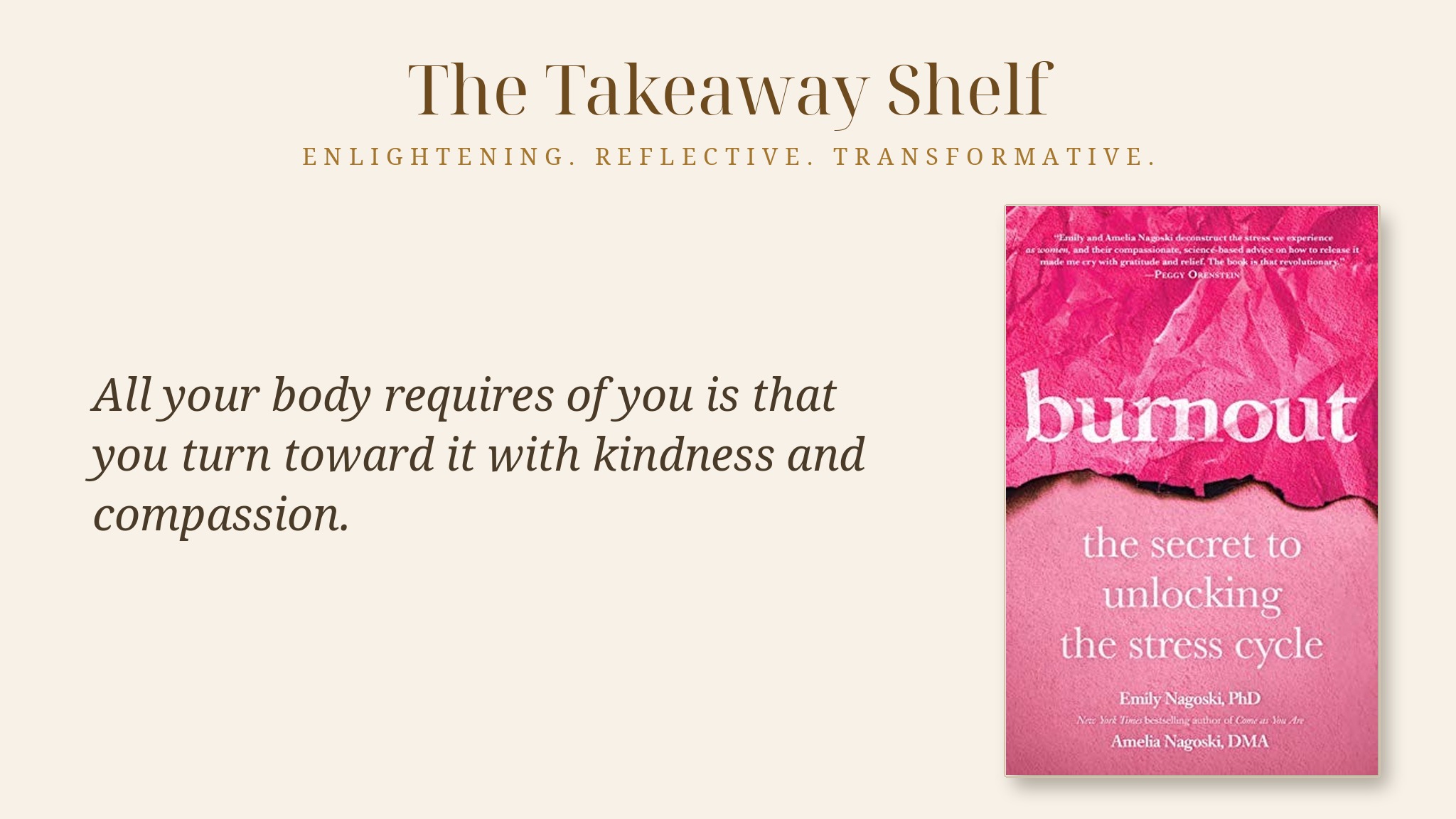
Discover 7 powerful takeaways from Burnout by Emily Nagoski & Amelia Nagoski — complete the stress cycle, rest without guilt, and grow mighty.
This post may contain affiliate links. We only recommend products we personally use and love (please see our full affiliate disclosure). If you click through and make a purchase, we may earn a small commission at no extra cost to you. Your support helps keep this blog running. Thank you so much!
What Remains When the Cycle Never Closes
Burnout opens with a distinction most of us were never taught: the stressor is not the stress. The stressor is the thing that set the alarm off — the deadline, the difficult conversation, the endless list. The stress is what happens inside the body once the alarm sounds — and the body does not know the deadline has passed until it gets the signal that the danger is over.
Emily Nagoski, PhD — health educator and the New York Times bestselling author of Come As You Are — wrote Burnout with her identical twin sister, Amelia Nagoski, DMA, a choral conductor who lived through severe burnout herself. Together they show that burnout is not a failure of effort or attitude. It is what happens when the stress response cycle starts again and again and never gets to finish — and finishing it is a physical act, not a change of mindset.
“What makes you stronger is whatever happens to you after you survive the thing that didn’t kill you. What makes you stronger is rest.”
Table of Contents
What the Book Is About
Burnout is a book for any woman who has felt overwhelmed and exhausted by everything she had to do, and yet still worried she was not doing “enough.” That is the book’s own opening line, and it names its reader plainly. The Nagoskis wrote it for the givers — the people, mostly women, who were taught that their job is to meet everyone else’s needs first and to feel guilty for having needs of their own.
Burnout moves in three parts: what we take with us into burnout, the science of the stress cycle and the seven evidence-based ways to complete it, and finally “Grow Mighty” — how to change the relationship with the inner critic and build a life around what matters. Burnout’s argument is hopeful and practical at once: the body already knows how to recover. It only needs to be allowed to finish what it started.

7 Powerful Takeaways from Burnout
Each lesson comes from the Nagoskis’ own words — the science they explain and the practices they tested in their own lives. Together, they form a guide to finishing the cycle, resting without apology, and growing mighty instead of merely coping.
Lesson 1: Stress Is Not Bad for You — Being Stuck Is
“The good news is that stress is not the problem. The problem is that the strategies that deal with stressors have almost no relationship to the strategies that deal with the physiological reactions our bodies have to those stressors. To be ‘well’ is not to live in a state of perpetual safety and calm, but to move fluidly from a state of adversity, risk, adventure, or excitement, back to safety and calm, and out again. Stress is not bad for you; being stuck is bad for you.”
This is the reframe Burnout turns on. Stress itself is a healthy, adaptive response — the body mobilizing to meet a challenge. The damage comes when the response has nowhere to go: the email is answered, the meeting ends, but the body is still braced for a lion that is no longer there.
A reader who takes this lesson stops asking how to eliminate stress and starts asking how to move through it. Wellness is not the absence of adversity. It is the ability to move fluidly from effort back to safety and calm, and out again.
Lesson 2: Complete the Stress Cycle With Movement
“Physical activity is the single most efficient strategy for completing the stress response cycle.” The Nagoskis add: “Physical activity—literally any movement of your body—is your first line of attack in the battle against burnout.”
The body speaks body language. It does not understand “the deadline is over” or “the argument is settled” — it understands running, jumping, dancing, walking. Movement is what tells the brain the threat has been survived and the body is a safe place to live again.
The Nagoskis are specific and forgiving about this: twenty to sixty minutes a day helps, but even a single song danced out in the kitchen counts. A reader who takes this lesson does not need a gym membership or a training plan. They need to move — any movement — until the body gets the message that it is safe.
Lesson 3: Rest Is 42 Percent, Not a Reward
“So how much rest is ‘adequate’? Science says: 42 percent. That’s the percentage of time your body and brain need you to spend resting. It’s about ten hours out of every twenty-four.”
Forty-two percent sounds impossible until the Nagoskis point out that it does not have to happen every day — it can average out over a week or a month. And they refuse to sell rest as a productivity trick: “It’s true that rest makes us more productive, ultimately… But we think rest matters not because it makes you more productive, but because it makes you happier and healthier, less grumpy, and more creative. We think rest matters because you matter. You are not here to be ‘productive.'”
A reader who takes this lesson stops treating rest as something to earn after the work is done. Rest is the work the body needs, and skipping it does not make a person stronger — it only means the 42 percent will take them, as the Nagoskis warn, by force.
Lesson 4: Deal With the Stress Before the Stressor
“If you’re hiding from your life, you’re past your threshold. You aren’t dealing with either the stress or the stressor. Deal with the stress so you can be well enough to deal with the stressor.”
Most advice about stress starts with the stressor: fix the problem, have the conversation, make the plan. The Nagoskis insist on the opposite order. A body still flooded with stress cannot think clearly, decide well, or hold a boundary — so the first job is to deal with the stress itself, and only then turn to the thing that caused it.
A reader who takes this lesson learns to recognize the hiding — the scrolling, the numbing, the busywork that looks like coping — as the signal that they are past their threshold. The way back is not a better to-do list. It is finishing the cycle first, and then dealing with the stressor from a steadier place.
Lesson 5: Name Human Giver Syndrome and Refuse It
“Human Giver Syndrome – the contagious belief that you have a moral obligation to give every drop of your humanity in support of others, no matter the cost to you – thrives in the patriarchy, the way mold thrives in damp basements.”
Human Giver Syndrome is Burnout’s name for the rule many women were raised on: “Human givers must, at all times, be pretty, happy, calm, generous, and attentive to the needs of others, which means they must never be ugly, angry, upset, ambitious, or attentive to their own needs.” The Nagoskis call it a syndrome because it behaves like one: it spreads, it is rarely named, and it makes the person carrying it sick.
A reader who takes this lesson starts by naming it out loud. The belief that worth must be earned by giving everything away is not a personal failing — it is a learned rule, and a learned rule can be refused. The first refusal is often the smallest one: saying no, and letting the no stand.
Lesson 6: Turn Toward Your Inner Critic With Compassion
“Remind her that you are the grown-up, the homeowner, or the teacher, and she can trust you to maintain the attic so that she always has a safe place to stay. Thank her for the hard work she has done to help you survive.”
The “madwoman in the attic” is the Nagoskis’ name — borrowed from Jane Eyre — for the inner critic: the voice that says you are not enough, that a broken relationship was all your fault, that you are failing in the mirror. She is harsh, shaming, and perfectionistic, and she was built to protect you — to bridge the gap between who you are and who you were told to be.
Burnout’s answer is not to silence her or to argue her down. It is to describe her, to listen for the sadness or fear underneath her noise, and to answer her as the grown-up in the house: she is safe, she is heard, and she does not have to run the place anymore. “Each person’s madwoman is different. For you, maybe she’s more like a shadow, following you around, a perpetual reminder of what you’re not.” Meeting her with compassion — not combat — is how a reader grows mighty instead of merely enduring.
Lesson 7: Connection and Autonomy Are Both Needs
“No one is ‘complete’ without other people—and we mean this literally. To be complete without social connection is to be nourished without food. It doesn’t happen. We get hungry. We get lonely. We must feed ourselves or die… And it is also true that the lifelong development of autonomy is as innate to human nature as the drive to connect. We need both connection and autonomy. That’s not a contradiction. Humans are built to oscillate from connection to autonomy and back again.”
Burnout refuses the false choice between needing people and needing space. Loneliness, the Nagoskis write, is a form of hunger — and like hunger, it has different flavors: the “am I crazy?” feeling after being gaslit, the “not enough” feeling of one person facing the world’s endless need, sadness, and rage swallowed instead of shared.
A reader who takes this lesson stops apologizing for either need. Connection is not weakness and autonomy is not selfishness; both are built into being human, and health is the freedom to move between them — from effort to rest and back, from connection to autonomy and back — without getting stuck at either end.
Why It’s a Must-Read
Burnout is one of the rare self-help books that never asks the reader to try harder. Burnout’s whole argument is that the reader has already been trying hard enough — too hard, for too long, without rest — and that the way out is not more effort but completion: finish the cycle, take the rest, name the syndrome, befriend the madwoman, and let other people in.
Burnout also sees its reader clearly. “None of us chooses the landscape in which we’re planted. If you find yourself on an ocean-battered cliff, your only choice is to grow there, or fall into the ocean.” And: “A tree that’s fought wind and gravity and erosion to grow strong and green on a steep cliff is going to look strange and out of place when moved to the level playing field.” For anyone who has ever felt bent and gnarled by the effort of surviving, that is a sentence that gives the struggle its dignity back.
And Burnout teaches the reader to listen again — to the body, to the fatigue, to the voice in the attic. “Most of us have spent our whole lives being taught to believe everyone else’s opinions about our bodies, rather than to believe what our own bodies are trying to tell us.” Burnout answers all of it with kindness.
Who This Book Is For
Burnout is for readers who are exhausted and still worried they are not doing enough — and for anyone who loves someone running on empty. It is for the givers, the helpers, the ones who hold everything together and apologize for needing rest. It is also for readers who like their self-help grounded in science, told with humor, and honest about the world that makes women tired in the first place.
It may not suit readers looking for a quick fix or a five-step plan — in Burnout, the Nagoskis are clear that there is no shortcut past the cycle, and that rest takes real time. Readers who liked The Gifts of Imperfection, or who are drawn to questions of self-compassion, boundaries, and what it means to be well, will find Burnout stays with them long after the last page.
Grow Mighty
Burnout‘s whole book can be summed up in one practice: turn toward your body with kindness, finish what the stress started, and then rest — not as a reward, but as a need. The stress will come again; that is life. What changes is that the reader is no longer stuck inside it.
Start with one completion — the smallest one in front of a reader right now. A walk around the block. Ten slow breaths. A good cry. A friend called just to say the hard thing out loud. The cycle closes, the body stands down, and the reader is free to deal with the stressor from a place of rest instead of a place of hiding. That is what growing mighty looks like: not never breaking, but knowing how to come back.
Get the book — Kindle: https://link.amazon/B06aC63jv · Hardcover: https://link.amazon/B0a1JZzr4
Keep reading on The Takeaway Shelf: The Gifts of Imperfection: 7 Powerful Takeaways — another guide to self-compassion and letting go of who you think you’re supposed to be.