The Gifts of Imperfection: 7 Powerful Takeaways
Discover 7 powerful takeaways from The Gifts of Imperfection by Brené Brown — let go of perfectionism, embrace who you are, and live wholeheartedly.
This post may contain affiliate links. We only recommend products we personally use and love (please see our full affiliate disclosure). If you click through and make a purchase, we may earn a small commission at no extra cost to you. Your support helps keep this blog running. Thank you so much!
Let Go of Who You Think You’re Supposed to Be
The Gifts of Imperfection begins with a simple, unsettling question: what would life look like if a reader stopped performing and started living? Brené Brown, a research professor who has spent years studying shame, vulnerability, and courage, wrote this book as a guide to wholehearted living — a way of engaging with life from a place of worthiness instead of a place of fear.
Brown’s central idea is that perfectionism is not the same as striving to be better. Perfectionism is armor: a belief that if a person looks perfect and does everything perfectly, they can avoid shame, judgment, and blame. Wholehearted living is the opposite — it is the daily practice of letting go of who a reader thinks they are supposed to be and embracing who they actually are.
Table of Contents
What the Book Is About
The Gifts of Imperfection is built around ten guideposts for wholehearted living, each one a practice for letting go of something that gets in the way — perfectionism, numbing, scarcity, comparison, exhaustion, the need for certainty, self-doubt, anxiety, and the fear of being ordinary. Each guidepost pairs a letting-go with a cultivation: letting go of perfectionism and cultivating self-compassion, letting go of numbing and cultivating a resilient spirit, letting go of anxiety and cultivating calm and stillness.
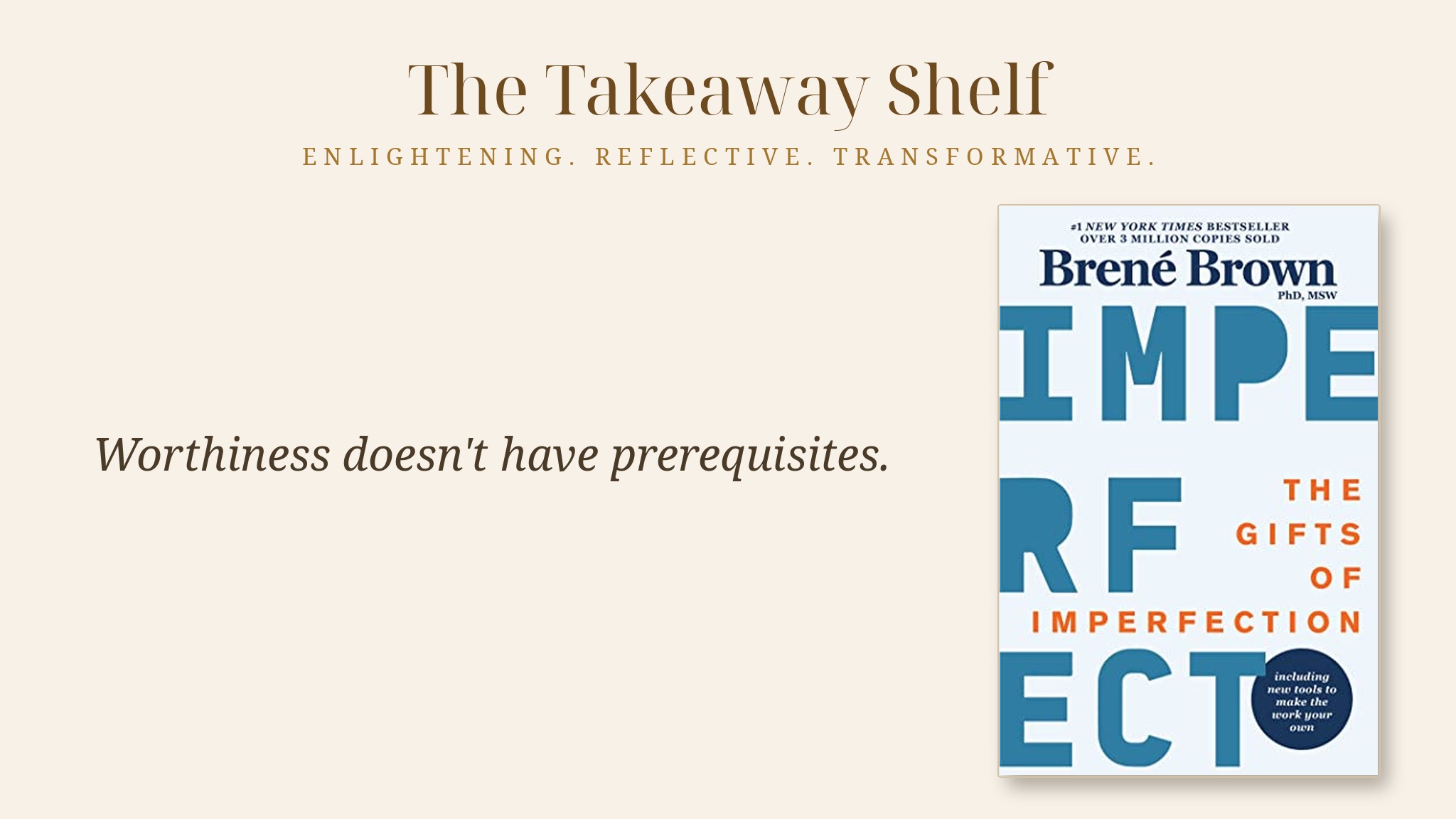
The book is short, warm, and practical. Brown writes like a researcher who has done the homework and a friend who has lived the struggle — she calls herself a recovering perfectionist and an aspiring good-enoughist. The result is a book that reads less like a lecture and more like permission: permission to be imperfect, to set boundaries, to rest, and to believe that worthiness does not have prerequisites.
7 Powerful Takeaways from The Gifts of Imperfection
Each lesson comes from Brown’s own research and writing — the definitions, the guideposts, and the sentences readers underline and come back to. Together, they form a manual for wholehearted living, one daily choice at a time.
Lesson 1: Authenticity Is a Daily Practice
“Authenticity is a collection of choices that we have to make every day. It’s about the choice to show up and be real. The choice to be honest. The choice to let our true selves be seen.” Brown refuses to treat authenticity as a personality trait a person either has or does not have. It is a practice — a set of small, repeated choices made every single day.
A reader who takes this lesson stops waiting to feel authentic before acting authentic. Showing up, being honest, and letting the true self be seen are choices made in the moment, not moods that arrive on their own. The practice is the point: each honest choice makes the next one easier, and over time the choices add up to a life that actually fits.
Lesson 2: You Are Already Worthy
“You are imperfect, you are wired for struggle, but you are worthy of love and belonging.” This is the sentence the whole book stands on. Brown’s research kept returning to the same finding: the people who live wholeheartedly are not the ones who have eliminated struggle, but the ones who believe they are worthy of love and belonging exactly as they are — imperfect, struggling, and all.
The lesson is that worthiness is not a prize for becoming perfect. A reader does not have to fix every flaw, finish every project, or earn a certain life before belonging counts. The belonging starts now, with the imperfect self, and everything else — the courage, the boundaries, the rest — grows out of that single belief.
Lesson 3: Boundaries Protect Connection
“When we fail to set boundaries and hold people accountable, we feel used and mistreated. This is why we sometimes attack who they are, which is far more hurtful than addressing a behavior or a choice.” Brown is blunt about this: boundaries are not walls, and they are not selfish. They are what keep relationships honest. Without them, resentment builds until it comes out as an attack on a person’s character instead of a conversation about a behavior.
A reader who takes this lesson learns to say the clear thing early — what is okay, what is not, and what happens next — instead of staying silent and then exploding. Boundaries protect connection because they keep the small hurts small. A clear no today is what makes a generous yes possible tomorrow.
Lesson 4: Healthy Striving Is Not Perfectionism
“Healthy striving is self-focused: ‘How can I improve?’ Perfectionism is other-focused: ‘What will they think?’” This one sentence untangles a confusion that traps many readers. Striving to improve is healthy; it is focused inward, on growth, on the work itself. Perfectionism is focused outward, on the audience — on managing what other people might think.
The lesson is a question a reader can carry into any project: am I doing this to get better, or to look better? If the answer is to get better, the work is healthy striving, and mistakes are part of it. If the answer is to look better, the work has become armor, and no amount of polishing will ever feel like enough — because the goal was never the work at all.
Lesson 5: Don’t Numb the Good with the Bad
“We cannot selectively numb emotions, when we numb the painful emotions, we also numb the positive emotions.” Brown’s research on numbing is one of the book’s most practical warnings. The habits people use to soften pain — endless scrolling, overworking, overeating, staying busy — do not work selectively. They dull everything, including joy, gratitude, and connection.
A reader who takes this lesson stops reaching for the numbing habit and starts reaching for the feeling instead. Sitting with discomfort is hard, but it is the only way to keep the good feelings alive too. The choice is never between feeling pain and feeling nothing — it is between feeling everything, or feeling nothing at all.
Lesson 6: Let the Light Define the Dark
“The dark does not destroy the light; it defines it. It’s our fear of the dark that casts our joy into the shadows.” Brown writes about joy with unusual honesty: joy is vulnerable, and the fear of losing it can make people dress-rehearse tragedy instead of simply enjoying the moment. The dark moments of life do not cancel the light ones — they are what make the light visible.
The lesson is to practice gratitude in the middle of joy, not after it. A reader who notices the good moment while it is happening — and names it, even quietly — keeps fear from stealing it. Gratitude is the practice that lets the light stay lit, even when the dark is still there.
Lesson 7: Calm Is a Practice, Not a Personality
“I define calm as creating perspective and mindfulness while managing emotional reactivity. When I think about calm people, I think about people who can bring perspective to complicated situations and feel their feelings without reacting to heightened emotions like fear and anger.” Brown’s definition of calm will surprise readers who think calm people simply feel less. Calm people feel everything — they just practice creating perspective before reacting.
A reader who takes this lesson stops trying to become a naturally calm person and starts practicing the moves instead: pause, breathe, get perspective, then respond. Calm is not a trait a person is born with. It is a skill built one paused reaction at a time, and every practice makes the next hard moment a little easier to meet.
Why It’s a Must-Read
The Gifts of Imperfection is a short book with a long afterlife. “Perfection is an unattainable goal.” Brown writes it plainly, and the whole book is the proof — a research-backed case that the chase for perfect is what keeps readers from the life they actually want. The book’s ten guideposts give a reader something to do on Monday morning, not just something to think about.
It is also one of the kindest books on the shelf. “Happiness is attached to external situations and events and seems to ebb and flow as those circumstances come and go. Joy seems to be constantly tethered to our hearts by spirit and gratitude.” That distinction — happiness as weather, joy as something steadier — is the kind of line a reader carries for years. That is why the book works as more than self-help — it is a permission slip, written by a researcher, to be imperfect on purpose.
Who This Book Is For
This book is for readers who are tired of performing — tired of the perfectionism, the people-pleasing, and the exhaustion of keeping up an image. It is for anyone who wants a practical, research-backed way to live more honestly, and for readers who like their self-help warm, funny, and free of jargon.
It may not suit readers who want a dense academic text or a step-by-step program with worksheets — Brown writes in stories and guideposts, not drills. Readers who liked The Four Agreements, or who enjoy books about courage, boundaries, and self-compassion, will feel right at home.
You Are Enough
Brown’s whole book can be summed up in one sentence: no matter what gets done and how much is left undone, a reader is enough. Wholehearted living is not a destination a person arrives at once the flaws are fixed — it is a practice that starts with that single belief, today, as is.
Start with one guidepost — the smallest one in front of a reader right now — and practice it the way Brown would: let go of one “supposed to be,” choose one honest moment, and set one clear boundary. The authenticity, the calm, and the joy all start the same way: with one choice, made today.
Keep reading on The Takeaway Shelf: 4 Life-Changing Lessons from The Four Agreements by Don Miguel Ruiz — another guide to personal growth, about the four agreements that can transform how a reader relates to themselves and to others.