

Chapter 9: A Virtuous Woman Bears Injustice and Hangs Herself; An Old Widower Seeks Revenge and Submits a Fierce Petition
by Angie Bellender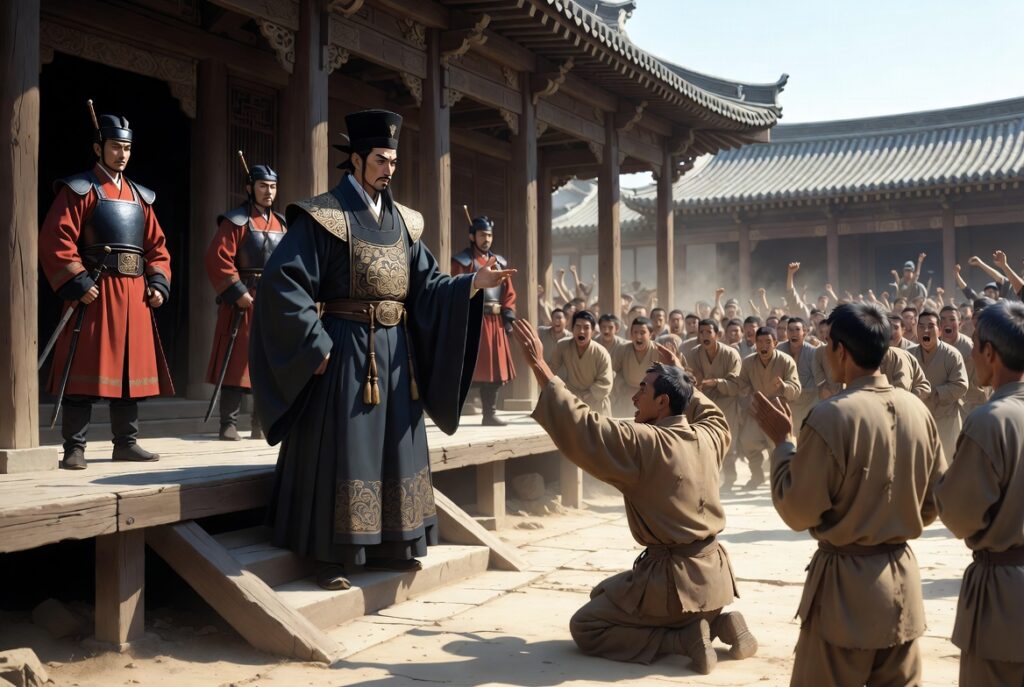
Two kinds of people ruin states and homes: The home by a favored concubine, the state by a eunuch minister. A clever scheme is hatched to part the new from the old, A few subtle words are used to estrange the closest kin. The virtuous are made villainous, the false becomes the true, Loyal flesh and blood are treated as mere dust. To be toyed with until death, without a single regret, Leaving bystanders to laugh until their hearts break.
Sister-in-law Gao used a mix of “sweet and bitter” words to convince Lady Ji to stop making a scene in the street. Chao Yuan, in his own heart, knew perfectly well that the person who left earlier was not a monk; he knew Little Zhen-ge was making things up and chasing shadows. However, firstly, he didn’t dare cross Zhen-ge, and secondly, he thought Lady Ji had been bullied into submission. He wanted to use this alleged “stain” on her reputation to suppress her, divorce her, and clear the way so Zhen-ge wouldn’t be annoyed—allowing him to live happily by elevating Zhen-ge to his legal wife.
He hadn’t expected the Ji father and son to be so firm and unyielding. Lady Ji was a woman of strong character; how could she endure such an injustice? Consequently, Chao Yuan was like a “wax-tipped spear hitting a stone”—his momentum collapsed halfway.
But Lady Ji was not about to let matters rest. She initially plotted to hack Zhen-ge into mincemeat and then take Chao Yuan’s life along with her own. Then she reconsidered: “I am but a small, physically weak woman; how do I have the strength for such a deed? Even if I succeeded, a woman killing her husband is a terrible crime. If I killed him but failed to die myself and fell into the hands of the law, the suffering would be endless. But how can I live with this foul reputation of ‘keeping priests and monks’?”
She turned it over and over in her mind: “I cannot win this fight with my life, and living here in agony is meaningless. Even if I wait for my in-laws to return, how can they shield me from this storm? It would be better to die and be at peace.” She was now ninety-nine percent committed to this plan.
Just then, the Ji father and son arrived at the front of the house. They sent a message to Chao Yuan: “Is the divorce letter written yet? I’ve come to take my daughter home.”
Chao Yuan made an excuse, saying he was so upset he had fallen ill and was bedridden, and that they should discuss it after he recovered.
Old Ji retorted, “If this isn’t settled quickly, it won’t just be ‘priests and monks’ coming around—every bastard and actor in town will be showing up!” With that, he walked to the back to see his daughter.
Lady Ji asked, “Yesterday, when Sister Gao was trying to calm me down, she mentioned that you and my brother were across the street talking to Yu Mingwu?”
Old Ji replied, “Exactly! We were right there talking to Yu Mingwu about this very matter when you came charging out.”
“Lady Ji asked, ‘What did Yu Mingwu say?’
Old Ji replied, ‘Sister Hai and Nun Guo left your place and ran right into Yu Mingwu as he was seeing off a guest. Yu Mingwu even said to them, “In this scorching sun, aren’t you two roasting?” He invited them into his house to rest in the shade. While things were in an uproar here, those two nuns were actually sitting in Yu Mingwu’s house having a meal.’
Lady Ji took a bundle of things from her room, untied it, and spread them on the table. She said, ‘This is fifty taels of silver, this is two taels of gold leaf, and these are two taels of pearls—all sent to me yesterday by my mother-in-law. Father, take them home for me and keep them until I arrive. These thirty taels of broken silver are what I’ve saved over the years, and here is a package of jewelry I no longer wear: two pairs of bracelets, two pearl headbands, and these gold earrings. Brother, take these home for me as well and keep them safe. Take this bolt of blue satin and have a tailor quickly cut a wide-sleeved robe for me; take this bolt of rose-pink silk and have him cut a medium-length jacket. With what’s left, have my sister-in-law make me a padded undergarment using these two catties of silk floss. Keep whatever remains, Brother, and bring the clothes to me by noon tomorrow so I can finish packing and go home.’
Old Ji asked, ‘In the heat of midsummer, why are you making winter clothes?’
Lady Ji snapped, ‘Your words irritate me to death! What do you care what I do? If I don’t hurry and have these clothes made to take home, you two paupers will probably hock them for yourself, and I’ll be left with nothing but to sue the Young Master! I’ll pack my other trifles in the trunks; you can send people to carry them away tomorrow. The clothes are the priority. I won’t keep you for a meal; go now.’
After sending her father and brother away, she began packing her room as if she were truly leaving, but she also brought out many clothes and distributed them one by one among the serving women. A maid said, ‘Mistress, there’s no need to give everything away. The Young Master only spoke of divorce to satisfy his big mouth. The Old Master and Old Madam married you to him with proper rites as his primary wife. With them still around, who dares divorce you? Even if the Young Master did, you shouldn’t just leave!’
Lady Ji replied, ‘According to you, if someone is driving me out with a club, I’m supposed to just stay and beg?’
‘Naturally, no one would dare drive you out,’ the maid insisted.
Lady Ji then had a girl pull out a bundle of copper coins she had saved from under the bed and distributed them among the women who served her, saying, ‘Take these as a memento of me.’ The women all cried, ‘Even if you go home to stay for a while, we should just lock this door and go with you to serve you. Why would we stay here alone?’
Lady Ji said, ‘I won’t take you with me, and naturally, you won’t be able to go.’ As she spoke, they all began to weep.
It was around the hour of the Dragon (8:00 AM). Since the firewood from the farm hadn’t arrived yet and breakfast wasn’t ready, Lady Ji personally smashed several panels from her new sedan chair to use as fuel for the stove. She even took the sedan poles and burned them until they snapped into seven or eight charred pieces. A maid lamented, ‘What a waste! Wouldn’t it be better to burn the old chair and keep the new one?’
Lady Ji said, ‘I have been divorced; I am no longer a member of the Chao family. How could I sit in a Chao family sedan chair?’
When Chao Yuan heard that Lady Ji was packing to return to her parents’ home, he was quite pleased that his plan had succeeded, though he didn’t know exactly when she would depart.
By noon on the eighth day of the sixth month, Old Ji and his son returned with the clothes, all finished and wrapped in bundles. They handed them to Lady Ji and called for men to carry away her trunks. Lady Ji only allowed them to take four large bundles, saying, ‘I’ve thought about it; these old trunks and cabinets aren’t worth a few copper coins. If the neighbors see you taking them, they’ll say you’re stealing his things. I won’t bother with his junk!’
‘You are quite right,’ Old Ji agreed.
Lady Ji said, ‘I haven’t finished packing everything yet. I suppose I’ll return home tomorrow.'”
“Don’t come tomorrow morning,” Lady Ji told her father and brother. “Wait until I send someone to call for you, then come fetch me. It’s hot, so you must get me into the house quickly. Once I’m settled in my room, there will be time enough for you to speak. Use the things I sent yesterday if you need them—just don’t sell me for cash!”
Old Ji’s heart sank. “Listening to you speak… are you thinking of something short-sighted? If you truly do such a thing, do not think that because he is wealthy and powerful I cannot fight him—but even if I could, he would never be made to pay with his life! You must listen to me!” He pleaded and counseled her again and again before finally leaving. Lady Ji then used the rest of the smashed sedan chair as fuel to cook her final lunch.
As evening fell, Lady Ji bathed, lit a coil of incense, and wept a great, bitter gale. Eventually, the household settled down. The serving women, exhausted, fell into a sleep as deep as dead pigs. Lady Ji rose, washed her face with cold water, and bound her hair tightly. She put on a few select hairpins and rings and wrapped her feet and hands firmly.
She dressed herself in layers of her finest new clothes: silver-red brocade trousers, a white embroidered silk skirt, a moon-white silk bodice against her skin, a sky-blue inner jacket, a silver-red silk mid-jacket, and a moon-white satin shirt. Finally, she donned the new sky-blue satin wide-sleeved robe. She took a needle and thread and painstakingly sewed every layer of clothing and her shoes together so they could not be easily removed. She placed a piece of gold and a piece of silver in her mouth, took a peach-pink sash, and quietly opened the door. She walked to the central gate of Chao Yuan’s quarters and hanged herself from the doorbeam. In less time than it takes to drink two cups of hot tea:
Mid-sky, the sound of phantom footsteps is heard; Over the wall, the shadow of a swinging soul is cast.
While Lady Ji was seeking her end outside, Chao Yuan was lying on his pillow with Zhen-ge, scheming. “Heaven simply won’t tolerate her,” he said. “I thought the divorce was a lost cause, but she’s so ashamed she wants to move back to her father’s. Once she’s gone, we’ll open up the back rooms to the rear gate and rent them out. It’ll bring in at least three or four taels a month, and it’ll keep the place more secure.”
The two of them went back and forth, delighted with their plan. At dawn, Chao Yuan called for a maid to open the gates so the servants’ wives could come in to cook. When the maid opened the door, she let out a piercing scream and collapsed to the ground, unable to make another sound.
“Xiao Xiajing, why are you screaming?” Chao Yuan called out. He asked several times before the maid scrambled back, trembling.
“I opened the door… and there’s a woman hanging from our doorbeam, swinging back and forth!”
“Didn’t you recognize who it was?”
“I was scared to death the moment I saw her! How could I tell who it was?”
“Where is she now?”
“She’s still there under the gate; she hasn’t gone anywhere!”
Chao Yuan tumbled out of bed, pulled on his trousers, stepped into his shoes, and ran out. “This is bad! The Ji woman from the back must have hanged herself!” When he reached the spot, his guess was proved correct. He reached out to feel her mouth—it was ice-cold, with not a breath of life left.
Panic-stricken, Chao Yuan hurriedly woke the servants and told them to cut her down and take her to the back. As they scrambled to do so, a servant named Li Chengming shouted, “Don’t touch her! Quickly, call Old Master Ji and his son to see her first before we move the body. It’s clearly a suicide, but if we take her down now, how can we explain how a perfectly healthy woman died overnight? They’ll say we murdered her, and we won’t have a leg to stand on. Send someone for Old Ji and the brother immediately! And tell Auntie Zhen to find a place to hide. Don’t let her stay here; if the Ji women come and catch her, they’ll tear her apart!”
At that moment, Little Zhen-ge’s usual bravado vanished. She hurriedly pinned up her hair, threw on a half-new raw silk jacket and an old moon-white skirt, and dragged her feet in a pair of old shoes. Two maids knocked open the door of their neighbor, Yu Mingwu, and hurried Zhen-ge inside to hide.
Old Man Ji had been tossing and turning since the fourth watch (3:00 AM), his heart racing with an inexplicable dread. He only managed to close his eyes as the fifth watch was ending. In his dream, his daughter appeared wearing the very clothes she had commissioned, a red sash wound around her neck. She stepped toward him and said, “Father, I am here. Whatever you do, do not spare that woman!”
Old Ji woke in a cold sweat. Just as he sat up, his son, Young Ji, came running to his window, shouting, “Father, get up quickly! Something has happened to my sister! I’ve had a terrible dream!” When they spoke, they realized their dreams matched perfectly, down to the last detail. Father and son both let out a cry of grief.
As they were hurriedly grooming themselves, a servant from the Chao household began pounding on their door, shouting, “The Young Mistress has had a fit of ‘phlegm’ (a stroke/seizure)! The Old Master and the Young Master must come at once!”
Old Ji replied grimly, “Your mistress already came to my house just now, wearing a sky-blue wide-sleeved robe with a red sash around her neck. I am coming.”
They ran to the Chao estate, covering the distance in half the usual time. There they found Lady Ji, suspended from the doorbeam of Chao Yuan’s own quarters. Father and son let out a roar of agony. Old Ji grabbed Chao Yuan and began beating his own head against him in a frenzy of grief and rage. All of Chao Yuan’s previous arrogance had vanished; he could do nothing but kowtow and beg for mercy, stammering that they were “kin that even a sharp knife couldn’t sever” and pleading for them to show mercy for the sake of his father, the Magistrate. Old Ji hunted everywhere for Zhen-ge, but she was nowhere to be found, which sent him into a jumping rage.
At this point, Chao Yuan was as limp as a runny nose. Even his fierce servants and cunning maids didn’t dare lift a finger or say a word. Young Ji, seeing the situation, spoke up: “Father, you should have taken charge earlier. Now that my sister is dead, taking charge now is too late and will only needlessly ruin the harmony between relatives. Even if you don’t care for my brother-in-law, think of the elderly Master and Madam Chao. What is the use of acting like this? It is a scorching day—we cannot just leave her hanging there!”
Old Ji remembered his daughter’s final instructions: It is hot, so get me into the house quickly… once I am in the room, there will be time to speak. He realized his son was playing a deeper game—”a large scroll wrapping a small one, a painting within a painting.” He followed his son’s lead, stopping his cursing and keeping his hands to himself.
Young Ji continued, “We can’t let outsiders handle this. Brother-in-law, you come hold her up while I untie the rope and prepare a place to lay her out.”
Chao Yuan stammered, “Where should we put her? Perhaps in the central hall of the quarters where she lived?”
“Nonsense!” Young Ji snapped. “She is the eldest daughter-in-law of this house. If you put her in the back, it will be impossible to process the coffin out later. Open up the main formal hall! Clean it and set up the mourning bed immediately! Call the maids to carry the body!” Indeed, they moved her to the main hall and laid her out properly.
Young Ji then asked, “Do you have wood for a coffin?”
Chao Yuan replied, “We have a few sets in storage, but I fear they aren’t good enough.”
“That is for you to decide,” Young Ji said. “If you want to be ‘just enough,’ use those. But if you care for the bond of husband and wife, send someone to buy the best immediately!”
“I’ll ask you to lead the men to the Wei family shop at the South Gate to pick out a fine set,” Chao Yuan conceded.
As they spoke, local carpenters had already heard the news and arrived. They followed Young Ji to the lumber shop. There was a set for eighty taels, one for one hundred and seventy, and a premium set for three hundred. Young Ji declared, “My sister may be the daughter of a small family, but she is the mistress of a great one. She deserves this fine wood.”
They settled on a price of two hundred and twenty taels. The eight carpenters took a “kickback” of thirty taels for themselves and arranged a thirty-tael “gratitude gift” for Young Ji, leaving the shop with a net profit of one hundred and sixty taels. They hired a dozen men to shoulder the heavy planks and carry them to the Chao estate. Once inside, they set to work with a flurry of activity, and the sounds of sawing and hammering filled the air.
Seeing that Young Ji spoke so reasonably and acted as a mediator, Chao Yuan clung to him like a lifesaver. Forget the two hundred and twenty taels for the coffin—he would have willingly paid a thousand. By late afternoon, the coffin was finished and lined with protective pitch. It is said that the bodies of those who die of great injustice do not quickly decay; by evening, Lady Ji’s remains were still perfectly preserved. Though she had hanged herself, her tongue did not protrude and her eyes were not bulging. In death, she had shed the fierce, aggressive air she had while alive, appearing instead gentle and serene.
Old Ji, though he had lost his fortune, came from an established lineage. He had three or four nephews who were licensed scholars (xiucai), and his clan still included many respectable households. By this time, over two hundred men and women from the Ji clan had gathered. They watched as Lady Ji was encoffined and placed in the central hall of the main house, draped with white silk mourning hangings and set before an altar with incense and ritual tables.
Once everything was in order, Young Ji knelt to thank his clansmen, then rose and said, “My sister is safely in her ‘room’ (the coffin) now. Let’s have ourselves a bit of a row!”
At this signal, the men outside pounced on Chao Yuan. They tackled him, kicked him, and beat him mercilessly. They smashed tables and chairs, broke windows and doors, and scattered wine, vinegar, rice, and flour everywhere until they were satisfied. A mob of women, armed with clubs and whips, searched every corner of the house—under beds, behind woodpiles—hunting for Zhen-ge. Unable to find her, they completely demolished her bedroom. Finally, they forced Chao Yuan to kneel before the gathered Ji clan and write a formal confession and plea for mercy.
The Confession of Guilt I, Chao Yuan, took the prostitute Zhen-ge as a concubine and, believing her slanders, constantly oppressed my legal wife, Lady Ji. I denied her food and clothing, imprisoned her in a cold room, and frequently beat and insulted her. On the sixth day of this month, because Lady Ji allowed Nuns Hai and Guo to visit, Zhen-ge falsely accused her of adultery with priests and monks. She incited me to beat Lady Ji and cast her out. Unable to endure the injustice, Lady Ji hanged herself with a red sash at Zhen-ge’s door during the night. Now, my father-in-law has shown mercy for the sake of our kinship and refrained from taking me to court. I, Chao Yuan, solemnly pledge to conduct a proper and lavish funeral without any corner-cutting. Written by my own hand on this eighth day of the sixth month.
After the document was read by the crowd, it was handed to Old Ji for safekeeping. Young Ji said, “Let him up for now! we still need him to handle my sister’s burial. We’ll settle the rest of the bill with him later!”
A banquet was set, and they invited their neighbor, Yu Mingwu, to join them. Yu Mingwu said, “Uncle Ji, hear me out. Your daughter’s death was truly bitter, and Brother Chao is deeply in the wrong. But she is gone now, and she still needs to be buried in the Chao family plot. Furthermore, considering how close you and Old Master Chao once were—closer than brothers—please, for the sake of the old man, just make Brother Chao perform the full rites and give her a grand funeral. Let’s put an end to the cursing and fighting from here on.”
Old Ji replied, “Brother Yu, if you hadn’t mentioned that in-law of mine, I might have kept my peace. But if we’re talking about that old scoundrel, there’s no one like him in the world! Back when he was a penniless scholar, I was a wealthy young lord. Let’s not even mention how my mother supported him then! Let’s just talk about the time from when we became in-laws until he became an official. These past years, the rice he ate was mine, the cotton he wore was mine, the millet for his wine was mine; the wheat for his New Year’s buns and the straw to patch his roof—all mine! It was like a fixed tribute, paid year after year without fail.
“And when it came time for your daughter to marry, even though I had fallen on hard times, I strained every nerve to provide a dowry of no less than five or six hundred gold taels. I was left with only four qing of land, and because my daughter had no mother to look after her, I even threw in one qing of land for her support. Later, when he went to the capital for his exams and had no travel money, poor as I was, I took my late mother’s pearl crown and hocked it for thirty-eight taels of silver. I didn’t keep a single cent; I sealed it up and gave it all to him.”
“He even sold twenty mu of my daughter’s land for another forty taels. When he finally passed the provincial exams and spent nearly a year in the capital waiting for an appointment, that whole family of his lived off the produce of my daughter’s remaining land.
“Now that he’s a high official with bottomless pockets, the ‘Young Scoundrel’ (Chao Yuan) scorns his wife for being ugly and not grand enough for his ‘great house.’ Meanwhile, the ‘Old Scoundrel’ (Old Master Chao) scorns his in-laws for being poor, claiming we disgrace his status and aren’t fit to sit with his new, fancy relatives. In the five years since he went to Huating, he hasn’t sent a single note the size of four fingers, nor a single cent’s worth of a gift to ask how I am!”
Yu Mingwu asked, “Based on what you’re saying, Uncle Ji, is Old Master Chao truly that kind of man?”
Old Ji replied, “My dear Brother Yu, I’m not just making things up to slander him because my daughter is gone! I’m speaking in front of all these relatives and his own stewards. It’s no use lying about people! The stinginess of that father and son isn’t limited to me. Think of all his old friends in this city—does he care about who showed him kindness? Does he even recognize them?
“When Yuan Wanli was building his house, Old Master Chao—a high official with no shortage of timber—decided to flatter him by sending twenty large pine beams. Yuan didn’t want to just take them, but Chao insisted! Yuan said, ‘If you take my money, I’ll take your wood; if you won’t take payment, I can’t accept the beams.’ He sent forty taels of silver, and ‘Young Master’ Chao took it. At market price, those beams were easily worth five or six taels each. But when Yuan Wanli died recently, Chao claimed he was owed for the wood! He’s been filing petitions left and right for two or three hundred taels, targeting Yuan’s widow, his seven-year-old child, and his stewards. It’s the kind of thing a decent human just doesn’t do! You know this, Brother Yu.”
Yu Mingwu remarked, “Master Chao didn’t exactly come out ahead on that one; it made the Old Master look terrible. I suspect the Old Master didn’t even know; it was likely the Young Master’s doing.”
“If that’s one the Old Master didn’t know about, let’s leave it aside,” Old Ji said. “I’ll tell you one he definitely knew about. That year he offended Hanlin Scholar Xin by failing to provide horses and men, and Xin ended up losing his ‘Dragon Credentials’ (imperial tokens). Scholar Xin was set on submitting a formal impeachment when he returned to the capital. Luckily, one of Chao’s runners was in the capital, heard of it, and realized it would take seven or eight hundred taels to hush it up.
“Our local Zheng Bolong was serving as a military officer in the capital then, and the runner consulted him. Zheng said, ‘It’s a good thing you found out; if that petition hits the throne, it’s all over! Losing an imperial credential is no joke! We’ll scrape the silver together.’ Zheng Bolong stripped his own house—cash, silver wine vessels, jewelry, even his wife’s and daughter-in-law’s pearl headbands—to raise the eight hundred taels and stop the disaster. He was paid back in bits and pieces later, and he never charged a single cent of interest.
“Later, when Zheng Bolong had his own imperial audience, he asked Chao for a loan of eight hundred taels and wrote two notes for four hundred each. Chao tricked him into handing over the notes but never gave him the silver! A year later, Chao Yuan actually used those notes to demand the money from Zheng! It got to the point where Zheng Bolong had to offer to swear an oath and issue a ‘divine summons’ at the Temple of the Lord of the Grave before Chao finally let it go.
“And think about the capital—is anything there cheap? These past few years, whenever Chao sent five, six, or eight people to the capital on business, they all stayed at Zheng Bolong’s house. They’d stay for two or three months at a time. Chao Yuan himself went two or three times, staying with Zheng and being treated to four dishes and eight bowls every day. If Chao wanted to buy something, he’d just send a tiny note, and Zheng would buy every single item and send it along.
“Yet when Zheng Bolong returned home recently, Chao Yuan didn’t even pay him a visit, let alone give him a cup of water! And that year Chao was at the Academy in the capital and caught typhoid fever? Our local Huang Ming’an was there and treated him like his own father. Fearing others wouldn’t be careful enough, Huang waited on him day and night for forty days. When Huang recently went to Tongzhou to see him, Chao gave him a measly two taels of silver, fed him one meal, and sent him packing. Huang is back home now, sick with rage!”
Old Ji’s stories were endless. Finally, everyone stood up and dispersed.
Chao Yuan had been severely beaten by the Ji clan; his injuries were significant enough that he couldn’t get out of bed, let alone hang the mourning banners at the gate. Zhen-ge remained hidden at Yu Mingwu’s house, not daring to step outside dawn or dusk for fear that someone from the Ji family was lurking to ambush her. Fortunately, she and Yu Mingwu were old acquaintances, so she wasn’t lonely. Moreover, Yu Mingwu’s wife had gone to the farm to oversee the millet harvest, so Yu Mingwu didn’t mind having Zhen-ge around.
Old Ji consulted with his clansmen about filing a lawsuit. Some clansmen cautioned, “This depends entirely on your own judgment. Weigh it carefully: if you think you can overmatch him, then file the suit. If you suspect you can’t, then you’d better just settle for what we’ve already extracted from him. If it were winter, we could have left the body uncoffined to negotiate slowly, but look at the season! We had no choice but to encoffin her, and once that’s done, the leverage in this case loosens considerably.”
However, the few scholars (xiucai) in the group spoke up indignantly: “What kind of talk is that? He treats our Ji family like we aren’t even human! He hounded a person to death, and if not a single one of us even lets out a gasp of protest, people will laugh their teeth off! We all have daughters married into other families; if we don’t make an example of this, they’ll all be choked to death by their in-laws! Stop wavering—submit the petition tomorrow! That written confession he signed is our smoking gun!”
Old Ji asked, “Where is the best place to submit this petition?”
The scholars replied, “A case involving a loss of life must go through the County Magistrate; where else would you send it? Simply state that Zhen-ge hounded and coerced her until she hanged herself. Do not claim she was beaten to death—if the autopsy proves that false, it will ruin our case.”
Having reached an agreement, they bid farewell to the rest of the crowd.
Old Ji and his son did not go home. Instead, they went straight to the county yamen and found a professional petition-writer nicknamed “Wild Chicken” Sun. They gave him two mace of silver to draft the formal accusation, which read:
The Formal Accusation
Plaintiff: Ji Du, aged 59, native of this county.
Charge: A concubine hounding the primary wife to death.
Statement: My daughter, Lady Ji, was married to Chao Yuan from a young age, and they lived in harmony. Unfortunately, once Chao Yuan attained great wealth and the rank of Imperial Student, he suddenly grew to despise my daughter for her family’s poverty and her own plain looks. He spent eight hundred taels of silver to take a stage actress named Zhen-ge as a concubine. He imprisoned my daughter in a cold room, cut off her food and water, and frequently beat her on fabricated pretexts. On the sixth of this month, simply because the nuns Haihui and Guo visited the house, Zhen-ge slandered my daughter, claiming she had committed adultery with monks and priests. She incited Chao Yuan to beat my daughter and divorce her, leading my daughter to hang herself at Zhen-ge’s door. Bitter over her innocent and wrongful death, I cry out for justice.
Defendants: Chao Yuan, Zhen-ge, Xiao Meihong, Xiao Xinghua, Xiao Liuqing, Xiao Taohong, Xiao Xiajing, Lady Zhao, Lady Yang.
Witnesses: Haihui, Nun Guo, Yu Chengxian, Lady Gao.
On the tenth day of the sixth month, they waited for the Magistrate of Wucheng County to open court. When the “Petition Board” was brought out, Old Ji grabbed it, followed the official inside, and submitted his document. After the roll call, he was sent outside to wait for the verdict on the board. On the eleventh, the petition was granted. Two runners, Wu Xiaochuan and Shao Cihu, were dispatched to summon the parties involved. The two officers met with Old Ji and his son first before heading to the Chao estate.
The gateman, seeing they were county officers, did not dare be arrogant. He invited them into the hall and sent word to Chao Yuan.
Chao Yuan endured his physical pain, put on a mourning headwrap and a white raw-silk robe, and came out to meet them. After reviewing the summons, he treated the officers to wine and a meal, recounting the events from his perspective during the meal.
The runners remarked, “It’s true she hanged herself, but what of it? It’s not as if you’ll have to pay with your life. However, since you don’t have a formal ‘official’ standing yourself, the outcome depends entirely on the Magistrate’s judgment. Master Chao, you should make your own arrangements; you ought to submit your counter-petition tomorrow.”
As they rose to leave, Chao Yuan took out two taels of silver. “We shall be seeing much of each other in the coming days,” he said. “Consider this small gift as ‘donkey money’ (travel expenses). Once I submit my counter-petition tomorrow, I shall invite you back properly to discuss further matters.”
The runners made a show of polite refusal before calling over their groom to take the silver, then bid him farewell.
Chao Yuan immediately sent for Yu Mingwu to consult. He also sent someone to the yamen gates to fetch the petition-writer Song Qinwu. He explained the situation, gave him five mace of silver, and provided a meal. Song Qinwu drafted the counter-petition:
The Counter-Petition
Respondent: Imperial Student Chao Yuan, son of Chao Sixiao, current Magistrate of Tongzhou in North Zhili.
Subject: Slander and extortion of property.
Statement: Unluckily, I took the shrewish daughter of Ji Du as my wife. She was naturally unvirtuous and committed countless acts of filial disobedience. Recently, over a minor household grievance, she brandished a sharp knife, attempting to kill me. To escape her, I fled, whereupon she ran into the street to make a public scene. Yu Chengxian and Lady Gao can testify to this. Knowing she was in the wrong and overcome with shame, she hanged herself. Ji Du then led his ‘tiger-son’ Ji Bala and over two hundred clansmen to swarm my home. They beat me nearly to death, smashed every window and vessel, and looted all my jewelry and clothing. Now, seeking to extort more wealth, they have filed this malicious accusation. I cry out for justice.
Accused: Ji Du, Ji Bala, and over two hundred Ji clan thugs.
Witnesses: Yu Chengxian, Lady Gao.
In the twelfth month (a likely textual error for June), this petition was also accepted by the Wucheng County court. A warrant was issued, and the same runners were assigned to summon the parties.
Though Chao Yuan had money and influence, he was utterly isolated. The people he usually associated with were not seasoned or wise men, but merely a few “nouveau riche” youngsters—calves just born. He had many other relatives and friends, but they could not stomach the arrogance and stinginess of the Chao father and son. None were willing to step in and help him. Truly, he was a man “abandoned by his own kin.”
Old Man Ji might have been poor, but his clan still carried significant social weight; the fact that over two hundred relatives showed up unbidden for the encoffinment had Chao Yuan feeling quite anxious. Yet, as the proverb goes: “When a lawsuit as big as the sky comes crashing down, just use silver as big as a millstone to smother it.” Why fear Heaven?
Human hearts may lean toward such corruption, but one must wonder if Heavenly Justice will allow it. Let us see how this concludes.
Translator’s Note
1. The “Posthumous Lawsuit” Strategy
Lady Ji’s suicide is not an act of despair, but a calculated legal maneuver.
- The Location: She hangs herself specifically at Zhen-ge’s door. In Qing-era law, the location of a suicide was critical evidence. By dying there, she physically “attaches” her death to her rival.
- The Clothing (Layers and Sewing): The detail about her sewing her clothes together in “thick, dense layers” (密密層層) is historically significant. Suicidal women did this to prevent their bodies from being shamed or manipulated during the mandatory official inquest (jiǎnyàn). It also signaled to the coroner that she was a “virtuous woman” who died with her dignity intact.
- The “Spirit Returning” (Soul-returning Coin): She places gold and silver in her mouth. This is both a burial custom and a superstitious belief that it would empower her ghost to seek revenge.
2. “A painting within a painting” (畫裡有畫)
- The Phrase: Huà lǐ yǒu huà.
- Context: Young Ji (Ji Bala) acts as a “buffer.” He stops his father from a futile physical assault on Chao Yuan to focus on the “big game”—getting a signed confession and a high-status burial. This “scroll within a scroll” strategy shows the Ji family’s transition from raw grief to cold, calculated litigation.
3. The “Confession of Guilt” (伏罪文約)
This document is the “smoking gun.” Under traditional law, a signed confession (gōngàn) was often more powerful than witness testimony. By forcing Chao Yuan to admit he “listened to slanders” and “denied food and clothing,” the Ji family effectively wins the first round of the legal battle before it even hits the magistrate’s desk.
4. The Six Ministries Comparison (六科給事中)
Earlier in the text (regarding Qingmei), and echoed in the family’s logic, there is a comparison to the Six Ministries. This highlights the “bat-like” nature of certain social classes (nuns/clerks) who exist between the gaps of official power, answering to no one while exerting influence everywhere.
- 蠟槍頭 (Làqiāngtóu): “Wax-tipped spear.” A brilliant idiom for someone who looks formidable but collapses the moment they hit resistance. It describes Chao Yuan’s sudden loss of bravado when faced with a dead body.
- 劈開兩片頂門骨,傾下一盆冰雪來 (Pī kāi liǎng piàn dǐng mén gǔ, qīng xià yī pén bīng xuě lái): “Splitting the skull in two and pouring in a basin of ice and snow.” A recurring visceral metaphor in this novel for sudden, paralyzing terror.
- 三心二意 (Sān xīn èr yì): “Three hearts and two minds.” To be indecisive or wavering. The scholars use this to push Old Ji toward a formal lawsuit.
- 官官相為 (Guān guān xiāng wéi): “Officials protecting officials.” This cynical worldview drives Lady Ji’s initial desperation—she believes the system is rigged against her because her husband’s father is a magistrate.
0 Comments