
Chapter 3: The Old Scholar Appears Twice in a Dream; The Young Master Decides to Visit his Relatives
by Angie Bellender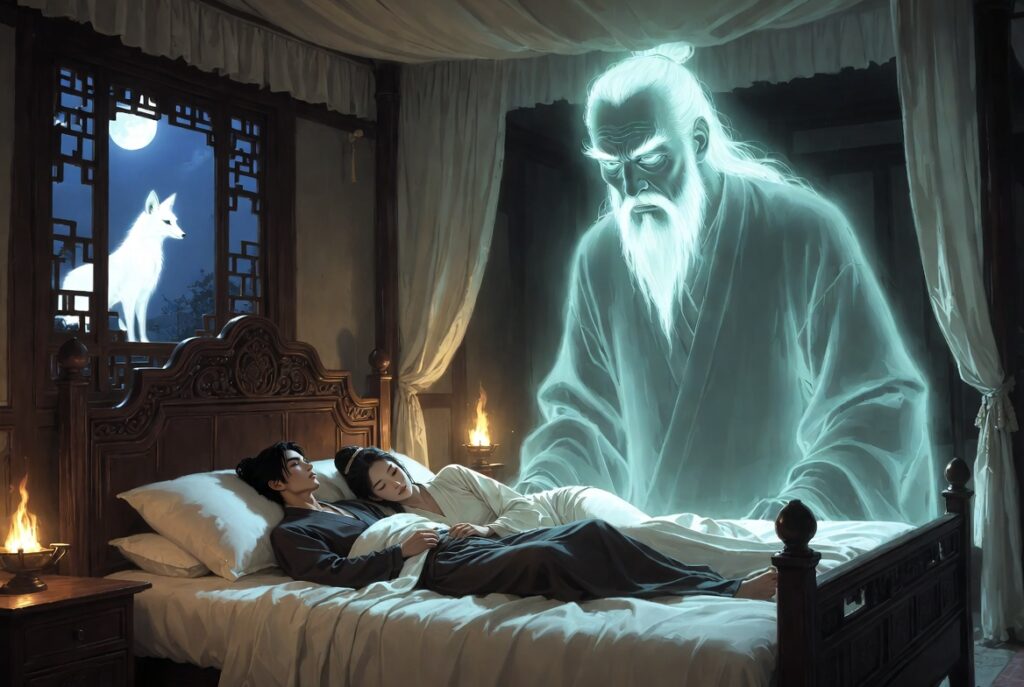
The Opening Verse
Parents worry only when their children fall ill, To guard one’s body is to honor their will. Look upon the dry bones within the grave, Even in death, for their kin, they remain a slave.
The Omen of the Hawk
One of the Chao family servants, Li Chengming, tucked the white fox pelt under his arm and headed out the gate. He was tasked with getting it cured quickly so it could be made into a saddle cushion for the New Year’s ride.
He hadn’t walked more than a few dozen paces when a massive hawk dived from the sky. It struck Li Chengming across the face with its right wing—a blow so powerful it felt like a slap from a giant. The hawk snatched the fox pelt in its talons and soared high into the clouds.
Li Chengming returned home dazed and pale-faced. He recounted the supernatural theft to Chao Yuan. Surprisingly, because Chao Yuan’s household discipline was lax, he didn’t punish the servant; he only muttered, “What a waste of such a fine pelt,” and let the matter drop.
The Grandfather’s Ghost
On New Year’s Eve, after preparing his new clothes and ordering the horses to be readied for morning visits, Chao Yuan shared a few final drinks with Zhen-ge and fell into a deep sleep.
In his dream, an old man of seventy or eighty appeared. He had a long white beard and wore an ivory-white cap with a semi-worn brown Daoist robe. The old man spoke:
“Yuan, I am your grandfather. Listen to me: Your father worked hard to build this estate and fortune for you. Why won’t you live a quiet, happy life? Why must you act so recklessly?”
The Grandfather’s Warning
The old man in the dream, with his white beard and ivory cap, spoke with a voice of grave concern:
“Yuan, I am your grandfather. Listen to me: Your father earned this fortune for you so you could live in peace, yet you refuse to behave and insist on acting recklessly. It was bad enough to lead a pack of women and a mixed crowd into the wild—being the laughingstock of the village is a small matter—but you have invited a heavenly disaster upon yourself!
That fox-lady in the cave of Mount Yong had cultivated her spirit for over a thousand years; she had reached true power and was the fourth or fifth most famous subordinate of the Sovereign of Mount Tai. When you first saw her, you shouldn’t have let a lewd thought enter your mind. Because you felt a connection to her, she hoped you would save her. If you wouldn’t save her, that was one thing, but you shot her dead and even stripped her skin to be tanned!
The one who slapped you across the face when you saw your guests out was her; the hawk that struck Li Chengming yesterday was also her. Fortunately, both you and your father are currently in a period of great prosperity, so the Door Gods and House Deities refuse to let her in. Just now, when you welcomed me home to receive offerings, that fox-lady was sitting on the mounting stone outside, clutching her own skin.
When she saw me, she recounted your crimes in detail. She said that if you hadn’t moved your heart with lust and lingered over her, she would have naturally stayed far away. But you lured her close, then took her life. She says she will certainly strike tomorrow when you go out; she wants her first taste of revenge. Once your luck finally fades, she will conspire with those closest to you to take your life in payment.”
The Truth About Lady Ji
The grandfather continued, revealing the secret of Chao Yuan’s marriage:
“She also told me: Your wife, Lady Ji, though she is not ‘virtuous’ in her temper, is a decent soul. In a previous life, you were the wife and she was the husband. Because you did not love her then and treated her with contempt, she has returned in this life as your wife to repay you. Her only flaw is bullying her husband; otherwise, she is a good person. She has not shamed your family name nor ruined your estate. Once these few years of karmic debt are repaid, you will part ways naturally.
But now, you refuse to be forgiving. You wronged her in the past, yet she did not ruin you; she wrongs you now, yet you treat her even worse! I fear this cycle of revenge will never end. Listen to me: Do not go out tomorrow. Stay hidden for two months, then follow your parents to Beijing to escape this disaster. When you leave, take that cinnabar-printed Diamond Sutra from the estate with you. The fox-lady intended to burn your estate down, but because that scripture is there, divine generals guard the place, and she has no way to strike. She also fears the city because your wife, Lady Ji, was her companion in a religious society three lifetimes ago, and she fears frightening her. It is clear she is terrified of that Diamond Sutra.”
Before leaving, the grandfather struck Zhen-ge on the head and cursed: “What kind of lustful demon are you, to lead my descendants to death and their home to ruin?”
The Awakening
Chao Yuan jolted awake, realizing he had had a profound and terrifying dream. Beside him, Zhen-ge also woke up screaming from a nightmare, feeling a sharp, searing pain in her temple where the grandfather had struck her.
The night watch drums were sounding the fourth point of the fifth watch (just before dawn). As Chao Yuan dressed, he turned to Zhen-ge and said, “That fox we shot the other day… we truly shouldn’t have killed it.”
The Hubris of New Year’s Morning
Chao Yuan thought to himself, “I’ll tell her the rest in a couple of days.” Though he felt a lingering fear, his arrogance won out: “My health has returned. If I stay inside during the Great New Year, I’ll die of boredom! Besides, if my friends hear I’m staying home, they’ll all swarm my house to bother me. The cost of the wine and food is a small matter, but I don’t have the energy to host them.” He weighed his options and decided: “I’m going out; let’s see what happens.” He finished grooming himself and changed into his finery. After burning incense before the Heaven and Earth altar and bowing at the family shrine, the eastern sky began to brighten. He noticed Zhen-ge was still in bed, complaining of a splitting headache and alternating between chills and fever.
“Since your head hurts, take your time getting up,” Chao Yuan said. “I’ll head to the temple to kowtow, drop my card at the County Yamen, and come right back. We’ll eat together, and I’ll finish my visits later.”
The Fall from the Mounting Stone
Chao Yuan dressed in a lychee-red silk Daoist robe embroidered with plum blossoms and donned a brand-new sable-fur hat he had bought for fifty-five taels. He stepped out the front gate, surrounded by a grand procession: two servants carried red silk lanterns, one carried his felt rug, two held his box of visiting cards, and several others followed behind.
He stepped onto the mounting stone to get on his horse. Suddenly, it felt as though someone lunged from the stone and shoved him with all their might. He crashed to the ground, his head striking the edge of the stone.
Fortunately, the thick fur of his expensive hat absorbed the blow; the hat was torn open in a patch the size of a bowl, and while his head swelled up like a peach, the skin didn’t break. He lay unconscious for a long time before being carried back inside. Once they stripped his robes and removed his headgear, he was laid in bed across from Zhen-ge.
He finally believed: the dream was true, and the Fox Spirit’s revenge was real. He was gripped by terror. Meanwhile, Zhen-ge’s headache was so intense she was wailing to the heavens. One lay groaning in the bed, the other moaning on the window-side kang.
Dr. Yang’s “Treatment” and Hidden Games
On the second day of the New Year, they had no choice but to summon Dr. Yang once again. Entering the room, the doctor joked, “Are you two suffering from lovesickness? Why have the ‘Talented Youth’ and the ‘Beautiful Maiden’ both fallen ill at once?”
Chao Yuan recounted the bizarre fall from the mounting stone and described Zhen-ge’s symptoms—how she had woken up screaming from a nightmare on New Year’s Eve and hadn’t been able to leave her bed since.
Dr. Yang laughed it off: “I don’t even need to feel your pulses to know what’s wrong. You’re from a wealthy house; you’ve clearly overexerted yourselves with New Year preparations. Master Chao, you stayed up too late, woke up too early, and definitely drank too much.” He then leaned in and whispered in Chao Yuan’s ear: “And since you ‘bid farewell to the old year’ [had sex] on top of all that, your head spun, your eyes blurred, and down you went the moment you tried to mount your horse.”
He moved to take Chao Yuan’s pulse, declared his guess correct, and then moved to Zhen-ge’s bedside. The maid pulled back the curtain, and Zhen-ge, putting on an act of modesty, covered her head with the quilt.
As Dr. Yang felt her pulse, he took advantage of the maid turning her back to viciously pinch Zhen-ge’s wrist. Zhen-ge endured the pain without a sound but seized the moment to dig her nails into Dr. Yang’s hand, leaving two white gouges in his skin.
A Pinch, a Scratch, and a New Diagnosis
After Zhen-ge dug her nails into Dr. Yang’s hand in silent retaliation for his pinch, the doctor simply pulled his chair back and acted as if nothing had happened. “It’s a bit of overexertion,” he announced smoothly, “combined with a slight external chill.”
He bid farewell to Chao Yuan, and after drinking a large cup of tea in the main hall, he was handed a “medicine fee” of one tael of silver. A servant named Chao Fengshan followed him home to collect the prescriptions.
The servants soon returned and scrubbed two medicine pots, marking them carefully to avoid a mix-up. Chao Yuan’s medicine was, predictably, the same “Ten-Ingredient Great Tonic.” Since he had no real symptoms other than the trauma from his fall, the medicine sat well enough with him. Zhen-ge’s prescription was a “Qianghuo Tonic for the Interior.” After drinking it, she broke into a light sweat and her fever began to recede by the afternoon, yet her headache only grew more agonizing.
Consulting the “Almanac of Afflictions”
Seeing her distress, Chao Fengshan’s wife suggested: “I’ll go find a Suìshū (an Almanac of Afflictions/Supernatural Causes). We’ll perform a ritual to send off whatever spirit is bothering Auntie Zhen, and I guarantee she’ll be fine!”
She sent someone to borrow the book from Priest Chen at the True Warrior Temple. They first checked the entry for the 30th (New Year’s Eve), which read: “The Kitchen God is displeased. Offer five sheets of yellow spirit money, tea, wine, and cakes at the hearth. Auspicious.”
Chao Yuan corrected her: “It wasn’t the 30th. She only felt the pain after waking up at the fourth point of the fifth watch—that’s already New Year’s Day. Look up the 1st.”
The entry for the 1st day read: “Offended an Ancestral Spirit. The ghost sits facing forward in the family hall. Sincere repentance and prayer. Auspicious.”
Chao Yuan suddenly remembered his dream—how his grandfather had struck Zhen-ge on the head and cursed her before leaving. The almanac’s mention of “offending an ancestral spirit” matched the dream perfectly. He instructed Fengshan’s wife: “Don’t wait for nightfall. Go to the family hall right now and pray fervently before my grandfather’s tablet. Tell him to let her recover, and then she will come to apologize in person.”
The Servant’s “Lecture” to the Ghost
Chao Fengshan’s wife was a fast-talking woman with a sharp tongue. She went to the ancestral hall, knelt before the tablet of Old Master Chao, and after four kowtows, she began her “prayer”:
“It’s the New Year! We invited you home to receive offerings, yet instead of blessing us in every way, you’re acting like a common person, making people suffer with headaches and fevers! Even if they did bump into you or offend you, a ‘great person’ like you shouldn’t hold a grudge against ‘little people’ like them. If you won’t do it for her, do it for your grandson’s sake! If you keep her this sick, do you think your grandson will even have an appetite to eat?”
Strangely enough, after she returned from this blunt lecture, Zhen-ge’s headache actually began to fade. However, the luck did not extend to Chao Yuan. The left side of his face and his left eye began to swell up severely, causing intense throbbing pain. The left side of his body hurt so much he couldn’t even turn over in bed.
The “Magnet and the Needle”
On the 3rd day of the New Year, servants were sent again to Dr. Yang for more medicine. Still obsessed with Zhen-ge, the doctor found an excuse: “I must go and see them myself before I can adjust the dosage.”
He mounted his horse and arrived at the Chao residence. When the servants went to the back to announce that Dr. Yang insisted on taking the pulse in person, the “muddled and senseless” Chao Yuan didn’t realize that Zhen-ge was a giant magnet and the doctor was merely the needle being pulled in. Instead, he said: “Master Yang is truly a close friend. He doesn’t mind the travel and insists on seeing me personally!” He immediately ordered the room to be prepared for the doctor’s visit.
A Scuffle of Wits and the “Hidden Dog”
On that day, Zhen-ge was fully recovered. She combed her hair, dressed in brand-new robes from head to toe, and kowtowed before the Heaven and Earth altar. Just as she finished, Dr. Yang (Yang Guyue) entered the inner quarters. Zhen-ge hurried into the east room to hide, but the doctor still caught a glimpse of her. After finishing the pulse reading and leaving the room, he once again passed the window.
Zhen-ge, speaking through the peephole as before, taunted him: “You little rascal! I’ll teach you to let him be!”
Dr. Yang suppressed a laugh. Pointing at a golden-haired Pekingese dog, he asked the guiding servant: “When did your family find such a clever dog? It looks ready to bite someone the moment it gets a chance!” (A subtle jab back at Zhen-ge’s sharp tongue). He then proceeded to the hall for tea, received his fee, and sent the servant for the medicine—the usual routine.
Pills, Potions, and Pillow Talk
Zhen-ge walked back into the room and complained: “You should at least give a warning before letting him in! He barged right in while I was finishing my prayers. My eyes were dark; I couldn’t stand the sight of him, yet he still ran into me.”
Chao Yuan teased her: “You probably just couldn’t stand that he uses ‘Gecko Tonics’ and ‘Tortoise-head Ointments’!”
Zhen-ge shot him a sharp look and cursed: “Where did you hear such stinking rumors?”
Chao Yuan laughed: “That’s the ‘stink’ coming from the Pear Blossom Pavilion in Yin Pingyang’s study!” (Referencing the gossip circles of his profligate friends). Having hit the mark, Zhen-ge simply smiled and remained silent, ordering the maids to set the table by Chao Yuan’s bed.
The Terror in the Ancestral Hall
After they ate, Zhen-ge said: “You rest here. I’m going to the family hall to kowtow to the Old Grandfather and thank him for his protection the other day.”
“That’s a good idea,” Chao Yuan replied. “Take a few of the women with you.”
Zhen-ge stepped into the ancestral hall and approached the tablet of Old Master Chao. Just as she knelt down—before her forehead could even touch the floor—she looked up, let out a piercing scream, and bolted for the door. Her white silk skirt caught on the threshold, tripping her violently. She went sprawling, one of her high-heeled red silk shoes flying three or four paces away. She was pale with terror, unable to make a sound. The nursemaids, too frightened to even pick up the shoe, hoisted her up and fled back to the bedroom as if for their lives.
Chao Yuan was terrified by the sight of them. It took a long time before Zhen-ge could speak and realize she had lost her shoe. While a servant was sent to retrieve it, she gasped out the story:
“I had just knelt down to kowtow when I saw an old man over eighty sitting up there! He wore a purple square cap and a brown wool jacket. He gave a loud cough, and I was so scared I jumped up to run—but at the door, it felt as if someone grabbed my skirt and wouldn’t let go!”
Chao Yuan realized the gravity of the situation: “That was our grandfather! How can he be so powerfully manifest? He came to me in a dream the other night with terrifying warnings. He told me repeatedly not to go out on New Year’s Day, saying enemies were seeking revenge. Before he left, he struck you on the head and cursed you—and you woke up with that headache immediately after. To think he is showing himself so clearly now! He said many other things in that dream… it seems we must obey every word he said.”
He immediately sent a servant to the ancestral hall to burn spirit money, beg for forgiveness, and offer a vow of penance.
The Lingering Shadow over the Master
Zhen-ge was no longer physically ill, but her spirit remained “scattered” (shǎo hún méi shí), as if the grandfather’s ghost had shaken the very core of her confidence. For Chao Yuan, though the swelling on his face had slightly subsided and he could finally turn over in bed, he remained a “cripple climbing a treasure mountain”—he had all the wealth in the world but was physically unable to enjoy it.
The “Frozen” Back Courtyard
While the front was a scene of luxury, Lady Ji and her small circle of original servants were living in total deprivation. Pride prevented Lady Ji from asking for supplies, and Chao Yuan offered nothing.
The servants in the back courtyard, seeing the contrast, began to mutiny. They grumbled loudly enough for Lady Ji to hear:
“What kind of master have we served? Even a beggar gets a steamed bun and a few coins at New Year! Following a disgraced mistress like this is like an eighty-year-old woman getting married—what hope is there for growth?”
Others mocked their own fate:
“Who told you not to burn incense in your past life? Those serving Auntie Zhen in the front must have earned their luck in a previous incarnation. How can we compete with them?”
Lady Ji heard it all but pretended to be deaf, her heart a mixture of fury and profound sadness.
A Father’s Visit and a Bitter Truth
On the seventh day of the New Year, Old Man Ji and his son, Ji the Scarred, came to pay their respects. They found the stoves cold and the pots empty. Lady Ji couldn’t even offer them a cup of tea.
Her father sighed deeply:
“Who knew that when his family became wealthy, your life would become like this? Why argue with him? Take some of your clothes or jewelry and hock them for food. Don’t look to me or your brother for help; we have no power here.”
Lady Ji replied with a bitter smile, “What respectable wife sells her dowry just to buy a meal?”
As they left, the old man wept, hoping that Chao Yuan might one day “change his heart.” Lady Ji’s response was chilling: “Go in peace. I will endure what I can. If I cannot, I will wait for my parents-in-law to return and tell them everything. Even if I die, I will die with the truth made clear!”
The Reversal of Power
The author concludes this section by reflecting on the extreme “reversal” of their marriage. Formerly, Chao Yuan treated Lady Ji like a living Bodhisattva:
- If he thought of hitting her, he feared hurting his own hand.
- If he thought of cursing her, he would stand as still as a nail, waiting for her to finish scolding him before he dared to move.
He used to hold her in his hands fearing she’d fall, or in his mouth fearing she’d melt. To go from such devotion to total abandonment highlights the “karmic swap” mentioned by the grandfather in the dream.
The Cries of the “Starving Ghost”
Chao Yuan’s world had turned upside down. He acted like a rebellious child who refused to listen to his parents; far from fearing Lady Ji, he now found a thousand ways to humiliate her, treating a woman he once revered as a “Living Bodhisattva” like common trash. Even a wooden puppet would have been enraged by such treatment.
After seeing her father out, Lady Ji returned to her room. Reflecting on Chao Yuan’s cold-hearted betrayal and the fickle cruelty of the servants, she could no longer restrain herself. She let out a wailing cry that seemed to shake the mountains:
“O Heaven! O Heaven! Bow your head and hear my prayer! You allow that man to forget every debt of gratitude and kindness—have you no sense of justice? You let a virtuous woman be ground down into a starving ghost of the underworld, while you let a harlot be worshipped like a manifest deity! I burn incense every day for your fairness, yet it seems you are just like the people of this world—siding only with the bandits! Fine! I know I have little power to escape their trap. I’ll steel my heart, go to the Yellow Springs of death, and settle this account with him before King Yama himself!”
The War of Words
Chao Yuan, nursing his injuries, pricked up his ears. “Who is that wailing during the Great New Year? We need peace and good luck in this house. Who is that stinking woman making such a racket? Go and find out!”
Zhen-ge interjected sharply: “No need to check, it’s your ‘Lady from the Qiu Hu Play.’ She’s been howling since earlier. I didn’t say anything because I didn’t want to worry you. She’s counting her grievances and blackening my name—it all comes down to me being here! You might as well just send me away; then your wife can be your wife again, and you can be her husband. Why should you be cursed with such ‘cold-tongued’ insults on New Year’s just because of me?”
Her words were a calculated strike, designed to chill Chao Yuan’s heart further against Lady Ji. Chao Yuan scoffed, “Let her curse! As they say, ‘A curse brings ten years of prosperity; even gods and ghosts won’t dare approach!'” He sent a maid to the back with a message: “It’s New Year; keep quiet! The Master is still sick and in bed. It won’t be too late to cry when he’s actually dead!”
When the maid delivered the message, Lady Ji fired back: “What a harlot’s voice! We live in separate quarters; she has no authority over me! She’s living the good life, so she knows it’s New Year; I’m living in hell, where no holiday ever reaches! I’ll cry now while he’s still alive so people know I’m airing my grievances. If I wait until he’s dead, people will think I’m actually mourning him!” She then intentionally raised her voice, letting out several piercing shrieks.
The Ominous Rebuttal
When the maid repeated these words, Chao Yuan gave a hollow laugh. Zhen-ge, her face flushing with anger, snapped: “If hitting is ‘love’ and scolding is ‘affection,’ then you certainly have a lot to laugh about!” She glared at the maid and cursed her for being spineless.
Chao Yuan tried to calm her: “Little Zhen, that’s enough. On the morning of the first, Grandfather’s dream was ill-omened. He said the life we’re living now still depends on the small bit of ‘blessing’ he left behind!”
Zhen-ge pushed her nose up with her hand, let out a disdainful “Pah!”, and mimicked a famous line of the villainous Pan Jinlian from The Golden Lotus:
“Three-legged toads are hard to find, but two-legged, stinking wives can be found by the thousands!”
The Lantern Festival Preparation
By the 14th day of the first month, Chao Yuan had been resting for nearly two weeks. The swelling on his face had subsided by half, and the pain in his body had lessened. He said to Zhen-ge:
“Today is the day to light the lanterns. I’ll struggle to get up and have the servants hang them. Have the women prepare a snack box; we’ll watch the lanterns and set off fireworks for fun. If I don’t get up, the whole house will feel lifeless.”
Zhen-ge encouraged him enthusiastically. Chao Yuan forced himself to dress. He didn’t comb his hair but washed his face and put on a “Haoran” (scholar’s) cap, though his head still felt dizzy. Once the lanterns were hung throughout the house, they brought out two pots of plum blossoms and two pots of winter jasmine from the heated greenhouse to decorate the bedroom’s sitting area. He planned to drink wine with Zhen-ge for the next three nights.
On the night of the 16th, when all the lanterns were lit, Chao Yuan mentioned: “A fortune-teller has come to visit me and is staying across the street at Yu Mingwu’s house. I haven’t had a chance to meet him yet. Prepare a nice snack box, two large jugs of wine, a box of pastries, and a box of assorted fruits. Send them over to him first for the festival.”
Zhen-ge arranged for the servants to pack the items, saying, “He arrived at the perfect time. I was just about to have someone calculate my fate. Honestly, you should have yours done too—see where the Taisui (Grand Duke Jupiter) is sitting so you can avoid him!”
The Secret Gift
As the servant Chao Zhu headed out with the boxes, Chao Yuan followed him privately and whispered:
“Don’t take these to the fortune-teller. Take them to the Mistress (Lady Ji) in the back. Tell her: ‘Auntie Zhen sent these for the Mistress to celebrate the festival.’ Once you’ve delivered them, come back and tell Zhen-ge that you took them to the fortune-teller across the street. Do not tell her you went to the back!”
Chao Zhu understood the assignment. He carried the three boxes and two jugs of wine to Lady Ji’s quarters. He announced, “Auntie Zhen sent me with these boxes and wine for the Mistress to enjoy for the festival.”
Lady Ji’s face turned crimson with rage. She cursed:
“That shameless harlot! You live under my sky, you tread upon my earth, you occupy my husband—and now you have the nerve to ‘reward’ me with gifts for the festival? Is this not like snot flowing upward? (A total reversal of the natural order!)”
Her nursemaids and maids tried to calm her: “She sent them out of kindness. If you don’t accept them, won’t she be embarrassed?”
Lady Ji snapped back: “Silence! If she isn’t embarrassed, you can be embarrassed for her!” She turned to the servant: “Take these out of here immediately! Don’t provoke me further!” She drove him out and slammed the waist-gate shut with a violent thud.
Gemini said
Here is the translation of this next section for your blog, where a rare moment of attempted kindness by Chao Yuan is met with the fierce, wounded pride of Lady Ji.
The Lantern Festival Preparation
By the 14th day of the first month, Chao Yuan had been resting for nearly two weeks. The swelling on his face had subsided by half, and the pain in his body had lessened. He said to Zhen-ge:
“Today is the day to light the lanterns. I’ll struggle to get up and have the servants hang them. Have the women prepare a snack box; we’ll watch the lanterns and set off fireworks for fun. If I don’t get up, the whole house will feel lifeless.”
Zhen-ge encouraged him enthusiastically. Chao Yuan forced himself to dress. He didn’t comb his hair but washed his face and put on a “Haoran” (scholar’s) cap, though his head still felt dizzy. Once the lanterns were hung throughout the house, they brought out two pots of plum blossoms and two pots of winter jasmine from the heated greenhouse to decorate the bedroom’s sitting area. He planned to drink wine with Zhen-ge for the next three nights.
On the night of the 16th, when all the lanterns were lit, Chao Yuan mentioned: “A fortune-teller has come to visit me and is staying across the street at Yu Mingwu’s house. I haven’t had a chance to meet him yet. Prepare a nice snack box, two large jugs of wine, a box of pastries, and a box of assorted fruits. Send them over to him first for the festival.”
Zhen-ge arranged for the servants to pack the items, saying, “He arrived at the perfect time. I was just about to have someone calculate my fate. Honestly, you should have yours done too—see where the Taisui (Grand Duke Jupiter) is sitting so you can avoid him!”
The Secret Gift
As the servant Chao Zhu headed out with the boxes, Chao Yuan followed him privately and whispered:
“Don’t take these to the fortune-teller. Take them to the Mistress (Lady Ji) in the back. Tell her: ‘Auntie Zhen sent these for the Mistress to celebrate the festival.’ Once you’ve delivered them, come back and tell Zhen-ge that you took them to the fortune-teller across the street. Do not tell her you went to the back!”
Chao Zhu understood the assignment. He carried the three boxes and two jugs of wine to Lady Ji’s quarters. He announced, “Auntie Zhen sent me with these boxes and wine for the Mistress to enjoy for the festival.”
Lady Ji’s face turned crimson with rage. She cursed:
“That shameless harlot! You live under my sky, you tread upon my earth, you occupy my husband—and now you have the nerve to ‘reward’ me with gifts for the festival? Is this not like snot flowing upward? (A total reversal of the natural order!)”
Her nursemaids and maids tried to calm her: “She sent them out of kindness. If you don’t accept them, won’t she be embarrassed?”
Lady Ji snapped back: “Silence! If she isn’t embarrassed, you can be embarrassed for her!” She turned to the servant: “Take these out of here immediately! Don’t provoke me further!” She drove him out and slammed the waist-gate shut with a violent thud.
The Lie and the Laugh
Chao Zhu returned with the boxes. When he reached the front, he told Zhen-ge, “The fortune-teller has gone to another county; there was no one there to receive the gift.”
When Chao Yuan stepped out to the middle gate, Chao Zhu pulled him aside and repeated Lady Ji’s furious words verbatim. Chao Yuan simply gave a short laugh and said nothing.
The Secret Exposed
The old saying “walls have ears” proves true: a maid overheard Chao Yuan’s secret instructions to the servant and repeated them to Zhen-ge. Upon hearing that Chao Yuan had secretly sent the gifts to Lady Ji while lying to her, Zhen-ge flew into a terrifying rage.
“You useless coward! You muddled turtle!” she screamed. “If you couldn’t give up your ‘mother’ in the back, you shouldn’t have come looking for me! I didn’t tie you up with a pig-hair rope—why all this deception? You could send a thousand boxes or ten thousand buns for all I care, but why use a fake ‘fortune-teller’ to let that woman heap insults on me?”
She raged about Lady Ji’s claim that she “owned the sky and the earth,” asserting her own place in the house with venomous pride. Chao Yuan, far from the “Magistrate’s Son” he appeared to be, was reduced to a state of total submission. He spent the entire night bowing and apologizing, desperately pleading that he only wanted “harmony” and held no special affection for Lady Ji. The Lantern Festival was ruined; the lights were never lit, the incense went unburnt, and the household went to bed in a bitter, silent sulk.
The Second Visitation
Just as Chao Yuan drifted off to sleep, the Grandfather’s Ghost returned. He carried a staff and walked into the bedroom with an air of urgency. He used his staff to hook back the bed curtain and addressed his grandson:
“Chao Yuan, my grandson! You did not listen to an old man’s words, and now you are in a state of misery. I warned you specifically, yet you insisted on going out on New Year’s Day. If I hadn’t shielded you with all my might, that fall would have killed you on the spot! Even if your fate says you aren’t meant to die yet, you would have suffered in bed for a year.”
The ghost’s warning grew even more specific:
- The Fox: She is waiting for him with intense focus.
- The Concubine: Zhen-ge is described as a “wicked thing” (yāohuò) who is piling up sins and bad karma.
- The Wife: Lady Ji has reached her breaking point and has begun to harbor “unvirtuous thoughts” (likely contemplating suicide or a curse).
The grandfather’s final order was clear: Flee to Beijing immediately. He warned that his own spirit was departing and would no longer be there to protect Chao Yuan. He reiterated the need to carry the cinnabar-printed Diamond Sutra as a shield.
The Shared Nightmare
The ghost then moved to Zhen-ge’s bed. He raised his staff to strike her over the head for her “wicked and cruel heart,” but he hesitated and pulled back his hand, muttering, “Enough! Enough! It would only bring more suffering to my grandson!”
Zhen-ge jolted awake, screaming in terror. She recognized the old man as the same figure she had seen manifest in the ancestral hall. In a panic, she jumped off her bed and scrambled into Chao Yuan’s quilt, shivering and crying, “I’m scared to death!”
Chao Yuan, also waking from the same vision, called out to the empty room, “Grandfather! Don’t go! Stay and protect me!” The two of them, their petty anger from earlier completely forgotten, huddled together in a cold sweat, realizing that the supernatural debt was about to be called in.
The Decision to Flee
Chao Yuan, shivering from the shared nightmare, said to Zhen-ge:
“We must pack immediately and go to my parents. However, they are currently stationed in Huating (South), yet Grandfather repeatedly told me to go North to Beijing. This confuses me. From tomorrow on, I won’t step foot outside. I’ll send someone to the estate to fetch the Diamond Sutra, pack our bags, and head South first.”
As the proverb goes: The gods and ghosts have foresight; fortune and disaster reveal themselves when the time is ripe.
Translator’s Note:
The White Fox Pelt: In Chinese folklore, a white fox is often a sign of a high-ranking or ancient spirit. The hawk (likely a divine messenger or another manifestation of the fox spirit) taking the pelt back signifies that the “trophy” was never Chao Yuan’s to keep.
The Grandfather’s Appearance: In Chinese culture, Filial Piety extends beyond the grave. Ancestors appearing in dreams to scold descendants is a “final warning.” The fact that the grandfather is wearing “semi-worn” clothes suggests he was a humble, hardworking man—the total opposite of the flashy, extravagant Chao Yuan.
“Dry Bones as Oxen”: The opening poem of Chapter 3 emphasizes that parents and ancestors suffer even after death if their children are wicked. Chao Yuan isn’t just ruining his own life; he is disturbing the peace of his ancestors.
- The Sovereign of Mount Tai (Tàishān Yuánjūn): In Chinese mythology, Mount Tai is the realm of the dead and the source of life. A fox spirit serving under the Sovereign is a “registered” celestial entity, making Chao Yuan’s act of killing her not just a hunt, but a crime against the divine hierarchy.
- Karmic Gender Flip: This is a core theme of the novel. The revelation that Chao Yuan and Lady Ji have swapped genders from their previous lives explains why their marriage is so “unnatural” and violent. It is a literal settling of accounts.
- The “Mounting Stone” (Mǎtái shí): The fox sitting on the stone where guests mount their horses shows how close she is—she is literally waiting at the doorstep for his luck to run out.
- The Diamond Sutra’s Power: In the Ming/Qing literary tradition, the Diamond Sutra is the ultimate spiritual weapon. The fact that it is printed in cinnabar (a red mineral used in Daoist alchemy and demon-warding) makes it even more potent.
- The Door Gods: Traditional Chinese houses featured paintings of deities on the doors to block evil. The grandfather explains that Chao Yuan is only safe right now because he is “in a period of prosperity”—in Chinese fate-lore, when your “luck” is high, ghosts cannot touch you. But luck is temporary.
- The Suìshū (Almanac of Afflictions): In the Ming and Qing dynasties, people believed that many illnesses were caused by “clashing” with spirits or offending deities. This book allowed laypeople to diagnose which spirit was angry based on the date the symptoms started.
- The Ancestral Tablet (Shénzhǔ): This was a wooden tablet inscribed with the name of the deceased. It was believed to house the ancestor’s spirit during rituals. The servant’s “scolding” prayer shows a very informal, almost transactional relationship between the living and the dead in folk religion.
- The Left-Side Swelling: In traditional Chinese thought, the left side of the body is often associated with the “Yang” or male principle. The fact that Chao Yuan’s left side is failing him suggests his very essence as a “master” and “man” is being attacked by the Fox Spirit’s curse.
- The “Golden-Haired Pekingese” (Jīnsī hǎbā): Dr. Yang’s comment is a double entendre. While he is literally pointing at a dog, he is calling Zhen-ge a “bitch” who bites (insults) him the moment he gets close.
- The White Silk Skirt (Bái qiū luó): White is the color of mourning in China. The grandfather’s “ghost” grabbing her white skirt is a chilling omen—it suggests the “mourning” for the household has already begun.
- The Purple Cap and Brown Jacket: These details match the grandfather’s appearance in the dream exactly, confirming for Chao Yuan that this is a “True Dream” (Zhèn mèng)—a divine communication that cannot be ignored.
- The “Eighty-Year-Old Woman” Proverb: This is a cynical way of saying that some actions are futile or that it’s too late for a “new beginning.” The servants feel their career prospects are dead because they are tied to a wife who has lost her husband’s favor.
- “Selling Clothes for Food”: In Ming/Qing society, a wife’s jewelry and clothing were her private property (tǐjǐ). Forcing a woman to sell these was the ultimate sign of a husband’s failure and a household’s disgrace.
- The Pan Jinlian Reference: Zhen-ge quoting Pan Jinlian—the most infamous “femme fatale” in Chinese literature—is the author’s way of marking her as a truly dangerous and wicked character. It signals that Zhen-ge has no respect for the traditional “Wife” position and views Lady Ji as entirely replaceable.
- The “Three-Legged Toad”: A mythical creature representing extreme wealth and luck. Zhen-ge’s point is that while luck is rare, “wives” are common and disposable.
- “One Body Serving Two Roles”: Zhen-ge’s insult (yīshēn zěn dāng èr yì) refers to Chao Yuan trying to please both a wife and a concubine. In the Ming social order, this was a recipe for household collapse, as the “Head of House” was expected to maintain a clear hierarchy.
- The Staff (Guǎizhang): In Chinese iconography, an elderly man with a staff represents authority and the “Earth God” or ancestral protector. The act of using the staff to pull back the bed curtains is a violation of the “inner sanctum,” showing that the ancestors no longer respect the privacy of this “immoral” bedroom.
- “Fate Not Yet Finished”: The grandfather notes that Chao Yuan “isn’t meant to die yet.” In the novel’s Buddhist logic, this is actually a curse; he must live long enough for the Fox to enact a much more painful and ironic retribution in his next life.
- The Cinnabar Diamond Sutra: Why Beijing? Beijing was the seat of the Emperor (the “Son of Heaven”). The grandfather believes the “Imperial Aura” and the presence of Chao Yuan’s parents might provide a sanctuary that his own fading spirit can no longer offer.
0 Comments