
Chapter 2: Master Chao Kills a Fox and Falls Ill; Physician Yang Practices Medicine with Reckless Abandon
by Angie Bellender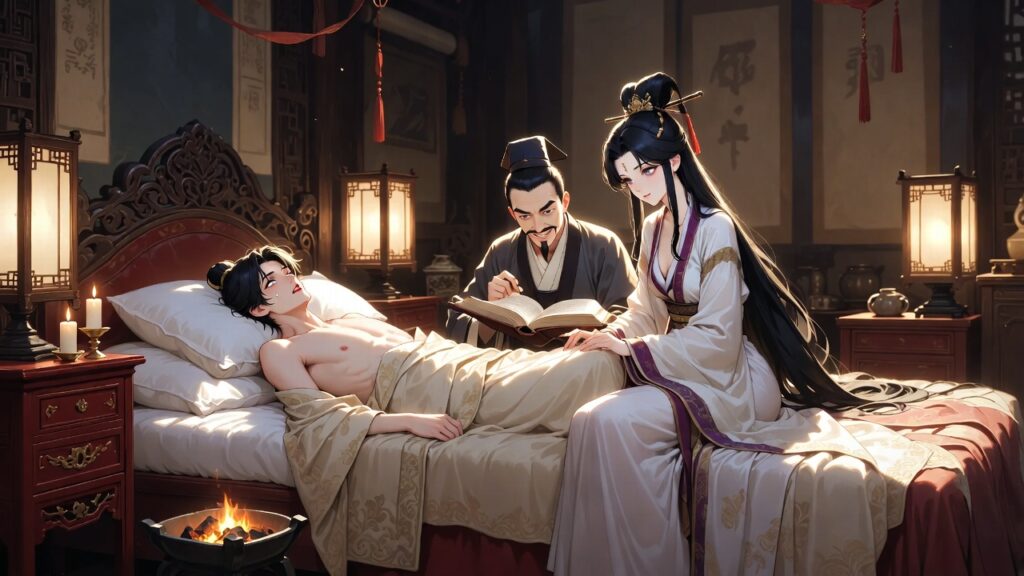
The Opening Verse
Leaves even the greatest doctor’s skill quite spent.
Rely not on the strength of youth or pride,
For spirit fades when darkness starts to stride.
To slaughter living things with cruel intent,
After seeing off his guests that evening, Chao the Young Master felt as though someone had slapped him hard across the face. A chill ran through his body, his hair stood on end, and he felt thoroughly unwell. He managed to hold on for a while, handing the divided pheasants, rabbits, and the dead fox to the servants to store away, then listlessly entered Zhen Ge’s room. He sat slumped in a chair, head bowed, without a word.
A Night of Sickness
From the moment Chao Yuan returned from seeing his guests out, his face felt as if it had been slapped. Shivers racked his body, his hair stood on end, and he felt profoundly unwell. He managed to endure long enough to hand over the pheasants, rabbits, and the dead fox to his servants before retreating to Zhen-ge’s room. He sat in a chair, head hanging, devoid of all spirit.
Zhen-ge, still buzzing from the day’s excitement and ready to gossip about the hunt, found her husband uncharacteristically silent. Her joy dampened. “You were so happy on the way back,” she asked. “Why are you so sullen now? Did you have another falling out with Yu Mingwu?”
Chao Yuan didn’t answer; he only shook his head.
“What is it, then?” Zhen-ge pressed. “Your face is as yellow as scorched earth and as brown as clay. You must have caught a chill on the road. I’ll have the servants make some hot and sour soup. Drink two bowls and sweat it out on the heated bed—that should fix you.”
Chao Yuan finally spoke: “Tell the maid to warm a pot of wine. I’ll drink two large cups and see how I feel.”
The Fever of the Fox
The maidservant brought four small plates of appetizers and a large pot of scalding hot wine, setting them on the bedroom table along with two silver-inlaid lacquered cups and two pairs of ivory chopsticks. Chao Yuan and Zhen-ge had no spirit for revelry; they listlessly downed a few large cups and called it a night. The maid swept the heated kang bed and laid out the quilts, and the two climbed in to sleep.
But sleep brought no rest. Chao Yuan was constantly jolted awake by nightmares, groaning incessantly. By the second watch (around 10:00 PM), his body turned burning hot. He complained of a bitter taste in his mouth and a splitting headache, drifting in and out of incoherent delirium.
Panicked, Zhen-ge had the maids light the lamps and stoke the fire. she called for the nursemaids to attend to him and even sent a servant to knock on Lady Ji’s door, asking her to come and see her husband.
Lady Ji’s Perspective: The “Woman General”
A few days prior, Lady Ji had heard rumors that Zhen-ge was having military attire made and buying riding gear to join the men on the hunt. At the time, she had put on a brave face, sarcastically remarking:
“Hunting is wonderful! Since the times are so chaotic, now that the ‘Lady Generals of the Yang Family’ have appeared, we needn’t fear any rebel invaders!”
Inwardly, however, she was seething: “These women believe every rumor they hear! Even if she was a courtesan before, she’s supposed to be a respectable wife now. How can she put on military clothes and follow a pack of men to a hunt? This must be a lie told just to make me angry. Well, I won’t give them the satisfaction! If she really goes, it just means I’m the only one not acting like a harlot. If that pimp wants to wear a ‘green turban’ (a symbol of a cuckold), let him!” She had dismissed the talk as wind in her ears.
But early on the morning of the 15th, just as Lady Ji was wrapping her feet in bed, the house erupted in a clamor. She heard the twenty-four mounted musicians borrowed from the garrison begin to play, followed by three booming cannon blasts.
“What is happening outside?” she demanded. “Why all this shooting and music?”
The nursemaid replied, “You didn’t believe it the other day, but Little Zhen-ge is heading out to the hunt with the Master right now.”
Lady Ji sat stunned for a long while. “How can such a bizarre thing happen in this world? Have they left yet?”
“They are just about to set off,” said the nursemaid.
“I must go out and see for myself what kind of spectacle this is,” Lady Ji declared.
She wrapped her head in a kerchief, pulled on silk boots lined with lambskin, threw on a short-sleeved jacket and trousers, and hurried to the front. By the time she reached the gate, Chao Yuan and Zhen-ge were already mounted. Lady Ji stood behind one of the heavy front doors, peeking out at the procession. It was indeed a grand, orderly sight. She felt a toxic mix of fury and humiliation.
The neighbor women from across the street had also come out to watch the departure. Some were envious, some were gossiping, and others were laughing at the absurdity of it. Seeing Lady Ji at the door, they all came forward to greet her.
“I haven’t even washed or combed my hair yet,” Lady Ji said, “so let’s skip the formal bows.” She invited them in for tea, but the women declined, staying only long enough to exchange a few polite neighborhood pleasantries before heading home.
The Neighborhood Gossip: “The Green-Cap and the Heroine”
One of the neighbors, Auntie You, asked: “Sister-in-law Chao, why didn’t you go out for a stroll with them? Why sit at home in such boredom?”
Lady Ji replied sarcastically: “My face is too ugly and my feet are too large. I’m not worthy of joining a pack of men for a hunt. I’ll just stay hidden at home and settle for my days of suffering!”
Fourth Sister-in-law Gao chimed in: “It’s not that your face is ugly or your feet are large; you just have ‘heavy bones and a solid frame.’ I’m afraid a horse wouldn’t be able to carry you!” She then turned her critique toward Chao Yuan: “The Master has no sense of propriety. If he wants to respect and pamper that woman, he should do it at home. What kind of spectacle is this? She’s used to it—she used to dress up as Zhaojun or Meng Rihong and ride horses with the other actors in funeral processions. But for the Master to act like this—neither monk nor layman—it’s unseemly. Not only will the neighbors gossip, but if Old Master Chao [the father] found out, he wouldn’t be pleased either.”
The Failure of the Father
Lady Ji scoffed at the idea of the father-in-law’s disapproval: “The neighbors’ laughter is unavoidable. But as for my father-in-law? He’ll actually be delighted! He’ll say his son knows how to have fun, how to relieve boredom, and how to spend money—that he’s ‘no fool.’
She continued, revealing the family’s past: “Back when our old house was right next to the Goddess Temple, my mother-in-law and I planned to visit on a quiet day to burn incense. When Chao Yuan heard, he made up a thousand vulgar excuses—claiming we’d be rubbing shoulders with men, flirting with our eyes, or having our clothes and shoes torn off by the crowd. We never got to the temple, and he gave my mother-in-law such a fit that she was trembling. If I hadn’t stepped in and slapped him twice, who knows how he would have insulted her!”
“The Master spoke to Old Mrs. Chao like that?” Fourth Sister-in-law Gao asked. “Didn’t Old Master Chao get angry?”
“Old Master Chao just stood there with a grin!” Lady Ji said. “He even said, ‘Serves her right! Serves her right! I told her not to go. It took someone saying it out loud for her to listen!’ That is how my father-in-law ‘disciplines’ his son.”
The “Biting-the-Umbilical-Cord” Son
Fourth Sister-in-law Gao joked: “You’re so good at disciplining him, no wonder the Master has turned into a Yaoqilang (Biting-the-Umbilical-Cord Son)!”
The others asked, “What do you mean by Yaoqilang?”
An old woman named Auntie Yan explained: “Oh, don’t you know the story? Yaoqilang went hunting and met his mother, Li Sannian, by a well. Now the Master is out hunting with his ‘little lady’ [Zhen-ge]—isn’t he just like Yaoqilang?” The crowd laughed, impressed by Auntie Yan’s knowledge of ancient lore.
Lady Ji sighed: “You talk about me disciplining him! Am I still the same me? Is he still the same him? Even before he married that ‘private-nest’ harlot, he had already given me two or three ‘show-of-force’ warnings. I’ve already submitted my letters of surrender!”
The Neighborhood Debate: Strength vs. Submission
Fourth Sister-in-law Gao gave Lady Ji a piece of stern advice: “Sister-in-law, you are a clever woman. Listen to me: don’t just sulk out of spite. If you don’t establish some discipline and let him run wild, this household will crumble. If he squanders the fortune or ruins his health, he’ll just kick the bucket and leave you to live in poverty and widowhood. As the saying goes about the grasshopper scholar: ‘He can’t fly away from you, and he can’t hop away from you.’
In my house, when my man has money, I let him dress up however he likes—I don’t say a word. If he wants to sleep with someone else for ten nights straight, I don’t get jealous. But if he starts acting like a fool or a profligate, I don’t show him or his harlots any mercy!”
Lady Ji sighed, “He’s seeing red now; he’s already rebelled. He won’t listen to a word of my management!”
Old Auntie Yan broke it down further: “It’s all about who matches whom. Sister-in-law Gao, you have the back of a tiger and the waist of a bear, while your husband is a shifty-eyed little fellow. If he wants to be a virtuous King Wen, you provide the music and rites; if he wants to be a tyrant like Jie or Zhou, you take up arms! He doesn’t dare lift a claw against you. But this Master Chao is like a fierce demon, and his new little lady [Zhen-ge] is an actress who has stood on the stage—she’s played the bandit-slayer Meng Rihong! How can poor Lady Ji, with her slight frame and limited strength, stand up to the two of them?”
Fourth Sister-in-law Gao laughed, “Nonsense! A swan is big, but a falcon is small—and the falcon still catches the swan!” With that, the women bowed to one another and dispersed.
The Midnight Terror
Lady Ji returned to her room and, thinking over their words, fell into a fit of weeping. She didn’t comb her hair or eat; she simply heated her bed and went to sleep.
In the middle of the night, a frantic pounding erupted at her door. In the past, Lady Ji wouldn’t have been afraid—she was a woman with a clean conscience. But after being “subdued” by Chao Yuan’s recent violence, her spirit had become timid, much like a servant who has been beaten into submission.
She thought in terror: “Why are they knocking so hard? Someone must have told that brute that I was at the gate watching him leave and gossiping with the neighbors. He’s come to pick a fight!”
She reached for the sharp utility knife by her bedside, unsheathed it, and hid it in her sleeve. “I’ll see what he intends. If he tries to grab and beat me like before, I’ll take the chance to stab him twice in the head, and then I’ll slit my own throat to end it all!”
Steeling her nerves, she called her maids to open the door. A servant’s wife stood there, trembling with panic: “The Master… we don’t know what’s happened! He’s terribly unwell, unconscious and talking in delirium. Please, Ma’am, come quickly and watch over him!”
Lady Ji replied coldly, “He and I no longer have anything to do with one another.”
The Bitter Refusal
When the servants came to summon her, Lady Ji didn’t hold back her scorn:
“When it was time for the hunt, there was no place for me! But now that he’s sick, you come looking for me? During the day, he was like a fierce demon, riding high on his horse with that woman, all majestic and bold—how could he fall ill so fast? This is surely some scheme cooked up by that pimp and his harlot to lure me there and do me harm. Tell him this: He doesn’t recognize me as his wife, and I no longer have a husband! Whether the illness is real or a sham, I am not going there in the middle of the night! If you mean to dispose of me, tomorrow is soon enough. Kill me or hack me to pieces in broad daylight if you wish! If he is truly sick and recovers, so be it; if he dies, he has parents at his father’s post to demand an accounting from that harlot. It is none of my business!”
The servant returned and repeated Lady Ji’s words verbatim to Zhen-ge. Zhen-ge acted tough, saying, “If the ‘King of Skins’ gets well, it’s everyone’s luck! If he dies, it’s just a scar the size of a bowl! With a woman like me around, it’s no big deal!” But despite her bravado, she was secretly terrified.
As Chao Yuan’s condition worsened into a deep stupor, Zhen-ge couldn’t wait for dawn. She dispatched a servant, Chao Zhu, to Xuanfu Street to fetch Imperial Physician Yang.
The Neighbors Gather
Among Chao Yuan’s close circle was Yu Mingwu, a wealthy local clerk who lived directly across the street. Seeing the servant Chao Zhu returning in a rush, Yu asked, “Why are you out so early and in such a hurry?”
Chao Zhu explained: “After the Master saw everyone out last night, he felt as if someone slapped him across the face. He started shivering, and by midnight, he was burning with fever. Now he’s unconscious and talking nonsense. I just went to Xuanfu Street to get Dr. Yang. He’s still at home getting dressed, so I came back to report.”
Yu Mingwu was shocked. “He was so energetic yesterday! How could he fall ill so suddenly?” He immediately gathered other friends from the hunting party—Yin Pingyang, Yu Fengqi, and Zhao Luoling. The four of them sat in the Chao family hall just as Dr. Yang arrived.
They exchanged bows and recounted the events of the hunt—how they went out, how they returned, and specifically, how Chao Yuan had personally shot and killed a demon fox. Dr. Yang listened intently, taking it all in.
Portrait of a “Quack”: Imperial Physician Yang
Dr. Yang was notorious throughout the county as a “Reckless Physician.” He was the kind of doctor who would prescribe blood-tonifying “Four-Substance Soup” for a toothache or cooling “Three-Yellow Powder” for a cold stomach—essentially the exact opposite of what was needed.
His character was equally crooked; he was stubborn, arrogant, and loved to gossip about the private scandals of the families he visited. Most people avoided him, but he and Chao Yuan were kindred spirits.
As he walked in, Dr. Yang’s mind wasn’t on the fox. He thought to himself: “Chao Yuan recently married that little Zhen-ge. I know that wild woman well—I’ve ‘tested’ her myself in the past. Even after I took gecko tonics and applied secret ointments, I could barely hold my own against her! I only managed a ‘draw’ by using every trick in the book. Chao Yuan may be young and strong, but how could he survive her constant ‘challenges’ day and night? He must be utterly depleted and exhausted from overindulgence!”
The Doctor’s “Wandering” Mind
As Dr. Yang prepared to enter, his mind was not on medicine. He reasoned to himself:
“He spent all day hunting, which is exhausting enough. Then last night, he surely indulged in ‘clouds and rain’ (sexual intimacy) with that woman. How could he not collapse in total defeat? Fortunately, he’s still young. Four doses of ‘Ten-Ingredient Tonic’ should get him back on his feet.” He then began to plot: “I heard he’s living in a separate courtyard with Little Zhen-ge. If I go in to take his pulse, she will surely come out to meet me. But if Yu Mingwu and that whole crowd follow me in, she might stay hidden. Then again, they are his closest friends; they were all hunting together yesterday, so they probably don’t avoid one another. Still, with so many people around, it’s hard to focus on… other things.”
While the doctor’s thoughts bobbed up and down like a bucket in a well—full of lewd distractions rather than clinical concern—Chao Zhu came out and said, “Master Yang, please come in.”
Yu Mingwu and the others added, “We want to go in and see him too.”
“There are no outsiders in the room,” the servant replied. “It is fine for everyone to enter.”
The Gaudy Sickroom
They passed through the hall and along the winding corridors to the inner chambers. The author describes a room filled with expensive but “tasteless” luxury:
Green railings and carved masonry; scarlet silk curtains hanging over the doors; gold-lacquered desks and emerald-embroidered cushions. Along the north wall stood a polished wooden bed with layers of kingfisher-blue quilts. By the south window was a heated brick kang with thick wool rugs.
In the midst of this lay the sick man, his eyes half-closed, muttering incoherently. Beside the bed stood three maidservants, shifting restlessly and whispering. A bronze brazier glowed red with charcoal, and an incense burner sent up spirals of green smoke. It was a room filled with “amateurish decorations” and “ill-fitted furnishings”—the classic mark of someone with more money than class.
The “Scientific” Diagnosis
The group approached the bed. Yu Mingwu spoke first: “Yesterday at the hunting grounds, you were jumping around like a tiger! How did you fall ill so fast? You must have caught a chill when you changed your clothes.”
Chao Yuan couldn’t find his voice; he only managed a weak nod.
Dr. Yang, trying to sound authoritative, disagreed: “This is not a chill from the outside. Look at the ‘false fire’ on his face. This is a clear symptom of exhausted Kidney Water (depleted vitality).”
The five men sat around the bed. Dr. Yang pulled his chair closer and looked at a maidservant with her hair in a bun. “Find me a book,” he commanded. “I need something to prop up his wrist while I take the pulse.”
Now, if he had asked for a silver ingot, there might have been several in the trunks. But a book? In this house? The maid looked left and right. Finally, she spotted a thick volume by Chao Yuan’s pillow and brought it over. The title on the cover read: “Secret Pictures of Spring Nights” (an erotic art book).
Dr. Yang complained, “This album is too stiff; it makes my hand uncomfortable. Find a soft-cover book. A large-print ‘Civil Service Directory’ would be best.”
The maid searched again and pulled another book from beside the pillow. The title was “The Tale of Lord Ruyi” (a notorious erotic novel of the Ming Dynasty). Fortunately, Dr. Yang didn’t open it and had no idea what “Lord Ruyi” was. He simply stacked it on top of the art book, pulled Chao Yuan’s left hand from under the quilt, and rested it on the “medical equipment.”
The “Expert” Diagnosis
Dr. Yang put on a great show—tilting his head and closing his eyes as if deep in concentration. In reality, his mind was already made up. He wasn’t even feeling for the traditional “Cun, Guan, and Chi” pulse points correctly. Instead, he was thinking: “With a setup this fancy, Zhen-ge must be living the life. I wonder if she ever thinks of old Dr. Yang?”
After a few moments of random prodding, he announced: “As I said, this is no external chill. It is purely internal damage.”
Yu Mingwu asked nervously, “Is it serious?”
Dr. Yang scoffed, “It’s nothing to a man of my skill! But if a mediocre doctor mistook this for a cold and gave him medicine to induce sweating, he’d be nine parts dead. I shall prescribe the ‘Ten-Ingredient Great Tonic’ with added ginseng and gastrodia. I guarantee he’ll be up and playing with us by the New Year.”
The group dispersed, and the servant Chao Zhu followed the doctor with five silver mace to collect the medicine. Along the way, Dr. Yang whispered to the servant: “Your master is in a bad way! He looks sturdy, but he’s hollow inside—like a high wall with no foundation, just propped up by a stick. Tell your ‘Auntie’ [Zhen-ge] to take it easy on him; don’t work him to death!”
Zhen-ge’s Reaction and a “Lucky” Recovery
When Chao Zhu returned and repeated the doctor’s warning, Zhen-ge gave a small, knowing smile and cursed: “Nonsense! That stinking, tail-lifting mule of a doctor! What do I ‘work him’ for?”
Nevertheless, she carefully prepared the medicine, adding extra ginseng. Remarkably, Dr. Yang’s “shot in the dark” seemed to work—likely because Chao Yuan was indeed physically exhausted from the hunt. After drinking the tonic, Chao Yuan fell into a peaceful sleep. By midnight, his fever broke, and the delirium ceased. By the next morning, he was conscious again.
The Wedge Between Wives
Zhen-ge wasted no time in “reporting” the events of the previous night to the recovering Chao Yuan. She made sure to highlight how Lady Ji had flatly refused to come to his sickbed. Zhen-ge squeezed out a few tears for dramatic effect:
“Thank the Heavens you are better! If anything happened to you, I’d have to follow you to the grave. If I’m even a step too slow, that ‘Woman from the Qiu Hu Play’ [Lady Ji] would have me at her mercy!”
Chao Yuan, his voice still weak, sneered: “You have no spirit! She wants me dead. Why on earth did you send for her? If you don’t believe me, go look—she’s probably tapping her shoes and chanting Buddha’s name in joy right now!”
Zhen-ge replied with a smirk, “Don’t be so quick to talk; just ask your own heart who truly cares for you.”
The “Grateful” Patient
Chao Yuan awoke feeling much improved, but his first thoughts were of spite rather than recovery. He dismissed Lady Ji’s absence with a vulgar insult, reaffirming his devotion to Zhen-ge:
“I only recognize Little Zhen-ge; I don’t know any ‘Big Sister Ji’! Now, get up and send for Yang Guyue (Dr. Yang) again so he can see me and adjust the medicine.”
He ordered the servant Chao Zhu to ride a horse and fetch the doctor immediately, reporting that the first dose had worked wonders—the fever had dropped, and the delirium had stopped.
The Doctor’s Vanity
When the doctor heard the news, he was beaming with pride. “If the pulse is read correctly,” he boasted, “why would a second dose even be needed? Your master is simply extremely depleted; he needs a few more doses to build himself back up.”
He couldn’t help but fish for a compliment regarding Zhen-ge: “I’ve cured her man for her—how is she going to thank me?”
Chao Zhu, being a blunt messenger, repeated exactly what had happened the day before: “I told her what you said about not ‘working the Master to death,’ and she just said, ‘Nonsense! That stinking, tail-lifting mule of a doctor!'” They shared a laugh before the doctor mounted his horse and headed to the Chao residence.
The “Clean” Diagnosis
Upon entering the sickroom, Dr. Yang’s eyes were nearly invisible behind his treacherous, grinning face. “With a skill like mine and a friendship like ours, what is there to fear?”
When it came time to take the pulse again, the maid instinctively reached for the erotic books (“Secret Pictures of Spring Nights” and “The Tale of Lord Ruyi”) they had used the day before.
Chao Yuan, now conscious and perhaps a bit embarrassed in front of his friends, snatched them away. “Go to the east room and find a different book!” he barked. The maid returned with a copy of “Asking Nothing of Others” (a popular household almanac/encyclopedia). Using this “wholesome” book as a wrist prop, the doctor declared the illness 70% gone.
The Window Peeker
As Dr. Yang left the room, he passed by the window of the east chamber. Zhen-ge had poked a small hole in the paper window screen to spy on him. As he walked by, she called out his childhood nickname in a voice that was neither too loud nor too soft:
“You little rascal! I’ll teach you to talk too much!”
Dr. Yang suppressed a laugh, lowered his head with a cough, and scurried out. He sent a fresh dose of medicine back with a young servant, and after taking it, Chao Yuan’s health continued to improve. His circle of “thick friends,” including Yu Mingwu, began a steady stream of visits, bringing gifts of honeyed citrus, crispy pears, smoked oranges, water chestnuts, and black caltrops to celebrate his recovery.
A Cold Recovery and a Bitter “Thanks”
Chao Yuan spent a full month recuperating. By the 15th day of the 12th month, he finally got up to wash and groom himself, though his body still felt “floaty” and weak. This was likely because, despite his illness, he hadn’t stopped his “pillow-talk” dalliances with Zhen-ge, preventing a full recovery.
After offering sacrifices to Heaven and Earth to fulfill his vows for healing, he wandered to the back of the house to Lady Ji’s door. With dripping irony, he called out:
“Hey, you of the Ji family! I was deathly ill, and I must thank you for coming to see me! See how I’ve managed to get up today? I’ve come specifically to pay my respects!”
Lady Ji shot back from behind the door: “Don’t talk nonsense! Do you even know who I am? Me, go to see you? Go and give your thanks to whoever actually visited you! Why bother thanking me?”
After this brief, cold exchange, Chao Yuan retreated to the front of the house and was in bed before sunset.
Preparations for the New Year
The next day, the 16th, he inspected the game from the hunt. Even after a month, the freezing winter weather had kept the pheasants and rabbits perfectly preserved. He set them aside as New Year’s gifts.
He then took out the dead fox and turned it over, examining it closely. The fur was thick and lush, and the color had turned almost entirely white. He ordered his servants to skin it and send the pelt to be cured, planning to turn it into a luxurious saddle cushion for his horse.
As the year-end approached, the household became a whirlwind of activity: casting candles, frying New Year cakes, slaughtering pigs, commissioning couplets, buying door-god posters, and preparing gifts for Dr. Yang. Amidst the chaos of the “Short Days and Long Nights,” New Year’s Eve arrived.
The peach-wood charms are swapped for new, The firecrackers bid the old year adieu.
Translator’s Note:
The “Green Turban” (Lǜ Tóu Jīn): Lady Ji uses a very sharp insult here. In ancient China, the husbands of prostitutes were legally required to wear green headscarves. To this day, “wearing a green hat” is the standard Chinese idiom for being cheated on by a wife.
The Yang Family Female Generals: This is a reference to a famous Chinese legend about the women of the Yang family taking up arms to defend the country. By comparing Zhen-ge (a former actress/courtesan) to these legendary heroines, Lady Ji is being incredibly sarcastic.
The Heated Kang: A traditional masonry bed used in Northern China that is heated by a small stove. It was the center of domestic life during the cold Shandong winters.
The “Mute Eating Bitter Root”: This recurring theme of Lady Ji’s silent suffering highlights the lack of power a “discarded” first wife had, even if she was legally the head of the inner household.
The “Falcon and the Swan” Metaphor: This is a classic Chinese proverb (Hǎiqīng ná tiān’é). The “Haiqing” is a small but incredibly fierce hunting falcon (Gyrfalcon). The neighbors are telling Lady Ji that size doesn’t matter in a domestic power struggle; it’s about the “will to hunt.”
The “Yaoqilang” Reference: This is an allusion to the famous play The White Rabbit (Baituji). In the story, Liu Zhiyuan (Yaoqilang) goes hunting and accidentally reunites with his long-suffering mother at a well. The neighbors are using this “classic” story to mock Chao Yuan’s current hunt, implying that while the legendary hero found his mother, Chao Yuan is only out finding trouble with a concubine.
The “Four-Substance Soup” (Sìwù Tāng) and “Three-Yellow Powder” (Sānhuáng Sǎn): This is a brilliant piece of medical satire. In Traditional Chinese Medicine (TCM), these are famous formulas. By saying the doctor uses them for the wrong ailments, the author is telling the reader that Dr. Yang is not just incompetent—he is dangerous.
The “Ghostly Slap” Reconfirmed: Note how the servant repeats the detail about the “slap on the face.” In the logic of the story, this is a clear symptom of a spiritual attack (the fox’s revenge), but the “modern” doctor is about to misdiagnose it as a purely physical issue of “exhaustion.”
The “Gecko Tonic” (Gégè Wán): Dr. Yang’s internal monologue about using aphrodisiacs to “battle” Zhen-ge highlights the complete lack of professional ethics in his character. It also reinforces Zhen-ge’s reputation as a “devouring” woman who drains the life force (Qi) of men.
The “Ten-Ingredient Great Tonic” (Shíquán Dàbǔ Tāng): This is a real TCM formula used to treat severe Qi and Blood deficiency. While it “worked” to restore Chao Yuan’s physical strength, the author implies that it’s just a temporary fix. It doesn’t address the Fox Spirit’s curse, which is spiritual, not physical.
The “Cun, Guan, and Chi” Positions: These are the three spots on the radial artery used to diagnose different organs. By showing Dr. Yang ignoring them, the author confirms he is a “quack” who relies on guesswork and social gossip rather than science.
The “Qiu Hu Play” (Qiū Hú Xì): This refers to the story of Qiu Hu, a man who returned home after many years and didn’t recognize his own wife, attempting to flirt with her. Zhen-ge uses this reference to portray Lady Ji as a cold, “traditional” woman who only cares about social propriety, whereas she (Zhen-ge) is the one with “true” passion.
“Tapping her shoes and chanting Buddha’s name”: This is a vivid image of someone celebrating another’s misfortune while pretending to be religious. Chao Yuan is projecting his own malice onto his wife, further justifying his mistreatment of her.
The Paper Window (Chuāngzhǐ): In traditional Chinese architecture, windows were covered with tough, translucent paper rather than glass. Poking a small hole in the paper to spy on visitors is a classic trope in Ming and Qing dynasty literature, often used to show a character’s curiosity or flirtatiousness.
“Asking Nothing of Others” (Wànshì Bùqiúrén): This book title is an “Easter egg.” It was a famous Ming-era encyclopedia containing everything from fortune-telling to household recipes. By using this book instead of the pornography from the day before, Chao Yuan is trying to signal a return to “respectability,” though the neighbors know better.
The Nickname “Xiao Leng Deng Zi”: Zhen-ge calling the doctor by an informal, childhood nickname confirms their past intimacy. It suggests that the “social distance” between a doctor and a patient’s family was completely non-existent in this corrupt circle.
Karmic Foreshadowing: Though the physical symptoms are fading thanks to the “Great Tonic,” the root cause—the Fox Spirit—has not been addressed. In the logic of Xingshi Yinyuan Zhuan, a physical recovery often just sets the stage for a more creative spiritual punishment.
0 Comments