

Chapter 11: Lady Ji’s Ghost Appears to Deliver a Message; The Greedy Official Sees a Ghost and Breaks Out in Sores
by Angie Bellender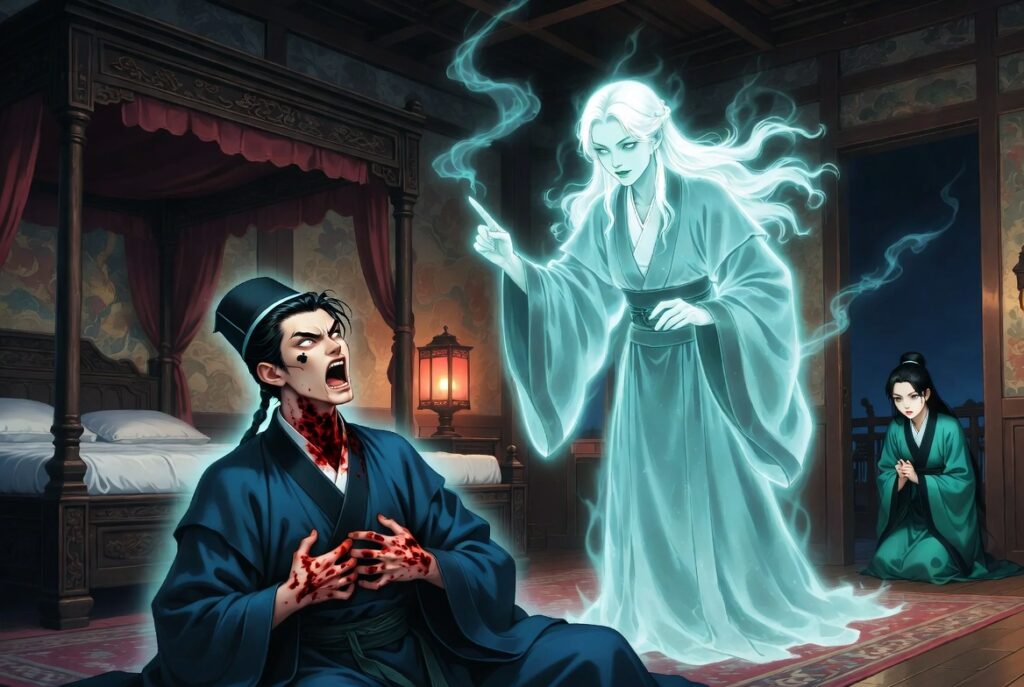
Do not say there are no ghosts or gods in this world, For they have existed among us since ancient times. They do not dwell in the mid-air above, But walk beside us throughout our lives. The spirit waxes and wanes with one’s own heart; If the heart is corrupt, the ghost runs wild. If you can trust in your own conscience, What ghost would dare open its mouth? When courage fails and the heart turns ugly, That is when ghosts come to hinder your path. Since the ghost is born of your own mind, You know that calamity is not a random blow from Heaven. Houses that accumulate virtue find lasting joy; Those who do evil find disaster strikes suddenly. A ghost strikes the neck, a god pulls the hand, All because an injustice had no place to be heard. I ask the people of this world today: Does such retribution not make you tremble?
Zhen-ge, having hidden at Yu Mingwu’s for over a month, returned home to find the legal battle won. When Lady Ji was alive, she was like the later Emperors of the Zhou Dynasty—weak, perhaps, but still a source of restraint for the powerful “feudal lords” of the household. Now that Lady Ji was dead, Zhen-ge was like a bee without a queen, reigning over the house with chaotic tyranny. She summoned spirits and scolded demons, cursed the servants’ wives, and beat the maids. Even the old madam who had originally sold her into the trade now came and went as a relative, with everyone addressing her as “Old Mother.”
If Chao Yuan dared to cross her in the slightest, she would throw a tantrum ten times more formidable than Lady Ji’s original methods of subduing her husband. Chao Yuan’s current fear of Zhen-ge was of an entirely different order than his previous fear of his wife. In years past, if Lady Ji and her mother-in-law planned to burn incense at the neighboring Niangniang Temple, Chao Yuan still dared to voice a few words of protest to stop them. Now, if Zhen-ge wanted to tour the lake, she gathered her companions and went; if she wanted to visit the Mountain of Ten Thousand Immortals, she went; if she wished to go to the Temple of the Ten Kings, she simply climbed into Chao Yuan’s grand sedan chair and set off, and no one dared bar her path. She also frequently visited the procuress’s house.
It happened that a certain Scholar Kong, a relative of the Chao family, had a death in his household. Since Lady Ji was gone, the Chao family had no “lady of the house” to pay a visit of condolence, so they intended to let the matter rest. Little did they know that Zhen-ge, possessing a wealth of pearl and emerald jewelry and embroidered silks with nowhere to display them, insisted on dressing up to offer condolences at the Kong residence. Chao Yuan complied completely, preparing the grand sedan chair and assigning her two maids and two wives of his stewards.
Dressed in her finest and flanked by her entourage, Zhen-ge arrived at the Kongs’ inner gate and stepped out of her chair. The gatekeeper struck the drum twice. Scholar Kong’s wife hurried out to receive the guest, but the moment she recognized it was Zhen-ge, she pulled back and stopped in her tracks. Once Zhen-ge reached the altar and performed her bows, Scholar Kong’s wife offered a half-hearted, dismissive acknowledgment. She felt she had no choice but to stiffly offer a seat and tea.
Scholar Kong’s wife remarked, “When the servants reported that ‘Madam Chao’ had arrived, I was confused. I thought, ‘When did our Chao relative take a new wife? How could there be a Madam Chao already?’ So it’s you! I suppose you’ve been ‘elevated’ to the main hall then? If I were to advise our Chao relative, I’d say he still ought to marry a proper, respectable wife so that we relatives can socialize comfortably.”
In the middle of this, the drum sounded twice more, signaling another female guest. Scholar Kong’s wife called out to her servants, “Take a good look this time; make sure it isn’t another ‘Madam Chao’ arriving!” Though she spoke mockingly, she personally flew outside to greet the newcomer. After the condolences were offered, she showed a level of reverence and gratitude that was nothing like the treatment she gave Zhen-ge. She invited the new guests in for tea—it was the wife and daughter-in-law of the retired official Xiao. Their attire was far less grand than Zhen-ge’s, and their retinue was quite small.
Upon seeing Zhen-ge, they exchanged bows. Lady Xiao asked Scholar Kong’s wife, “Which relative is this lady? Her face is familiar, but I cannot quite place her at the moment.”
Scholar Kong’s wife replied, “Familiar indeed. This is our Chao relative’s favored lady.”
Lady Xiao exclaimed, “Ah! You’ve changed so much I didn’t recognize you!” Being an elder and refined, Lady Xiao was not as youthfully flippant as Scholar Kong’s wife; she bowed twice more to Zhen-ge and added, “How lovely for you!”
As they sat, Zhen-ge’s face turned a kaleidoscope of colors—blue, purple, green, and red—out of sheer humiliation. She stood to take her leave. Lady Xiao said, “Are you perhaps offended by me? Why leave just as I arrive?”
Zhen-ge replied, “There is much to do at home. We shall meet another day.”
Scholar Kong’s wife did not even bother to see her out. It was Lady Xiao who suggested, “Shouldn’t someone escort her to the gate?”
Scholar Kong’s wife said, “She’s practically family; I won’t bother.” She called over a generic old helper-woman and instructed, “You go see ‘the Chao lady’ out.” Zhen-ge departed in a fury.
Lady Xiao remarked, “She has blossomed into someone far more striking than before; I truly didn’t recognize her. I suppose she has been elevated to the main hall?”
Scholar Kong’s wife replied, “Our Chao relative has no sense of propriety! He should have done things properly and married a respectable lady of the house who could handle social obligations and manage the family. He should keep that one at home to play with like a puppet—why bring her out? It puts everyone in an awkward position. I’m going to settle scores with the gatekeeper later! He kept shouting ‘Madam Chao is here,’ making me think he’d remarried in a flash. I went running out in a panic, only to find it was her! I barely paid her any mind.”
Lady Xiao countered, “The gatekeeper only saw that grand sedan chair and such a large retinue; how was he to know who she was? When someone comes to our house, regardless of their status, we should treat them with standard courtesy. It is out of respect for our own elders, not for her sake!”
Meanwhile, Zhen-ge—who had dressed up like a celestial goddess expecting the Kong family to treat her with immense deference—had instead “bearded the lion and come back with a face full of ash.” She returned home with a face as yellow as a tiger’s, her mouth puckered in a sullen pout, looking for all the world like a grieving victim from the Ji family. She tore off her head ornaments, stripped off her fine robes, and sighed with heavy, resentful breaths. Chao Yuan, oblivious to the cause, asked after her with humble concern.
Zhen-ge snapped, “I’m just not feeling well! ‘How are you,’ ‘What’s wrong’—on and on you go! Come to think of it, being a concubine is a lowly business; I’d have been better off sticking to my old trade!”
Just as she was looking for a reason to explode, Li Chengming’s wife—who had absolutely no sense of timing—asked Chao Zhu’s wife to go find out how much rice to measure for lunch. Chao Zhu’s wife, a woman who knew better than to “poke a hornet’s nest,” said, “Why don’t you go ask? Always trying to order me around!”
It was Li Chengming’s wife’s misfortune to walk right into the trap. Clutching a winnowing basket and a measuring peck, she approached and asked “Auntie Zhen” how much rice to measure for the noon meal.
Zhen-ge’s eyes bulged and her eyebrows shot up in fury. She wished she could condense ten thousand curses into a single sentence—one that would melt Li Chengming’s wife into a puddle of pus on the spot. She screamed:
“You foul, stinking, home-grown whore! You mangy bitch, you open-door donkey who’s entertained ten thousand men! What is this ‘Auntie Zhen’ and ‘Fake Auntie’ nonsense? If you’re going to call me anything, call me ‘Madam’! If you won’t, then shut your dog mouth and get the hell away from me! What do you mean, ‘Auntie Zhen’? You thieving slave! How many ‘Aunties’ do you have in your house?
“Back when that dead piece of trash (Lady Ji) was here, you could call me whatever you liked, but now that the dead trash is gone, you’re still ‘Auntie Zhen, Auntie Zhen’! If my own slaves treat me like a nobody, how can I expect outsiders not to despise me? You thieving bastard!” she turned her fury on Chao Yuan. “I see your game! You’re encouraging these slaves to slight me because you’re planning to find another wife! Was that the talk of those foul-mouthed bitches at the Kong house? I’ll raise such a hell that your ancestors through nine generations won’t find peace in heaven! Don’t you dream of putting a main wife over me—I wouldn’t even let you put a concubine under me!
“From now on, I won’t have anyone calling me ‘Auntie Zhen’! And I won’t have that dead trash’s body sitting in the main hall! Tell someone to haul her to the back side-room and dump her there! And take down those white silk mourning hangings—I’m going to use them to make some undergarments!”
She began screaming for people to move Lady Ji’s coffin.
Chao Yuan pleaded, “Calm yourself for a moment! This business isn’t over yet! Old Man Ji and his son are making a massive noise outside, saying they’re going to take this to the Circuit Intendant. Even if he filed a petition to the Emperor, I wouldn’t fear him, but I am afraid of a lawsuit at the Circuit level.”
Chao Yuan pleaded, “If the Circuit Intendant deals us a heavy blow, what amount of silver could suppress it? What influence could smooth it over? He’s as incorruptible as Judge Bao himself!”
Zhen-ge snapped, “What a load of horse farts! Did I beat that home-grown whore to death? Go ahead, drag her out, flip the corpse, and examine her bones! If there’s a single wound, I’ll pay with my life! If there isn’t, I’ll grind her bones to ash and scatter them!”
Suddenly, she began slapping her own face violently. Her voice warped into a different register, rasping: “You filthy, low-born whore! Whose coffin are you flipping? Whose bones are you grinding to ash? You deceitful bitch! I tell you, your calamity is right under your nose! Go ahead, keep acting out—I’ll be waiting. You bastard’s whore! You want to flip my coffin, burn my bones, and turn my mourning hangings into undergarments?” She proceeded to slap herself repeatedly until her mouth turned purple and began to swell.
Chao Zhu’s wife cried out, “This is bad! The Young Mistress has possessed her! Listen—is that Auntie Zhen’s voice? That’s the Young Mistress speaking! Everyone, come here and kneel!”
The possessed Zhen-ge shouted, “She hates being called Auntie Zhen, yet you call her that again! Since the whore won’t kneel, you kneel in her place! Give yourself fifty slaps for me! Count them out!”
Zhen-ge then walked down to the lower area, knelt bolt upright, and began counting: “One, two, three, four, five, six…” She slapped her own face twenty-five times on each side until her cheeks were as bright and swollen as a monkey’s backside.
Then, Zhen-ge shrieked, “Pull out the filthy whore’s hair!” and began tearing out her own hair in large clumps. The maids and wives knelt in a circle, kowtowing and begging for mercy.
Zhen-ge sneered, “You treacherous slaves! ‘When old Yan Gong crosses the Western Seas, he can’t even save himself’—how dare you beg for others!”
The servants banged their heads against the floor until they thudded, crying, “Young Mistress! When you were alive, you might not have known what was in our hearts, but now that you are a spirit, surely you can see who has a conscience and who doesn’t? Ever since you left us, which of us hasn’t wept for your injustice? Who would dare be so cruel?”
Zhen-ge barked, “Don’t you old hags try to argue! Why is it that when my two maids fell into your hands, you all shared noodles and roasted cakes while you gave my girls nothing but thin rice water? And Li Chengming’s wife—you took my crown! Why did you let your children use it as a kickball? You followed that whore’s lead and didn’t even offer me a single bowl of soup or rice! Master and slave are equally cold-hearted! Strip the whore’s clothes!”
Following the command of her own voice, Zhen-ge stripped her upper garments completely, exposing her snow-white skin and full breasts. Chao Yuan stood by, watching the spectacle, paralyzed with terror.
Zhen-ge shouted again, “You filthy whore! Have you no shame? Strip the trousers, too!”
The servants scrambled to kowtow and pray: “Mistress, please, at least spare her the trousers! Would it really please the Mistress to have her kneeling here stark naked?” They looked at Chao Yuan and cried, “Master! Why are you just standing there? Quickly, kneel to the Mistress and help us plead!”
Just as Zhen-ge was about to pull down her trousers, she spoke to herself again: “Very well, I shall spare the whore her trousers for now!”
Chao Yuan knelt as stiffly as a post and pleaded, “I was misled by others’ words that day, but once things were cleared up, I let it drop. It was you who lacked the patience and sought your own end. I spent two or three hundred taels on your coffin and used white silk for the mourning hangings, planning to give you a truly grand send-off.”
Zhen-ge (the ghost) retorted, “As if I care for your white silk hangings! It’s enough to make a person die of rage—she actually wanted to take them down to make undergarments! It’s bad enough you act wickedly at home, scolding the servants, but when she opened her mouth to call Lady Kong a ‘whore’ and a ‘beggar,’ you just listened? Did you not have a single breath of protest in your nose? You hounded me to death without paying with your life, and then you used silver to frame my father and brother! During the trial the other day, if my grandfather, the First-Rank Scholar Ji, hadn’t entreated the Duty Officer of the Underworld to protect them, wouldn’t they have been beaten to death by that corrupt official?”
Chao Yuan could only keep kowtowing. “Since you are now a spirit, why stoop to the level of us mortals? If you release your hold, I will have sutras chanted for you for ten days. I’ll spend another two hundred taels to buy an outer casket and build a charcoal-lined tomb, and I’ll return the land to your father immediately. If I ever dare to be cruel again, you may possess me once more.”
Zhen-ge said, “Why would I bother possessing you? Your true nemesis will come for you soon enough. How much longer do you think your good luck will last? I’ll let the wicked deal with the wicked!”
Chao Yuan pleaded, “We were husband and wife; we had our good times. Do not hold a grudge against me. Protect me from the shadows instead, and I shall burn incense and tend your altar faithfully.”
Zhen-ge commanded, “Quickly, burn the spirit-money! Pour the ritual water and send me back to the inner chambers! If it weren’t for this slave being so utterly heartless, I would have waited for others to deal with her and wouldn’t have bothered with her myself!”
They burned a great many paper ingots and poured out two ladles of ritual water, then went before the coffin to burn incense and paper. From that day on, offerings were made twice a day; no one dared be negligent again, and Chao Yuan never again dared to plot against Old Ji and his son.
Zhen-ge fell silent and collapsed to the ground as if struck by a sudden illness. Her face was so battered and swollen it resembled the fierce Marshal Wen of the underworld. Without even dressing her, they carried her to the bed, covered her with a sheet, and she fell into an unconscious stupor. It wasn’t until the lamps were lit that she gradually came to. Her entire body felt as if it had been bound for a month and beaten a thousand times; the swelling in her face was unbearable.
She remembered nothing of the day’s events. After others recounted the story to her, she called for a mirror and caught a glimpse of herself by the lamplight, recoiling in horror. Though the possession had ended, her mind remained clouded, and her body felt as if she were drifting on clouds in mid-air. They sent someone out to fetch a dose of “Spirit-Calming and Soul-Settling Decoction” from Yang Guyue. Even the next day, she remained in a wretched state.
Meanwhile, Wu Xiaochuan and Shao Cihu collected the fines from Chao Yuan’s household and paid them into the treasury well before the deadline. The two nuns, following the Magistrate’s cynical advice, went door-to-door begging for alms. The ladies of the great houses gave so generously—three taels here, five taels there—that after paying their ten-tael fines and the extra “wastage” fees, each nun pocketed an extra twenty or thirty taels. They couldn’t stop chanting prayers of thanks for the Magistrate.
However, the trouble remained with the “eight reams of large paper” for Ji Du and his son. It required a total of sixty taels of silver to settle. Even though Lady Ji had left them those few taels before her death, how could they dare use them openly? They had to wait for Chao Yuan to return the land so they could sell it and pay the court.
Chao Yuan, however, argued, “The Magistrate only ordered the return of the land; he didn’t mention the standing crops. The yellow and black beans haven’t been harvested yet. I’ll hand over the land in the tenth month once the beans are in—that’ll be soon enough.” He used every trick in the book to stall and harass them.
Wu Xiaochuan and Shao Cihu, acting on Chao Yuan’s instructions, subjected the Ji family to humiliations and abuses that a thousand words could not fully describe. One day, they descended upon the Ji house again. Ji Du and his son happened to be out, so Wu Xiaochuan threatened to drag Ji Bala’s wife to court to be imprisoned as a guarantee for the fine. Just as they were about to use force, Ji Bala returned. He pleaded and begged until the runners finally showed a hint of relenting.
Ji Bala said, “Chao Yuan’s silver must be paid by now. And those two nuns’ silver surely hasn’t been fully collected yet. Is it really only my father and I who are in arrears?”
Wu Xiaochuan, filled with spite, reached into his boot-lining and pulled out a small leather book-folder. He flipped it open among many warrants and picked out the final sentencing sheet. Every name on the list, including the two nuns, was marked with the word “Settled”—except for Ji Du and Ji Bala. He showed it to Ji Bala, saying, “If yours weren’t the only names left, why would I be in such a hurry? Once this is finished, can we not be friends and kin again?”
As he spoke, he tucked the folder back toward his boot. However, he missed the opening; thinking it was secure, he let go, and the folder fell silently to the ground. Ji Bala quickly loosened his cotton skirt-belt, sucked in his belly, and stepped forward. Letting his skirt slip as if by accident, he bent down to “retrieve his clothing” and deftly slid the folder into his sleeve.
Wu Xiaochuan, still putting on an air of arrogance, gave him a three-day ultimatum to produce the silver, threatening that any further delay would result in a formal report to the Magistrate and the imprisonment of his family.
Once Wu was gone, Ji Bala hurried to his room to examine the contents. Inside were over a hundred warrants—some for arrests, some for sentencings. There was also a folded calling card that read: “The suspects in the case of Chao Yuan have been gathered and are awaiting trial.” On the side, written in vermilion ink, were the words: “Quickly exchange this for sixty taels of leaf gold for the restoration of a holy statue; deliver it today to receive the price.”
Ji Bala realized the truth. “Why would a request for gold be written on a legal filing?” He recalled a day at the money exchange when he saw Chao Zhu trading for gold. “When I approached, Chao Zhu said he’d come back later to finish his business. I asked the money changer what he was doing, and he said Chao Zhu was looking for fifty or sixty taels of gold in a great hurry. So this was the scheme! These two dogs, Wu and Shao, have tormented us enough—losing these official warrants will certainly give them a taste of their own medicine!”
He then thought, “Wu Xiaochuan is even more vicious than Shao Cihu. He’ll realize I picked it up, and when he can’t get it back by asking, he’ll search the house by force. If he finds it on me, he’ll claim I robbed him of official documents.” He lifted a corner of his bed, pried up a brick, dug a small hole, and hid the folder inside. He reset the brick and placed the bedpost firmly over it, leaving no trace.
He had just finished when Wu Xiaochuan and Shao Cihu burst back in with two extra assistants, along with Wu’s wife, daughter-in-law, and two married daughters. They charged in like a whirlwind. Wu slammed Ji Bala against the wall, shouting, “You pretended to pick up your skirt but cut my boot-strap and stole my warrant folder! Return it at once!”
He sent his “female generals” to strip-search Ji Bala’s wife and ransack the bedroom, while he searched Ji Bala himself. They turned the place upside down, but they found absolutely nothing.
Ji Bala exclaimed, “This is like seeing a ghost in broad daylight! If you had found it just now, I would have been content to die at your hands. But since you found nothing, by what right did you lead this mob, ignoring all boundaries of inner and outer chambers, to grope a woman’s body so thoroughly?” He grabbed a bronze washbasin, bolted the street gate, and began beating the basin like a drum, shouting, “Runner Wu Xiaochuan has led a mob of men and women to ransack a private home in broad daylight!”
A crowd of thousands—neighbors, locals, and passersby—swarmed the spot. Ji Bala recounted the events to them one by one. But as soon as the people heard the name of the county horse-runners, who were like the Living King of Hell on earth, they shut their mouths tight and slipped away. Only a few dozen remained. Ji Bala opened the gate and let them in, where they indeed found twelve or thirteen men and women maliciously searching the premises. None of them dared to say a word about the illegality of leading such a mob into the sleeping quarters or searching the person of a lady; they merely offered lukewarm, evasive words of mediation.
Wu Xiaochuan searched everywhere outside, failing only to flip over the very earth itself. His pack of women searched within Ji Bala’s wife’s undergarments, her bosom, and even the cloth wrappings of her legs; they felt every inch. They overturned the area behind the bed, under the mats, inside chests, cabinets, and dressing cases—even tossing out her sleeping shoes and her “Mother Chen” (sanitary accessory). Yet, the warrant folder was nowhere to be found. Ashamed and frustrated, the mob finally dispersed. Ji Bala shouted after them, “You come to my door to humiliate my family? Do not think that because you are Wucheng horse-runners—even if it were the Magistrate of Wucheng himself—I would still file a suit against you!” Wu Xiaochuan and Shao Cihu, knowing they were in the wrong, grumbled a few defiant remarks before leaving. Ji Bala thought to himself, “I must pay off the silver immediately; otherwise, my words will carry no weight against them!”
It was the time of Emperor Jingtai’s ascension, and a Great Grace had been proclaimed, resulting in promotions and gifts for officials near and far. At that moment, pearls were as precious as rare medicine. Ji Bala took the two pearl headbands Lady Ji had entrusted to him to an antique shop to be appraised and exchanged. Unexpectedly, the market for such high-quality goods was booming, and people scrambled to buy them. After the merchant, Old Chen, took a cut of twenty or thirty taels, Ji Bala was still left with seventy-six taels of silver. He walked to the horse-runners’ quarters by the yamen, but found it eerily quiet with not a soul in sight. He proceeded to the treasury gate, where he found only a single clerk named Zhang sitting in silence, guarding the vault. Ji Bala greeted him and stated his intent to pay the fine for the “large paper.” Clerk Zhang replied, “You must bring the original runners and the warrant. I will collect the amount according to the warrant, enter it into the ledger, and stamp your name with the seal of ‘Settled.’ Without the runners here, I could take the silver, but you would have no proof of payment.”
Ji Bala left and found the rest of the county offices equally deserted. Passing the Rites Office, he saw a man with a yellow ritual petition in one hand and a key in the other, opening the door. It was Ji Bala’s cousin, Fang Qianshan, a clerk in the Rites Office. Fang invited Ji Bala inside and asked his business. Ji Bala explained, “I brought silver to pay the paper fine.” Fang asked, “Is it paid?” Ji Bala replied, “The clerk wouldn’t take it without the runners present.”
Fang Qianshan said, “Wait a few days with that silver. Watch how the wind blows before you pay. Currently, the Magistrate has developed a massive, lethal carbuncle on his back; his condition is critical. Yesterday, a famous surgeon named Yan was brought from the Prince of Lu’s estate. After examining him, the surgeon called it a ‘Carbuncle of Heavenly Retribution for Injustice.’ He said that unless there is sincere prayer to the gods, medicine is useless. He wouldn’t stay and left. Privately, he whispered: ‘This sore cannot be cured; within ten days, it will rot through to his heart, liver, and vitals.’ I have just come from the City God Temple to have Daoist Master Cui write a petition to be sent into the yamen; they are going to perform a seven-day ritual to pray for his life.”
Ji Bala said, “I haven’t heard a word of this. When did he fall ill?” Fang Qianshan replied, “How could you not know? He began feeling unwell on the very day he passed judgment on your lawsuit. He managed to take the bench for three or four more days, but for the last five days, he hasn’t been able to move at all.”
“On the day of the trial,” Fang Qianshan continued, “I was certain both you and Uncle Ji would receive at least twenty-five strokes each. But after the Magistrate reached for the bamboo slats, he suddenly hesitated, gave Uncle Ji a verbal scolding instead, and stayed his hand. Everyone was baffled. As it turns out, there was a reason:
“They say as he reached for the slats, he saw a man in a red robe with a long beard physically pressing his hand down. Since returning to his private quarters, that red-robed spirit has appeared to him constantly. They even offered sacrifices of pigs and sheep, but as the spirit departed, it struck him across the back. Immediately, his mouth turned bitter, his body grew feverish, and a swelling the size of a bowl rose on his spine. They say the spirit has a two-foot beard and a black mole on its left temple. This is what the servants are whispering in secret—inside the yamen, they are trying to keep it quiet to prevent the news from leaking out.”
Ji Bala exclaimed, “Based on that description, that spirit is clearly my grandfather! My grandfather had a beautiful three-strand beard, exactly two feet long, and looked like a celestial immortal. He had a black mole the size of a coin on his left temple. But how did he manifest such power? And why were you so sure the Magistrate intended to beat us that day?”
Fang Qianshan replied, “How could you not know? That day, while I was waiting for drafts by the yamen communication tube, a steward peered out and mistook me for someone else. He handed me a petition—it was the report from Wu Xiaochuan and Shao Qiangren stating: ‘The suspects in the case of Chao Yuan have been gathered and are awaiting trial.’ Usually, when such a report goes in, a deal has been struck. I held it up to the sunlight and saw the number ‘Five Hundred’ written under the vermilion date-mark. Beside it, the Magistrate had written: ‘Quickly exchange this for sixty taels of leaf gold for the restoration of a holy statue.’ It meant he thought five hundred taels of silver was too little and demanded sixty taels of pure gold on top of it. The Chaos spent half the day scouring the city for gold—everyone was talking about it!”
“What happened to that paper?” Ji Bala asked.
“I happened to run into Wu Xiaochuan on my way out and gave it to him,” Fang said. “Having received such a massive bribe, why wouldn’t the Magistrate beat you? He even gave a large sum to the bailiffs that day, instructing them to lay the punishment on heavy. If not for Old Master Ji’s spirit protecting you in the shadows, you might not have died, but you certainly would have lost a layer of skin!”
Ji Bala said, “Cousin, since you knew all this in such detail, why didn’t you send me word so we could prepare? So much for us being brothers!”
Fang Qianshan replied, “Cousin, you didn’t know anything! You didn’t even remember you had a cousin like me, nor that I was in the Rites Office. If I hadn’t called out to you just now, you still wouldn’t realize I existed! Where was I supposed to find you to deliver the news?”
Ji Bala then asked, “Wu Xiaochuan and Shao Cihu haven’t come to harass me for three or four days now. Do you know why?”
“You think Wu and Shao dare show their faces now?” Fang said. “All those arrogant horse-runners are hiding in silence. They’re terrified that their many enemies will take this chance to seek revenge or demand their bribes back!”
While the two were talking animatedly, two or three “blank-headed” (urgent/unsealed) warrants were sent out from the inner yamen: one ordered the Works Office to find the finest cedar planks from the lumber shops; one ordered the purchase of two hundred bolts of plain white cloth and two hundred bolts of white shuttle-woven cloth; and one requested ten bolts of white silk. Furthermore, the Rites Office was ordered to immediately submit the ritual petitions, for a grand sacrifice would begin tomorrow morning:
- Day 1: The Magistrate’s own relatives will lead the incense offering.
- Day 2: Local gentry, scholars, and degree-holders.
- Day 3: Teachers and students of the local academies.
- Day 4: Clerks and scribes of the Six Offices.
- Day 5: Bailiffs, runners, and all yamen staff.
- Day 6: Merchants and guilds from the city and the four suburbs.
- Day 7: The common people at large.
On the seventh day, no fewer than two or three thousand commoners gathered. This was largely due to the efforts of the acting granary official, who, filling a vacancy, dispatched every bailiff and runner in the yamen. They brandished their placards and warrants, threatening to arrest and beat anyone who failed to appear. Thus, by squeezing three cents from one and five from another, they managed to amass several dozen taels of silver. After the official and the bailiffs took their cuts, five or six taels remained to pay the Taoist priests for their daily ritual fees.
When Ji Bala returned home and recounted everything to Old Ji, they finally understood the hidden sequence of events. They immediately bought paper ingots and prepared a ritual meal to kowtow in thanks to the spirit of their father, the First-Rank Scholar Ji, for his secret protection. From that day forward, Wu Xiaochuan and Shao Cihu never again dared to cross their threshold to harass them. Furthermore, those sixty or seventy taels intended for the “paper fine” were saved from being “thrown into the water,” thanks to the timely tip from their cousin in the Rites Office.
Two or three days later, word indeed traveled out from the yamen: that “honest and impartial” Magistrate of Wucheng had met the fate predicted by the surgeon Yan. The carbuncle had rotted into a hole as large as a bowl and half a foot deep, until his heart, liver, and vitals literally spilled out. The coroners found it impossible to even encoffin the body in such a state. They were forced to take a fresh sheepskin, slap it whole over the gaping wound, and painstakingly sew it to his surrounding flesh and skin before he could be placed in the casket.
After the five-seven mourning period (thirty-five days) and numerous commemorative rituals, the family obtained their travel permits and escorted the coffin toward their home in Jizhou. However, as they reached Yongping Prefecture, they happened upon the forces of Esen, who was escorting the captive Emperor Zhengtong in an invasion. The massive caravan of mules, horses, and carts carrying their ill-gotten treasures was plundered—leaving the family “pure and singular” in their poverty, without a trace of “private human desire” left to them. Fortunately, the family members were quick to hide, so everyone survived unharmed. Thanks to the Magistrate of Lulong, a fellow countryman, the coffin was given a temporary burial, and the family was pulled over the city walls to safety in a government hostel. They waited until Esen retreated beyond the Great Pass before gathering supplies to return to Jizhou.
Truly it is said: Evil men are ground down by evil men; what is stolen by a thief is taken by a bandit. One knows that Heaven’s calculations surpass human schemes, and in all things, the Old Man at the Border knows that a loss may be a gain.
Translator’s Note:
The Drum (司門鼓): The sounding of the drum at the gate was a formal announcement of a guest’s arrival. The number of beats often corresponded to the guest’s perceived status.
“Elevated to the Hall” (扶過堂屋): This is a sarcastic reference to the fǔzhèng (扶正) process, where a concubine is promoted to the status of legal wife after the original wife dies. In gentry circles, this was often looked down upon, as Scholar Kong’s wife makes brutally clear.
The “Monkey’s Backside” (猢猻屁股): This earthy, humorous simile is typical of the novel’s grit, contrasting the horrific nature of the self-mutilation with a vulgar visual to keep the tone grounded in the “fleshly” world.
Yan Gong (晏公): The reference to “Yan Gong crossing the Western Seas” refers to a sea deity. The idiom implies that when the situation is so dire that even a god is struggling, petty mortals have no business trying to save anyone else.
Marshal Wen (溫元帥): A blue-faced, fierce-looking guardian deity. Using this comparison for Zhen-ge’s face emphasizes the physical brutality of the “possession.”
Spirit-money and Ritual Water (楮錠, 漿水): These are the standard “payments” to pacify a restless ghost. Chao Yuan transitions from a husband to a fearful supplicant, showing how the domestic power balance has been utterly shattered by the supernatural.
The Vermilion Note: This is the ultimate proof of bribery. In the legal system of the time, the Magistrate’s vermilion brush was only for official rulings. Using it to demand “gold for a statue” (a bribe) on a case-related document was a high-risk criminal act of corruption.
- 馬快 (Mǎkuài): “Horse-runners.” Elite yamen runners or mounted police responsible for making arrests and enforcing court orders.
- 覃恩 (Tán’ēn): “Great Grace.” An act of imperial clemency or a general amnesty often granted when a new emperor ascends the throne.
- 發背大廱 (Fābèi dà yōng): “A massive carbuncle on the back.” In traditional Chinese literature, this specific ailment is frequently used as a symbol of divine punishment (kěndào) for corrupt or cruel officials.
- 天報冤業瘡 (Tiānbào yuānyè chuāng): “A sore of heavenly retribution for past injustices.” A direct diagnosis that the illness is supernatural and caused by the Magistrate’s moral failings.
- 白頭票 (Báitóupiào): “Blank-headed warrant.” An urgent administrative order issued without the usual formal headers, often used for emergency procurement or immediate action.
- 三花美髯 (Sānhuā měirán): “Beautiful three-strand beard.” A classic description of a dignified, scholarly, or deity-like appearance.
- 道場 (Dàochǎng): “Ritual Arena” or “Taoist Rite.” A grand religious ceremony performed to pray for healing, salvation, or the pacification of spirits.
- 主醮行香 (Zhǔjiào xíngxiāng): “Leading the sacrificial incense.” The act of officiating or serving as the primary patron of a religious ceremony.
Proverbs
- 神不靈,提的靈 (Shén bù líng, tí de líng): (Implied context from previous chapter) “If the god isn’t effective, the intermediary is.” Refers to how the power of a superior is often manifested through their subordinates.
- 捲土重來 (Juǎn tǔ chóng lái): “To return with the dust swirling.” To make a major comeback after a defeat (referenced in the transition to this chapter).
0 Comments