

Chapter 10: The Wealthy Imperial Student Resorts to Bribery; The Tyrannical County Magistrate Accepts Kickbacks
by Angie Bellender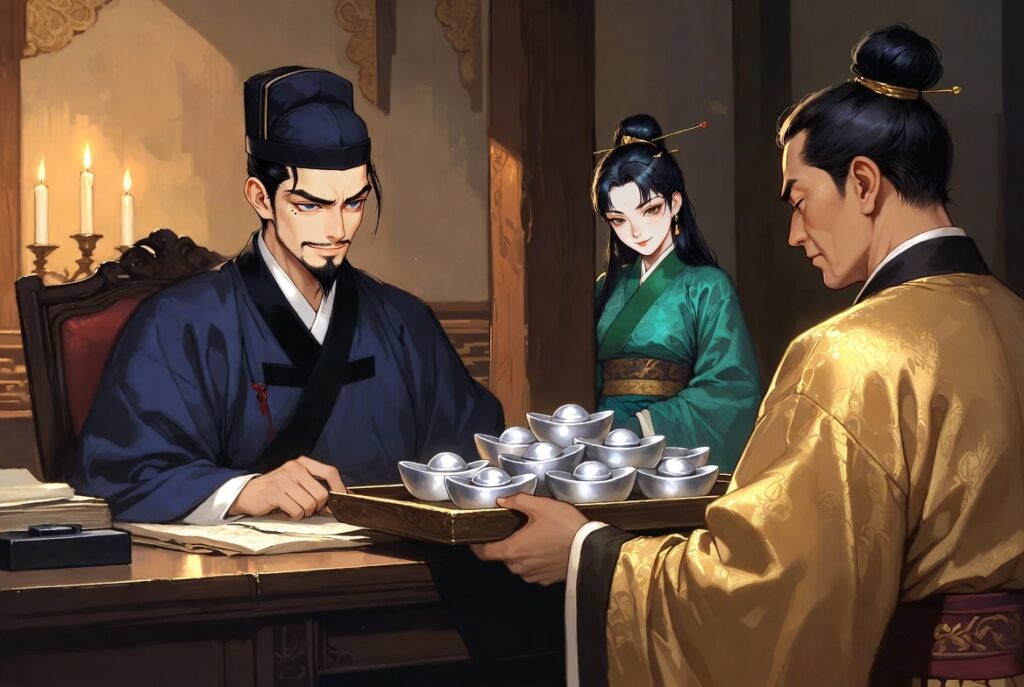
Of the three virtues of an official, integrity is the foremost beauty. Only by strictly observing the “Four Hidden Truths” can one be a gentleman. To pervert the law and accept bribes is to lack honor and shame. Disregarding human suffering, blurring the path of divine reason. Public opinion is overturned, right and wrong are brought to ruin. Despised by mankind, shunned by the scholarly forest. A bandit in official robes, the fragrance of books turned to stench. People’s resentment pierces the heart; the gods’ anger enters the marrow. When one’s evil deeds are full to the brim, how can death be avoided? Then there are the commoners, who stoop to any depth: Arrogant in judgment, burying the truth, engaged in theft and fraud; Relying on influence and wealth, acting with reckless depravity. Ten thousand evils reside within, every sin fully prepared. A favored concubine acts the clown, hounding a wife to hang herself. The body falls into the clutches of the law, yet is expert at drilling for loopholes. Managing the yamen, trapping officials in unrighteousness. Heaven’s net is not loose; the Recording Officer keeps careful note. Retribution is self-evident, a great delight to all.
Now, within the Ji clan, there was a man named Ji San. He was a greedy and wicked person, and an elder of Old Ji’s generation. Although the clan loathed him, they also feared him. When Chao Yuan saw that Old Ji’s petition had been accepted, he intended to use Ji San to “withdraw the troops.”
The following evening after the lamps were lit, Chao Yuan sealed up twenty taels of silver and had Chao Zhu tuck them into his sleeve. He went to Ji San’s house to ask him to mediate a settlement: he offered to return one hundred taels to Old Ji as a refund for the original dowry, give an extra twenty taels to Young Ji (Ji Bala), and return all the dowry lands—including the twenty mu Old Master Chao had sold off—by redeeming them and handing them back.
To everyone’s surprise, Ji San suddenly found his backbone. He declared, “If you want to settle, go talk to Old Master Ji yourself. Although I’m usually like a fly drawn to blood when I see silver, I refuse to sell my own granddaughter for cash! I’m not afraid of wicked men, but I am a bit afraid of ghosts who died of injustice!” After a few choice words, he turned and walked back into his house.
When Chao Zhu returned with this news, Chao Yuan realized the matter could not be suppressed. Knowing he could no longer hide it from his parents, he dispatched Li Chengming to ride through the night to Tongzhou to inform Old Master Chao. He needed his father to send letters to rescue him immediately, fearing he would lose the case and his reputation.
Meanwhile, he sent out invitations and laid out a lavish feast for the two runners. He gave them forty taels of silver each, one tael to each groom, and five taels to each of the assistant runners. Having bribed the whole lot to be “of one mind” with him, they agreed not to submit the case documents yet, waiting specifically for the letters from Tongzhou.
Finally, on the second day of the seventh month, Old Master Chao finished his letters and dispatched Chao Feng with a large sum of silver and Li Chengming to manage the bribes. The next morning, they arrived at the county yamen and found the Yin-Yang Clerk (the official intermediary). Knowing this was a letter regarding a life-and-death case, the clerk intentionally made things difficult, squeezing six taels of silver out of them before he finally agreed to deliver it.
When the County Magistrate opened the letter and read it, he flew into a towering rage. He shouted for the Yin-Yang Clerk to be brought in and gave him fifteen sharp strokes of the bamboo. Then he bellowed for the original runners. Wu Xiaochuan and Shao Cihu, sensing the news was bad, didn’t dare go up themselves and sent two assistants to answer the summons instead.
The County Magistrate, refusing to listen to explanations, immediately called for the finger-crushers (torture racks), shouting: “A human life is a grave matter! The warrant was issued twenty days ago, yet you have not brought the parties to trial, allowing the criminal to seek favors everywhere. How much money did you two slaves take to dare sell the law so boldly?”
The two outside runners argued desperately: “The Imperial Student Chao Yuan was mobbed and beaten by Ji Du and his clansmen; his injuries are so severe he hasn’t left his bed. Furthermore, many of the women named in the accusation are using aliases, and the witness Yu Chengxian has gone to the provincial capital for his shift. That is why the filing was delayed. We would never dare take bribes or show favoritism!”
The Magistrate barked: “I shall spare you the torture rack for now, but I limit you to tomorrow to bring everyone for trial! If you dare disobey again, I will have you beaten to death!”
Truly it is said: When you can let go, let go; where you can spare someone, spare them.
Wu Xiaochuan and his partner flew to see Chao Yuan. Chao Yuan already knew that the Yin-Yang Clerk had been beaten and that the runners had nearly been tortured. While he was panicking, his two “trusted” runners arrived and said, “Master Chao, have you heard? Those few taels of silver you gave us were practically life-saving money! If we had been beaten to death just now, there’d be no one left to spend your silver! You must make a decision quickly, or this case is going to go very badly for you!”
Chao Yuan replied, “After all, the woman hanged herself and has already been encoffined. What ‘grave charges’ could possibly come of this? Besides, I am from a family of acting officials—surely he must show some respect for our status?”
Shao Cihu countered, “How could he not? If he truly weren’t going to show respect, that Yin-Yang Clerk would have received fifty strokes instead of fifteen!”
“I understand the implication,” Chao Yuan said. “But how do we get the ‘offering’ inside?”
Wu Xiaochuan said, “With the two of us here, what is there that couldn’t get inside?”
“How much will it take?”
“It won’t be less than a thousand gold taels; anything less won’t move him!”
After much calculating and negotiating over the fees for every level of the yamen, they settled on a total of seven hundred taels of silver. The two runners left, promising to return that evening with news. They went to Wu’s house and folded a piece of paper, writing:
Your humble runners Wu Shengdao and Shao Qiangren report to Your Honor: The suspects in the case of Imperial Student Chao Yuan have been gathered and are awaiting trial.
At the top, they wrote the seventh month, and at the bottom, the character for “Day.” In the middle, where the official date-mark was supposed to go, they wrote in tiny script the words “Five Hundred.” This was the secret code recently established in Wucheng County for bribes. If the Magistrate agreed, he would take his vermilion brush and draw a thick date-mark over the “Five Hundred.” The intermediaries had their own “miraculous methods” to deliver the silver inside—unknown to men and hidden from ghosts. If the official thought the amount was too small, he would toss the paper aside and not return it, and the fixers would understand the hint and negotiate a new price.
That day, when the runners submitted the note, the Magistrate marked the date over the “Five Hundred,” but he also added a line of vermilion text on the side: “Quickly exchange this for sixty taels of leaf gold; it is needed immediately for the ‘restoration of a holy statue.’ Deliver it today to receive the ‘price’ (the verdict).”
The runners showed this to Chao Yuan, who had no choice but to comply. He dispatched men to various pawnshops and money exchanges to find the exact amount of high-quality gold and silver. Once the full sum was ready, he entrusted it to the two runners to deliver. Of the two hundred taels meant for “expenses,” fifty went to the delivering steward, ten taels each went to the outside runners, and one tael to each groom. The rest was split evenly between the two main runners.
The next morning, all the parties were gathered and the case was formally filed. The announcement went out: the first case on the docket was “The Defendant Chao Yuan and others.” After the second sounding of the signal bars, everyone waited before the county hall. Chao Yuan brought another twenty strings of copper cash to give to Wu Xiaochuan for grease throughout the yamen.
Because the Ji family were the plaintiffs, they also used some “influence money,” but the amount was pittance compared to Chao’s. Because Chao Yuan had “soaked” the yamen in money from the inside out, the staff didn’t treat him like a prisoner at all. Instead, he was treated like a gentry elder visiting the Magistrate. He was invited into the Guest Hall to sit in a high-backed chair, a page boy fanned him, and he was surrounded by a protective guard of his own servants.
The runners even invited the women of the party to sit in a pavilion behind the Guest Hall. The Record Office sent watermelons, the Punishment Office sent fruit, and the old caretaker of the Guest Hall served tea incessantly. It was truly an overwhelming display of hospitality.
The court had waited for some time before the County Magistrate finally took the bench. The attendant struck the jade sounding board, the treasury guards beat the “Ascending the Hall” drums, and the ceremonial gates swung open. Chao Yuan and the rest of the group knelt in order behind the second gate, facing the official placards.
The Magistrate called for the first witness, Yu Chengxian, but the runner knelt and reported: “He is a clerk at the granary office and has gone on duty.” Next, he called for Lady Gao (Gao Sishao).
The Appearance of Lady Gao
Her hair was as disheveled as a heap of wild greens, Her wrinkled face resembled a withered winter melon. She wore a coarse blue summer skirt and a plain black linen jacket. A headcloth hooded her messy locks; thick socks hid her large, sturdy feet. Boldly she knelt upon the stone platform, her voice ringing out with the truth of Heaven. Were it not for the Magistrate’s greed blinding his wisdom, Would not the crooked Student’s guilt have been plain as day?
The Magistrate barked, “Lady Gao, you must speak the truth! If you show any bias, my finger-crushers will show no mercy!”
Lady Gao retorted, “Your Honor, don’t be so unreasonable! I am a woman from a respectable family—on what grounds would you torture me?”
The Magistrate snapped, “An official tortures whom he pleases! What do I care for your ‘respectable family’?”
“That’s hard to say,” Lady Gao replied. “Even the Eight Vajra Warriors can’t move the weight of the word ‘Propriety’!”
“Fine, since you put it that way,” said the Magistrate. “Just tell the truth and why would I torture you? How did Lady Ji hang herself? Tell me what you know.”
Lady Gao said, “As for how she actually died, I don’t know. But I was there to persuade her during the uproar the day before.”
“Tell me about that uproar in detail,” the Magistrate ordered.
“My house is directly across from the Chao estate,” Lady Gao began. “Because they are a gentry family, we regular folks don’t go scraping around them, and I’ve never stepped foot inside. Only once, back in the eleventh month of the year before last, Lady Ji came to the gate to watch Master Chao go hunting; I saw her then, stood with a few neighborhood women, chatted a bit, and dispersed.
“Then, on the sixth day of the sixth month, I was at home with my trousers tucked up, reeling silk from some cocoons, when I heard a massive clamor in the street. I asked the children what was happening. They said, ‘It’s the wife of Master Chao across the street; they’ve had a row, and she’s at the gate screaming. The noise is from all the passers-by stopping to watch.’
“I thought to myself, ‘What a disgrace! The wife of a gentry family, so young, yet she has no regard for her reputation? What is this world coming to?’ I desperately wanted to go out and see, but my hands were busy with work. After a while, our neighbor Yu Mingwu came by and said, ‘Sister Chao across the street is in a fury and has run out into the main road. It’s most unseemly. We men can’t very well go and persuade her. Sister Gao, you must go; no one else can talk her down.'”
Suddenly, mid-sentence, Lady Gao complained, “This is a long story, and through these thin summer trousers, my kneecaps are killing me on this stone floor! Can I stand up and talk?”
The Magistrate relented. “Very well, stand to the side and continue.”
Lady Gao went on: “I told him, ‘I’ve been wanting to go out, but my hands were tied.’ I grabbed my skirt, threw it on, and hurried out. The street was packed solid—you couldn’t have fit a seal between the people! I had to shove with one hand and push with the other to reach their gate. Sure enough, there was Lady Ji inside the main entrance, a dagger in her hand, screaming that she wanted to trade her life for that of the ‘bastard’ and the ‘whore’!”
“Who did she mean by ‘bastard’ and ‘whore’?” the Magistrate asked.
“The bastard must have been Master Chao,” Lady Gao said, “and the whore must be Little Zhen-ge.”
“And who is this Little Zhen-ge?”
“The singing girl Master Chao took as his concubine,” Lady Gao replied.
The Magistrate asked, “Where did she perform as an actress?”
Lady Gao retorted, “Your Honor, there you go again! Haven’t you ever shared a drink with him? Haven’t you seen him watch a play?”
“Nonsense!” the Magistrate barked. “Keep talking. She was cursing—what happened next?”
Lady Gao continued, “I approached her and said, ‘Sister Chao, if we women don’t hold the high ground, how can our words carry weight or our husbands be managed? Is running into the street any way for a woman to behave? Get inside quickly! Speak your mind in the house.’ She tried to explain herself to me, but I said, ‘I’ve no patience to listen here; tell it inside.’ She cried out, ‘But I heard that whore incited him to divorce me!’ I cut her off and said, ‘Get inside! Just making this scene in the street is enough to justify a divorce.’ I spoke while pushing her back through the gates.”
“Where was Little Zhen-ge at that time?” the Magistrate inquired.
“With that kind of fury going on?” Lady Gao laughed. “Forget ‘Little Zhen-ge,’ even a ‘Little Fake-ge’ would have hidden! She was nowhere to be seen.”
“And where was Chao Yuan?”
“Master Chao was peering out from behind the second gate,” Lady Gao replied.
“What did he do when he saw her?”
“He just told the gateman, ‘Hold back the Young Mistress; don’t let her out into the street.’ He didn’t say another word.”
The Magistrate mused, “So Lady Ji was screaming at the gate, Chao Yuan was hiding behind a door not daring to speak, and Zhen-ge was nowhere to be found. It seems they were terrified of her. If she had vented her frustration so thoroughly, why would she still hang herself?”
Lady Gao shot back, “Look at this muddled Master! For example, if someone slandered you—saying you took bribes or were cruel—wouldn’t you be driven to wit’s end? Once you’re pushed to the brink, do you think the person who slandered you would dare show their face?”
The Magistrate gave a thin smile. “Nonsense! Did you go inside with her?”
“I pulled her in,” Lady Gao said. “It was my first time in that house. She asked me to sit, and I said, ‘If you have grievances, tell me everything, one by one, and let your anger out.’ She told me: ‘A hairy-headed nun named Haihui, who was originally a maid in a relative’s house, and another nun surnamed Guo from Jingzhou came to visit this morning. They stayed until noon and passed by Zhen-ge’s door on their way out.'”
“Does Zhen-ge not live with Lady Ji?” the Magistrate asked.
“Have you no sense of a household, Your Honor?” Lady Gao replied. “Can you hitch two braying donkeys to the same post? Zhen-ge lives in the front quarters; Lady Ji lives in the back.”
“And who does Chao Yuan live with?”
“If he shared his time between both, things might have been fine,” Lady Gao said. “But he never goes to the back; he only stays in the front with Zhen-ge.”
“Continue,” the Magistrate said. “What happened when they passed the door?”
Lady Gao went on, “Zhen-ge saw them and started a massive row. She claimed Haihui was a priest and the Guo nun was a monk, slandering the Master’s wife by saying she was ‘keeping’ them in broad daylight without any shame. Master Chao should have used his own head and not listened, but before he even heard the whole story, his ears were already sprouting feet! He called her father and brother to divorce her. A woman can endure other slanders, but being accused of adultery? How could she not be driven to the brink?”
The Magistrate countered, “Perhaps they were priests and monks disguised as nuns. That does happen.”
“Your Honor, you’re talking nonsense again!” Lady Gao exclaimed. “That hairy-headed nun was originally a maid named Xiao Qingmei from Commander Liu’s house. And as for that Guo nun from Jingzhou, which house in this city—great or small—has she not visited? She just hasn’t happened to stop by your house yet.”
“She wouldn’t dare come to my house,” the Magistrate muttered.
The Magistrate continued his interrogation of Lady Gao: “And what time exactly did Lady Ji hang herself?”
Lady Gao replied, “I left after I persuaded her to go inside. Who knows how or when she actually did it?”
“Did she ever mention to you that she intended to seek her own death?” the Magistrate asked.
“She didn’t say she would kill herself,” Lady Gao noted. “She only said she wanted to trade her life for the lives of Master Chao and Zhen-ge.”
“I see. You may step aside,” the Magistrate said. He then summoned the rest of the group. “Haihui!” then, calling for the other nun, “Nun Guo, where are you from?”
“I am from Jingzhou,” she answered.
“And what are you doing here?”
“The wife of Minister Gao in Jingzhou gave me a letter of recommendation to stay with the wife of Imperial Relative Jiang for the summer. I am waiting for autumn to go burn incense at the summit of Mount Tai.”
The Magistrate eyed her suspiciously. “You are such a stout woman; how is it I see no breasts upon your chest?”
In response, Nun Guo reached inside her robe and yanked down her stomacher. With a sudden thud, two breasts as large as basins sprang forth, straining against her thin summer garment. Seeing this, Haihui started to unfasten her own stomacher to show the Magistrate her anatomy as well, but he cut her off. “No need for you. I have known of your reputation, Qingmei, for a long time. As for you, Nun Guo, since you are a guest of Madam Jiang, you should have stayed quietly in the Jiang mansion. Instead, you went prowling through other people’s homes, leading to ruin and death. By rights, you two should each be tortured with the finger-crushers and given a hundred strokes! However, I shall spare you criminal punishment and instead fine you twenty shi of grain each.”
The two nuns protested, “We are monastics who live off alms and can barely feed ourselves! Where would we get twenty shi of grain? You could grind our bones to powder and we still couldn’t produce it!”
The Magistrate smirked. “You foolish slaves! I am doing you a favor. Use this fine as an excuse to go door-to-door begging for alms; you have no idea how much profit you’ll actually rake in!” Realizing the “divine hint” he was giving them, the two nuns immediately accepted the judgment.
The Magistrate then turned his gaze to Chao Yuan. “Chao Yuan, you are the son of an official family and an Imperial Student. Why could you not live a quiet, disciplined life instead of taking a prostitute as a concubine? It led directly to your legal wife’s suicide. If I were to pursue this to the full extent of the law, both you and your concubine would forfeit your lives.”
Chao Yuan argued, “Your Honor, as a wife, she was the most unvirtuous woman in this entire county. Moreover, her father and brother are of ill character and incited her daily. I would never have dared to mistreat her without cause.”
“Even if you took a prostitute, she didn’t stop you; how is that unvirtuous?” the Magistrate countered. “Technically, your conduct is flawed enough to have your name struck from the Imperial Academy registry. However, I shall waive the report to the Ministry. Instead, you are fined one hundred taels of silver for the repair of the Confucian Temple. As for Zhen-ge, though she is exempted from appearing in court, she is fined thirteen taels for famine relief.”
Next, he called forward the maids and servants: Xiao Meihong, Xiao Xinghua, Xiao Liuqing, Xiao Taohong, Xiao Xiajing, Lady Zhao, and Lady Yang. “What is the relationship of these two women to Chao Yuan?” he asked, pointing to Zhao and Yang.
“We are the wives of his stewards,” Lady Zhao replied.
“Then you seven women are not to be spared,” the Magistrate declared. “You were all present and allowed your mistress to hang herself without intervention or rescue. Bring seven sets of finger-crushers! Torture them all at once!”
The bailiffs on both sides let out a thunderous shout. They rushed forward with seven sets of wooden racks, grabbing at the terrified maids’ hands to fit the devices. The women began to wail and howl like ghosts. “I shall spare you for now,” the Magistrate relented at the last second, “but each of you is fined five taels for relief funds.”
Finally, he called for Ji Du and Ji Bala.
“You two slaves are the most detestable of all!” the Magistrate barked. “Your daughter was in another’s house; instead of teaching her to be a good wife, you incited her to be a shrew and unfilial. What do you have to say? It is common for men to take concubines or singing girls. Since when does a legal wife brandish a knife and run into the street? You clearly wanted your daughter to bully her husband’s family so she could steal things for you. And once she died, you saw it as a chance to extort money!”
As he spoke, his hand reached into the tally jar to grab the bamboo slats for a beating.
Old Ji spoke up: “Your Honor must investigate the truth of this matter. Will you listen only to Chao Yuan’s side and ignore public opinion? The Chao family are gentry, but though I am currently in low spirits, am I not also the son of a high official? All the gentry in this city, great and small, are my close kin. When a man’s daughter is married off, she relies on her husband; her only hope is to please her in-laws and live in harmony. Why would a father incite her to be unvirtuous?
“Who says men don’t take concubines or singing girls? But there must be a distinction between high and low, between the legal wife and the concubine. Can the crown and the shoes be reversed? That base concubine wears pearls and silks far above her station and feasts on grand meals, while the legal wife was imprisoned in a cold room—her body barely covered, her stomach never full. This past New Year, she didn’t see so much as a scrap of a steamed bun! She was treated as if she were already dead, yet they wouldn’t let her be. They insisted on ‘cutting the grass and pulling the roots,’ believing that prostitute’s slanders to manufacture a scandal of adultery with monks and priests. What woman would willingly endure the name of a harlot? Now that these two nuns are here, Your Honor should have someone examine them. If they are indeed monks or priests, then my daughter deserved her fate, and you may sentence me to death without objection. But if they are proved to be women, then that prostitute has killed with a ‘tongue-sword’ just as surely as if she had committed murder. Yet Your Honor won’t even make her appear in court? Is it for fear of staining the ‘dignity’ of such a woman?”
The Magistrate countered: “You claim she was imprisoned in a cold room—what proof have you? If they gave her no food or clothes, how has your daughter survived these past years?”
Old Ji replied: “Chao Yuan spent six thousand taels to buy the former estate of Minister Ji; it has eight levels of grand buildings. He and his prostitute live in the second level, while my daughter lived with two maids and an old woman in the seventh level. There are two levels of empty rooms between them! If there weren’t a well in the back, she wouldn’t even have had water to drink. When she married, I provided a dowry of no less than six hundred gold taels, and because she had no mother, I added an extra qing of land. For years now, she has worn only her wedding clothes and eaten only what that land produced—until Old Master Chao sold twenty mu of it to pay for his trip to the capital for exams!”
“Look at this beggar and his crafty words!” the Magistrate barked.
Old Ji snapped back: “Your Honor, do not judge only by the present! I was wealthy before I became poor; his family was poor before they became wealthy. How am I a ‘beggar’?”
Lady Gao, who had been standing some distance away to the east, stepped forward and said: “What he says is the truth. Though he is poor now, his roots are excellent! Who in this city, great or small, doesn’t know the family of Ji the First-Rank Scholar?”
“Outrageous!” the Magistrate screamed. “Beat her out! Drive her out!”
The bailiffs brandished their boards, preparing to strike her. Lady Gao shouted: “I’ll leave on my own! It’s boiling hot anyway—who would want to stay here? You invited me here with a formal summons in red and black, and now you want to beat me out? You thieving murderers! You rogue-beaters!” Grumbling and muttering, she cursed all the way out the door.
The Magistrate then continued: “Ji Du and Ji Bala are exempted from a beating and criminal charges. Instead, each is fined four ‘reams of large paper’ (dàzhǐ).”
Dear reader, do you know what this “large paper” was? It was the name for a type of fine, red-bordered paper. Though the fine was officially in paper, it was actually a code for silver. According to the established “old rules” of corruption, each ream was converted to six taels of silver. For the father and son, four reams each meant eight reams total. At six taels per ream, that equaled forty-eight taels. With the treasury adding a “weight fee” of twenty-five percent, the total came to nearly sixty taels.
Old Ji, unperturbed, asked: “Who is supposed to pay for this paper?”
“You must pay it yourself,” the Magistrate said.
Old Ji replied: “Sixty taels for eight reams of paper? Even if you flayed the skin off my bones, I doubt my meat would weigh sixty taels! Those two nuns can go door-to-door begging for alms, but where am I supposed to beg?”
The Magistrate knit his brows and called out, “Chao Yuan! Since that one qing of land was originally your daughter-in-law’s dowry, and since she is now deceased, that land must be returned to her father so he can sell it to pay his ‘paper fine.'”
Chao Yuan protested, “Your Honor, do not listen to his nonsense! He was so poor he had nothing to eat; how could he have a hundred mu of land to give as a dowry? The land Lady Ji farmed belonged to my family all along.”
Old Ji shot back, “Then tell us: what year did you acquire it? What was the purchase price? Who was the original owner? Where is the deed? And whose name is on the tax register?”
Chao Yuan was struck dumb, unable to offer a single word of rebuttal. The Magistrate declared, “You’ve been caught! The twenty mu you already sold are gone, but the remaining eighty mu must be returned this very day!” He then gave the order to dismiss the case and sent the parties out.
Among the crowd, some said the verdict was fair, while others harbored bitter resentment or hurled curses—as is common in such matters.
The Official Verdict & Fees
The court clerk immediately drafted a public notice and a formal warrant detailing the fines. Below is the breakdown of the “justice” meted out by the Wucheng County Yamen:
| Person(s) Charged | Penalty / Fine | Purpose |
| Chao Yuan | 100 Taels of Silver | Repair of the Confucian Temple |
| Nun Haihui | 20 Shi of Grain (Converted to 10 Taels) | Administrative fine |
| Nun Guo | 20 Shi of Grain (Converted to 10 Taels) | Administrative fine |
| The 7 Maids/Wives | 5 Taels each (Total 35 Taels) | Famine Relief |
| Zhen-ge | 20 Taels of Silver | Famine Relief |
| Old Ji & Ji Bala | 8 Reams of “Large Paper” (Total 48 Taels) | Court processing fees |
| Lady Gao | 10 Shi of Grain (5 Taels) | To be paid by Chao Yuan |
Property & Rites Order:
- Chao Yuan must return the 80 mu of dowry land to Old Ji immediately.
- Chao Yuan is ordered to conduct Lady Ji’s funeral with full rites and honors.
The Magistrate’s Final Summary
The Magistrate drafted a formal case summary for the archives:
“Having investigated, I find that Chao Yuan married Lady Ji in his youth and later took the prostitute Zhen-ge as a concubine. While it is natural for beauties to feel jealousy and for friction to arise in the ‘inner palace,’ Chao Yuan failed to mediate properly, leading to the wife’s death while the concubine remained.
The maids sat by and watched their mistress die without rescue; the nuns entered the household and incited turmoil; Ji Du and Ji Bala failed to guide their daughter/sister with proper family discipline, leading to her suicide; and Lady Gao stepped outside her station as a woman to involve herself as a witness. By law, all should be punished. However, considering the recent poor harvests and difficult times, I have opted for moderate fines rather than criminal prosecution. The case is hereby closed and archived.”
The clerk bound the documents into a formal volume, stamped it with the official seal, and placed it upon the shelf.
As for Chao Yuan, now that the lawsuit was settled, his arrogance returned tenfold. If Heaven were the greatest power, he felt himself to be the second.
After returning from the county yamen, Chao Yuan fetched Zhen-ge back from their neighbor’s house. Yu Mingwu, who had successfully avoided court by claiming to be on official duty at the granary, personally escorted her home. Chao Yuan met him and offered profuse thanks for the “disturbance” of housing her, though Yu Mingwu didn’t bother thanking Chao Yuan for the “favor” of the legal mess. They discussed the logistics of the lawsuit and agreed to wait until after the autumn harvest to hold Lady Ji’s funeral.
The following day, the two runners arrived at the Chao estate. Chao Yuan showered them with gratitude, crediting their “guidance” for his legal victory, and hosted a lavish feast. They coordinated the payment of fines at the county treasury on the eleventh. Beyond his own hundred taels, Chao Yuan ended up paying Zhen-ge’s twenty taels, the thirty-five taels for the seven maids, and Lady Gao’s five-tael fine.
Chao Yuan grumbled, “I’ll pay the rest, but paying that old hag Gao’s five taels galls me! She stood there talking ‘justice’ for the other side until the end. If the Magistrate hadn’t ordered her kicked out, who knows how much more nonsense she would have spewed!”
The runners offered, “Should we take the warrant to her house and harass her a bit?”
“I’m just venting,” Chao Yuan admitted. “Why provoke that tigress? Didn’t you see even the Magistrate was a bit wary of her? If it had been any other woman, he would have squeezed her heart out with the torture racks!”
The runners nodded. “You’ve got a sharp eye, Master Chao. The Magistrate sized her up and realized she wasn’t a ‘soft persimmon,’ which is exactly why he made you pay her grain fine.”
The runners then asked, “When will you return those eighty mu of land? He needs to liquidate it to pay his ‘paper fine.'”
Chao Yuan replied, “I’ll give it back, but there’s no rush! If he gets it now, he’ll just sell it off cheap, pay his fine, and be scot-free. I want you two to put the squeeze on him. Press him hard and let me vent some of this frustration!”
“But if the land isn’t returned, he can’t sign the receipt, and we can’t close the warrant,” the runners cautioned.
“It’s only a matter of ten days or so,” Chao Yuan said. “It’s not like I’m making him wait half a year!” With that, they parted ways.
Translator’s Note: The narrator pauses here to offer a warning: In all worldly affairs, never push things to the absolute limit; always leave a person a path to retreat. If you chase someone but leave them a way to run, you can stop once they are gone. But if you block the front and press too hard from behind, even a dog will turn and bite. Had Chao Yuan simply returned the land and let the runners be lenient, Old Ji might have swallowed his pride and endured the loss. But Chao Yuan’s insistence on “driving them to a dead end” sets the stage for a counter-attack. As the saying goes: The victor in war is hard to predict; a comeback from the dust is always possible.
Translator’s Note
- The “Four Hidden Truths” (四知): Mentioned in the opening poem, this refers to a famous story of an honest official (Yang Zhen) who refused a bribe, saying: “Heaven knows, Earth knows, I know, and you know.” It highlights the theme of secret corruption.
- “Eight Gold Vajras” (八個金剛): These are guardian deities. Lady Gao uses them to emphasize that even divine power respects social propriety—a subtle jab at the Magistrate’s lack of it.
- The Bribe Mechanism: The text reveals a sophisticated “dark” system of bribery using codes (“Five Hundred”) and “religious restoration fees” (the gold leaf for a holy statue) to bypass legal scrutiny.
- The “Hairy-Headed” Nun (連毛姑子): Lady Gao refers to Haihui as “hairy-headed” because, as established earlier, she was a Daoist nun (who kept her hair) rather than a Buddhist nun (who shaved it). This distinction was crucial in the era’s gossip, as Daoist nuns were often stereotyped as being more socially mobile and sexually suspect.
- The “Two Donkeys” Metaphor: Lady Gao’s earthy language (“Can you hitch two braying donkeys to the same post?”) illustrates the impossibility of harmony in a polygamous household where the husband clearly favors the concubine over the wife.
- The Nuns’ “Alms” Scam: The Magistrate’s suggestion that the nuns use their fine as a pretext for begging is a cynical look at how the clergy and the state cooperated in local corruption. He “fines” them knowing they will fleece the public to pay him.
- The “Commutation” of Punishment: Chao Yuan’s fine for “repairing the Confucian Temple” and the maids’ “relief fund” fines are classic examples of bāojiě (paying to settle a case). The money ostensibly goes to public works, but in reality, much of it likely padded the Magistrate’s pockets.
- Victim Blaming: The Magistrate’s harshest words are reserved for the Ji family—the victims. By framing Old Ji as an extortionist (zhàcái), he provides the legal justification for dismissing the murder/suicide charge and protecting the wealthy Chao family.
- Crown and Shoes (冠履倒置): This is a classic Confucian metaphor for social order. The “crown” (the legal wife) belongs on the head, and the “shoes” (the concubine) belong on the feet. Old Ji’s argument is that by allowing Zhen-ge to displace Lady Ji, Chao Yuan has committed a moral crime that justifies his daughter’s “rebellion.”
- The “Paper” Fine (罰紙): This section provides a cynical look at late-imperial administrative corruption. Fining someone “paper” was a common legal euphemism. By setting a ridiculous conversion rate (6 taels per ream), the Magistrate transformed a minor administrative penalty into a massive cash bribe.
- The “Holy Statue” Context: Earlier, the Magistrate asked for gold leaf to “repair a holy statue.” This was a common euphemism for high-level bribes that didn’t need to be recorded in the official fines listed above.
0 Comments