
Chapter 1: Master Chao Shoots a Fox in the Hunting Grounds; A Fox Fairy Loses Her Life to a Stray Arrow
by Angie Bellender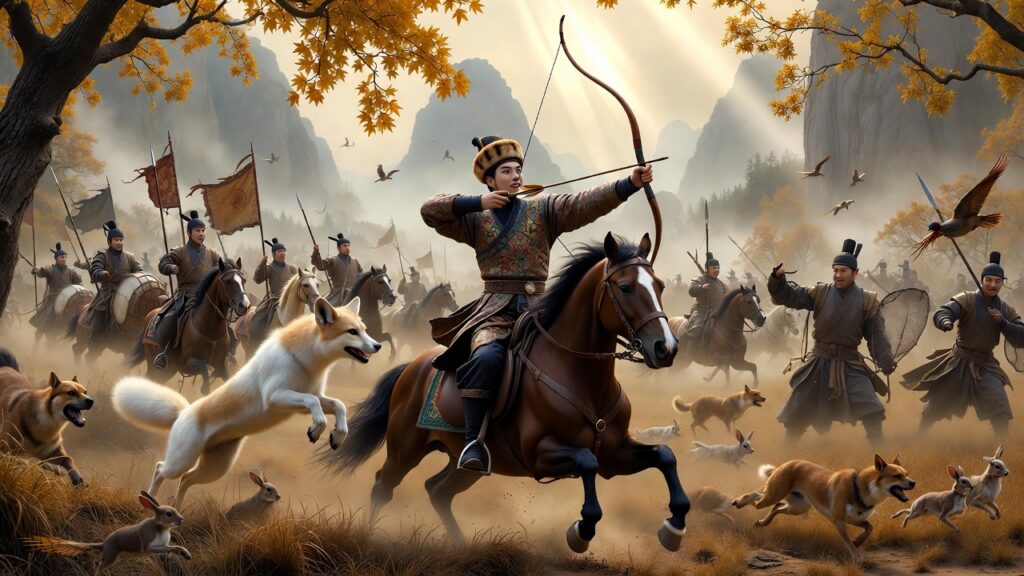
The young master has a luxurious nature,
Windflow and wild in his studies, mad with abandon.
He disciplines himself without measure or rule,
His mouth moist but lacking in literary talent.
He selects courtesans, treating gold as cheap,
Calls friends busily for green ant wine.
Swaggering through wine shops,
Barking orders as he charges into the hunting grounds.
Dressed in finery with sable as adornment,
In military attire with leopard as garment.
His flirtatious words lack purity like snow,
His critiques of beauties have biases like orpiment.
Relying on youth to bully the old,
Depending on strength to habitually insult the good.
Lending at usury while fishing for lust,
His family fortune will perish in no time!
In the eras of Sage Kings, the world was filled with a steaming harmony that gave birth to the Qilin, a creature of benevolence—the male called Qi and the female Lin. When the Qilin travels, it chooses paths where no grass grows and no insects dwell before setting down its hoof. It is unwilling to harm even a single blade of grass or the life of a tiny bug. Though the Qilin is an auspicious omen of a Sage King, it is ultimately still of the animal kingdom.
Man, however, is the soul of all things, born from the spiritual roots and virtuous essence of Heaven. Heaven and Earth are my parents; all living things are my siblings. Where Heaven and Earth cannot fully realize the life-nature of all creatures, I must assist in their nurturing transformation. Thus, a truly sincere Sage does not merely perfect himself or others; he molds and completes all living things, ensuring that even the smallest crawling creature finds its rightful place. This is the heart of a person of supreme benevolence.
If one views all creatures as falling outside the bond of “siblings,” then one will eventually view fellow human beings as strangers. How could such a person be called “Great”? In this world, save for the evil-natured tigers and wolves who eat men, the poisonous snakes and scorpions who sting, the rats who burrow through walls to steal grain and ruin books, or the flies and mosquitoes who plague the skin—creatures so vile they might be struck dead even before the Compassionate Guanyin without it being a sin—if we set these few aside, why must we slaughter the birds, beasts, and fish that do no harm to man?
Man sees them as a different species, but in the eyes of Heaven and Earth, all possess the same spark of life. One need not even mention the legends of the bird returning the ring, the dog bringing the grass, the horse holding the reins, or the turtle offering treasure; simply consider that a gentleman embodies the “love of life” held by Heaven and Earth. His heart should naturally find slaughter unbearable. By expanding this heart of “not-bearing” to see suffering, one moves from protecting animals to protecting one’s wife and children, and eventually to protecting the citizenry.
Conversely, if one expands a “cruel heart,” the killing of sheep leads to the killing of oxen; the killing of oxen leads to the killing of men; and the killing of men leads to the point where—like Duke Xian of Jin or Emperors Minghuang and Suzong of Tang—one kills even their own flesh and blood. Why else did the ancients say a gentleman stays far from the kitchen? It is precisely so that the act of slaughter does not touch his eyes or ears, thereby nourishing that small “unbearable” heart. Therefore, parents and elders must preserve the “unbearable” heart of a child from an early age. If this becomes habit, they will not grow up to be cruel. Their lives will be long, and their blessings eternal.
The Introduction of Chao Yuan
In those days, in Wucheng County, Shandong, there lived a scholar named Chao Yuan. His father was a famous literatus named Chao Sixiao, who consistently ranked at the top of the civil examinations. However, they were a family of modest means, living “by the plow of the tongue” (teaching) to make ends meet, and their household was not particularly wealthy.
At age thirty, Sixiao fathered Chao Yuan. Being an only son, the boy was extraordinarily doted upon. By the time he was sixteen or seventeen, he had grown into a handsome youth with ruby lips and white teeth—truly a beauty. However, he lacked cleverness in his studies and possessed little wisdom in his character. Had he been strictly disciplined and molded, even this “iron pestle” might have been ground into a “fine needle.”
Unfortunately, his mother spoiled him blindly, and Scholar Chao loved his son even more intensely than a woman might. Out of ten days, the boy would avoid his books for nine. On the one day he actually sat in the study, he hadn’t even arrived before maidservants were sent with tea and young valets with fruit, only to be fetched home before evening had even fallen.
Through such wasted time, it was a miracle that Chao Yuan was clever enough to at least write his basic primers. But as he grew older and his worldly knowledge expanded, he threw his books to the winds. He spent his time exclusively with a band of idle, worthless friends—touring lakes, drinking wine, snaring birds, fishing, and hunting rabbits. Scholar Chao and his wife did not see this as wrong. Fortunately, the scholar’s financial resources were limited, which somewhat restricted Chao Yuan’s wild and extravagant nature.
The Rise of Scholar Chao
Scholar Chao had failed the provincial examinations several times in a row and had only just managed to qualify as a “Senior Licentiate” (Suigong) to begin his official career. At that time, not long after the founding of the dynasty, the honors bestowed upon a scholar entering the civil service—such as ceremonial banners and plaques—were far more grand than they are today. Furthermore, the expenses required to live and travel in the capital were much lower, so his financial situation gradually became more comfortable. Soon after, he arranged a marriage for his son, Chao Yuan, taking the daughter of the retired scholar Mr. Ji as his wife.
After the wedding was completed, Scholar Chao immediately headed to the capital for the imperial court examination. At that time, the head of the Ministry of Rites was vacant, and the Senior Vice Minister was acting as the seal-holder. This Vice Minister had previously served as the Commissioner of Education in Shandong, and Scholar Chao had once placed first in the examinations under his supervision. Upon meeting, they reminisced about the time that had passed. The Vice Minister offered some words of comfort, saying:
“Though you did not pass the higher exams, you are not yet old, and with your dignified appearance, you are certainly not destined to remain a lowly teacher for the rest of your life. For now, skip the court exam and enroll in the Imperial Academy. Take the provincial exam one more time; if you pass, all the better. Even if you don’t, when you are eventually evaluated for an official post, you will surely not be ranked below others. Besides, I will be in the capital for a few more years and can look after you.”
Scholar Chao listened to this advice and followed it to the letter. The following year, he entered the northern examination hall. When the results were posted, he had failed. He thought to himself: “My mentor hoped I would pass the higher exam. Since I haven’t, if I don’t hurry and secure an official post while he is still in the capital, I’ll lose my patron. If I wait until he’s gone and end up as a mere assistant in some remote county, after a lifetime of study I’ll be forced to bow and scrape to others as ‘Your Honor.’ That would be a miserable existence!”
He confessed these true feelings to the Vice Minister, who agreed that his reasoning was sound.
Scholar Chao then submitted his petition and papers to the Ministry of Personnel. It so happened that the presiding official at the Ministry was also a student of the Vice Minister. With the Vice Minister’s prior recommendation, Scholar Chao joined the candidates for the placement exam. The essay topic was: “There are the people, and there are the altars of the spirits of earth and grain.” Scholar Chao was naturally competent, and with his mentor’s influence, the results showed he had been highly ranked and selected as a County Magistrate.
Scholar Chao was overjoyed, and the Vice Minister also felt he had gained prestige. However, Chao thought again: “I may have been selected as a Magistrate, but the difference between a ‘rich’ post and a ‘poor’ one is like the distance between Heaven and Earth. Why not strike while my mentor is in the capital and secure a good location now? Why wait!”
He immediately registered his years of service and prepared for the selection. As luck would have it, the position of Minister of Personnel became vacant, and the Senior Vice Minister of Rites was promoted to Minister of Personnel. During the great selection in April of the following year, Scholar Chao didn’t even need to use personal favors or beg for influence; when it came time to draw lots, he drew the assignment for Huating County in the Southern Zhili region.
Huating was a world-famous, wealthy “mega-county.” Usually, even those who passed the highest Imperial Examinations (the Jinshi) could not secure such a post despite spending vast amounts of wealth in bribes. Yet Scholar Chao, without even breaking a sweat, obtained it easily.
When the news reached his home, none of his relatives or friends could believe it. They said, “That Huating County has been occupied by Jinshi since ancient times; how could a mere Senior Licentiate get it?” The messengers of good news clamored in the streets and pounded on his doors, demanding three hundred taels of silver in tips, creating a massive commotion. Within two days, the official Gazette arrived, and it was indeed true! They draped the messengers in red silk, hosted them in the very study where Chao used to teach, and only after writing a promissory note for one hundred and fifty taels did the chaos finally settle down.
The Frenzy of Fortune
When the sycophants and petty people of Wucheng County heard that Scholar Chao had been selected as a Magistrate—and for the finest post in the land, no less—they couldn’t scramble fast enough to flatter him. They were so desperate to curry favor with Chao Yuan (Master Chao) that they would have gladly carried him on their shoulders or performed the most degrading acts just to be noticed.
The lower-class families begged through every relative and connection they had, seeking recommendation letters or face-to-face meetings, hoping to be taken on as domestic servants. Mid-level families were even willing to “gift” their own lands and houses to Master Chao, offering themselves up to serve as his stewards.
The local money-changers and moneylenders prepared grand gifts and flocked to his door.
- The money-changers said: “Whenever your household needs funds, regardless of the amount, just send a note to our shop. Our exchange rates are more generous than any other house, and we offer twenty extra coins per tael. If any of the coins are of poor quality, feel free to exchange them as you wish!”
- The moneylenders said: “Since Master Chao has been newly appointed, we fear he might be short on ready cash.” One would offer two hundred taels; another would offer three hundred, saying, “Take it and use it as you please! As for the interest, we leave that entirely to your generosity. If you only need it for a short time, we won’t even accept interest at all.”
Even among relatives and friends, people arrived in a steady stream, offering thirty or fifty taels without asking for a cent of interest.
Master Chao had always been a man of extravagant tastes, but being the son of a poor scholar had left him with “no battlefield on which to display his heroism.” He remembered how, in the past, trying to credit a mere couple of hundred coins at a shop was harder than climbing to heaven, and trying to borrow a single gold tael resulted in a hundred excuses. Now, seeing people deliver silver to his doorstep—not even daring to ask for a receipt—was the most satisfying experience of his life!
He accepted everything that was sent and borrowed from everyone who offered. He took in every person who came to serve, regardless of whether they were good or bad. Within ten days, he had dozens of servants and thousands of taels of silver. He spent ten thousand coins a day, all drawn via vouchers from various money-changers. He spent 250 taels on three fine horses and another 300 taels on six sturdy mules for transport. He bought silks, satins, and fine vessels; truly, “money could move the gods!”
In less than a month, Master Chao lived like the “Prince Consort of the Kingdom of Hua’an” (a reference to a famous dream of grandeur). He soon dispatched an old servant, Chao Shu, along with four new attendants—Zhu Shi, Gao Sheng, Qu Jincai, and Dong Zhong—carrying a thousand taels of silver to the capital to serve the needs of Scholar Chao.
Preparation in the Capital
Having secured such a plum post, Scholar Chao was daily hounded by those who dealt in “capital loans,” hoping he would borrow silver at low interest. However, as a newly appointed official to a major county, he was busy meeting with Ministry officials and local gentry; he hadn’t a spare moment to think about borrowing money. Since local shops were willing to provide for his daily expenses on credit, he wasn’t in a hurry and handled his affairs in an orderly fashion.
When Chao Shu and the four new servants arrived in the capital with the thousand taels, everything changed. With people to serve him and money to spend, Scholar Chao began his transformation. He bought fine fabrics, commissioned silver belts, hired tailors, had tea sets inlaid with silver, and ordered custom incense. He had seals carved and official robes for court and sacrifices prepared until everything was complete.
After a month, he received his official credentials. He went to East Legation Quarter (East Jiangmi Alley) and purchased three top-tier Fujian-style official sedans for himself, his wife, and Master Chao, as well as a secondary official sedan for his daughter-in-law, Lady Ji. All were outfitted with luxurious velvet and silk curtains.
The Arrogance of Power
With official regalia purchased and official seals carved, the time came for the family to return home and then proceed to the new post. Even while the master had been away, the household in Wucheng had radiated an air of immense power; now that the “true nobleman” had arrived, the sheer grandeur was beyond words. From the welcoming banquets to the departure ceremonies and finally the arrival at the official residence, everything went smoothly. The “official pockets” were filled to satisfaction, but these are mere trifles not worth dwelling upon.
The story turns to Chao Yuan, who accompanied his father to the official post. With his romantic and restless nature, how could he endure being cooped up inside a sterile county yamen?
There was, however, a legal secretary (mubīn) named Xing Chen (style name Gaomen), a scholar from Weichuan, Henan. He was a man of character—elegant and unrestrained. When meeting those of learning and principle, even if they were poor scholars, he was humbler than most. But for those who were illiterate or reeked of “village vulgarity,” even if they were princes or high nobles, he only feared them outwardly while harboring not a shred of respect in his heart.
Chao Yuan, fancying himself a high-born scion with deep pockets, treated Master Xing as a mere subordinate, putting on the haughty airs of a grand lord. But Master Xing was a man of such caliber that he would eventually rise to become a Minister of State; how could he possibly hold a common, unlettered “pretty boy” like Chao Yuan in high regard? Consequently, Chao Yuan found life in the yamen utterly tedious. After living there for six months, he pocketed ten thousand taels of gold, went to Suzhou to buy amateurish curios, commissioned clothes that exceeded his social station, and purchased many ill-fitted potted landscapes. He then hired a private passenger boat and a troupe of musicians to escort him and his wife, Lady Ji, back home.
New Status, Old Friends
His old friends, still thinking he was the same Chao Yuan of the past—one who struggled to make ends meet or had to pawn clothes for cash—bought gifts and came to welcome him home, hoping for a bit of financial help.
To their surprise, Chao Yuan now felt they were no longer “on his level.” Though he went through the motions of receiving them, his manner was grand, cold, and detached—nothing like the intimate friendship of the past. He would sit facing north with his eyes fixed on the tip of his own nose, utter two or three lines of empty “official-speak,” and then abruptly stand up with a dismissive bow.
Seeing the direction the wind was blowing, the visitors felt the sting of the snub and half of them stopped coming immediately. The new servants, seeing their master’s attitude, ensured that any of the old crowd who dared show up again couldn’t even get through the gate. Furthermore, Chao Yuan spent six thousand taels to buy the grand mansion of the Ji family (a former Minister). Truly, “the gates of the noble are as deep as the sea; how can an old friend dare to knock?”
The Shifting Heart
It is a common human failing that “status changes friendships,” but soon Chao Yuan began to think that “wealth should change wives.”
His wife, Lady Ji, was the daughter of a scholar who, though he hadn’t passed the higher exams, came from a respectable family. Lady Ji was neither particularly tall nor short; neither stunningly beautiful nor ugly; neither porcelain-white nor sallow-skinned. Her feet were not “three-inch golden lilies,” but they weren’t oversized either. In the past, while others saw her as ordinary, Chao Yuan had viewed her as a heavenly beauty. She had relied on his doting to be a bit willful, and Chao Yuan had been seventy or eighty percent afraid of her.
Now, Lady Ji was still the same Lady Ji, but Chao Yuan’s eyes were no longer the same eyes! He began to loathe her “vulgarity,” saying: “With such a poverty-stricken appearance, how can she preside over such a grand household?” He even looked down on her father and brother for being “village poor,” claiming it was inconvenient for them to visit such a high-gate mansion.
With sixty to seventy percent of his heart filled with disgust, the thirty percent of fear and respect he once held began to wither away.
The Domestic War and the New Favorite
Lady Ji still believed her husband was the same man of the past. She continued to exert her authority, shouting and striking out at him whenever she pleased. In the past, Chao Yuan would never have dared to talk back, but now he met her screams with a cold, angry stare. When she tried to hit him, instead of submissively accepting the blows as before, he began to block her hands or simply dodge out of the way.
Eventually, the balance broke. If Lady Ji cursed him twice, Chao Yuan would find an opening to curse her back once. If she rushed him to beat him, he would take the opportunity to shove her to the ground or push her away. Slowly, they moved to shouting matches and full-blown physical fights. Finally, it reached the point where Chao Yuan was the one initiating the abuse.
In the old days, Chao Yuan’s greatest fears were Lady Ji’s threats of suicide—hanging herself or slitting her throat—or her domestic punishments: barring him from the bedroom or refusing to let him into the bed.
Now, Chao Yuan feared none of these things. In fact, he secretly wished she would just “hurry up and perish” so he could marry a beautiful woman from a prestigious family. Even if she actually went through with hanging herself, he knew her father and brother were powerless to do anything to him. As for the cost of the funeral rites, it would be no more than a single hair off an ox’s back to him.
Previously, he had nowhere else to go; the house had only one bedroom and one set of bedding. Being locked out was a true hardship. Now, his mansion was filled with studies outfitted with ornate beds, silk canopies, rattan mats, and gauze quilts. His heated rooms featured red-hot stoves and ivory-inlaid beds. Furthermore, he kept a troupe of female actresses permanently in his home, along with male singers who never left his side. Lady Ji could bolt the door all she liked—even if she threw salt on the ground and hung bamboo branches (traditional charms to lure a guest’s carriage), his “goat-carriage” would never stop at her door again. Lady Ji was like a “Celestial Master with his hands tied”—utterly without recourse.
The Entrance of Zhen-ge
As Lady Ji’s spirit grew weaker by the day, Chao Yuan’s heart grew bolder. He took a maidservant as a concubine, but after two days, he grew bored and discarded her. He then spent sixty taels of silver to take the daughter of a Liaodong commander as a concubine, but he soon loathed her for not being “flattering” enough and eventually cut her off.
Daily, he was obsessed with only one person: Xiao Zhen-ge, the lead actress of the theatrical troupe.
Zhen-ge was not exceptionally beautiful, but she could sing several operatic scenes with great skill. Being an actress-courtesan, she was lively and clever, and Chao Yuan doted on her completely. He sent word to her “manager” (the pimp), expressing his willingness to pay any price to take Zhen-ge as his concubine. He even spread word that Lady Ji was already “five or six parts sick” and would likely die soon, at which point he would elevate Zhen-ge to his primary wife.
Zhen-ge was genuinely eager to marry into the Chao household, but the manager played hard to get. He argued:
“I invested three thousand taels into this troupe and have only just finished training them. I haven’t even made a few hundred taels back yet. If I lose my lead actress, the whole troupe is ruined! It would be better if Master Chao just bought the entire troupe.”
After much back-and-forth—with mediators taking their cut, servants taking kickbacks, and everyone demanding “gratitude gifts”—the deal was struck. The “wool came off the sheep’s back” (Chao Yuan paid for it all). For eight hundred taels of silver, Zhen-ge was officially brought into the house.
A House Divided and the Winter Feast
Though Lady Ji still dared to speak her mind in anger, she was no match for Chao Yuan, who now dared to act on his every whim. With Lady Ji refusing to humble her heart and Zhen-ge refusing to yield an inch, the household fell into a state of chaotic rebellion. Despite Chao Yuan’s wealth and power, his home was in such shambles that it hardly resembled a family residence.
Following a scheme proposed by his companion Dong Zhongxi, Chao Yuan prepared a separate residence for Zhen-ge. He commissioned new clothes, fashioned fine jewelry, assigned servants, and purchased maids. In no time, everything was ready, and he installed Zhen-ge within. From that point on, Chao Yuan would go entire months without stepping foot into Lady Ji’s quarters. Eventually, Lady Ji found herself lacking even basic firewood and rice, forced to beg for supplies from Zhen-ge’s hand. She was like “a mute eating the bitter root of the Golden Thread—unable to speak her bitterness to anyone!”
The Hunting Party Plot
On the sixth day of the eleventh month, the day of the Winter Solstice, a heavy snow began to fall. Chao Yuan ordered his cooks to prepare several tables of food and lit the floor heaters in the Spring-Lingering Pavilion. He invited a circle of wealthy profligates to admire the snow. Once the guests had gathered and taken their seats, the troupe of actresses came out to pour wine and provide company, though they did not perform a play that day.
The conversation among this group consisted of nothing but talk of adultery, theft, and fraud; their behavior was characterized by reckless indulgence. They were, without exception, a bunch of ill-bred, nouveau-riche scoundrels. As a dish of pheasant was served, someone remarked:
“There are so many pheasants and rabbits this winter, and wolves and tigers are roaming the wilds. This is a sign of anything but a fruitful year.”
One word led to another until they suggested:
“We all have horses, and we all have hawks and hounds. Why don’t we team up for a grand hunt and enjoy ourselves for a day?”
One among them, a man named Wen Ming, said:
“If we are to hunt, we must go to Brother Chao’s estate. The area around Mount Yong is vast and teeming with wild beasts. It would be best if Brother Chao acted as our host.”
Chao Yuan readily agreed. He pulled out an almanac and selected the fifteenth day of the eleventh month as an auspicious day for hunting. They agreed to dress themselves splendidly to look the part, and to gather at the drill grounds at the hour of the Rabbit (5:00 AM – 7:00 AM) to set off. They also planned to prepare two sets of “Three Sacrificial Animals” (pig, ox, and sheep)—one to honor the mountain gods and local deities, and another to consecrate the hunting banners. Chao Yuan declared, “That’s no trouble at all; I shall prepare it myself.”
The revelry lasted until the fifth watch of the following morning. As the snow eased, some guests headed home, while others stayed to sleep with the actresses in Chao Yuan’s heated rooms.
Zhen-ge’s Ambition
Having spent the night drinking and indulging in “romantic affairs” with Zhen-ge, Chao Yuan slept until the hour of the Monkey (3:00 PM – 5:00 PM). The friends who had stayed over had already departed. Without even washing or combing his hair, Chao Yuan downed two bowls of hot and sour soup. He sat for a moment as the lamps were lit, still not quite sober from the night before, and went back to bed with Zhen-ge.
On the pillow, he mentioned the plan for everyone to go hunting at Mount Yong on the fifteenth and the need to send word to the estate in advance. After hearing the details, Zhen-ge said:
“Since it’s for a day, I want to go along too, just to vent some of my boredom.”
Chao Yuan replied:
“You are a woman; how can you join a pack of men? Besides, everyone will be on horseback. If you take a sedan chair, how could you possibly keep up?”
Zhen-ge scoffed:
“As for that lot, there isn’t one among them whose ‘portrait of pleasure’ I couldn’t paint! Out of ten men there, eleven of them are former ‘acquaintances’ of mine. You think I’d be afraid of them? And as for riding, I wager I can outride the lot of you! Every time there’s a funeral procession, haven’t I dressed up to gallop on horseback? I’ve played everyone from ‘Wang Zhaojun Crossing the Border’ to ‘Meng Rihong Defeating the Rebels’!”
The Hunter’s Regalia: Zhen-ge’s Ambition
Zhen-ge continued her boast, “I’m not the least bit afraid of that lot! And as for riding, I’d wager even you men can’t outride me. Every time there’s a local funeral procession, don’t I dress up and gallop on horseback? Whether I’m playing ‘Zhaojun Crossing the Border’ or ‘Meng Rihong Defeating the Rebels,’ I’ve done it all. A real hunt can’t be much different from that!”
Chao Yuan replied, “You have a point. Having you there will make it all the more interesting. Tomorrow, find that stone-blue embroidered cloak and get a bolt of silver-red silk for the lining. I’ll have Chen the Tailor finish it so you can wear it on your horse that day.”
Zhen-ge laughed, “Oh, my dear naive man! Wearing a formal cloak to a hunt? I’d look like a festival lantern! No, I’ll ask the acting troupe for my gold headband, my pheasant feathers, and my dragon-patterned shoulder guards. I intend to go in full military regalia.”
Chao Yuan cried out from his pillow, “Wonderful! Splendid! But why borrow from the troupe? Their things are soaked in sweat and grime—filthy! We’ll have a set made specifically for you. We still have a few days’ time.” The two of them continued to egg each other on late into the night.
Preparations for the Grand Hunt
The next morning, Chao Yuan rose and began obsessively organizing the hunting party. He was determined to outshine the other wealthy families; he wouldn’t dream of being seen as their equal.
For Zhen-ge, he commissioned:
- A bright red “Flying Fish” robe with narrow sleeves.
- A stone-blue “Seated Dragon” shoulder guard.
- A “Zhaojun Rabbit” headpiece made from thirty-six taels’ worth of sable fur.
- Custom-fitted sheepskin-lined boots of azure silk.
- A golden-yellow silk belt and a silver-hilted hunting knife.
- A sleek black gelding, specially trained for her to ride.
He didn’t stop there. He selected six sturdy wives of his servants, four strong maidservants, and over ten wives of his tenant farmers to serve as an escort. Each was outfitted in fox-fur headpieces, sky-blue riding jackets, oil-green shoulder guards, and sturdy leather boots, complete with waist knives and sashes. He even chose one particularly robust woman to ride directly behind Zhen-ge, carrying a standard-bearer’s flag as a marker.
Chao Yuan’s own gear and the uniforms for his servants and tenants were meticulously prepared. He even leveraged his influence to borrow thirty horses and twenty-four mounted musicians from Commander Liu of the local garrison. To ensure the hunt was successful, he borrowed four more hounds and three sets of hawks from the Commander. At his country estate, he ordered the slaughter of several pigs and the milling of piculs of flour to feed the party on the fifteenth.
The Procession to the Drill Grounds
By the hour of the Rabbit on the fifteenth of the eleventh month, the other wealthy families had arrived at the drill grounds. Though they had tried their best to look the part, they lacked the professional touch.
Chao Yuan arrived last, leading a literal army from his house. First came a double file of female riders. Then came Zhen-ge in her full military finery, her horse followed closely by the standard-bearer. Behind the flag was a rearguard of nearly twenty “lady generals,” followed finally by Chao Yuan’s main body of troops.
The footwork was precise, and the ranks were orderly. Though it was essentially a game played by country bumpkins, it had the disciplined air of the Emperor’s own guard. The onlookers couldn’t help but cheer. Chao Yuan dismounted and introduced Zhen-ge to the assembled crowd.
The Hunt Begins: A Scene of Splendor
Although the men in the party were all former “acquaintances” of Zhen-ge, they knew better than to be overly flirtatious now that she had “followed the path of virtue” (married). After a few formal exchanges and a few cups of wine to toast the expedition, Chao Yuan—fearing the others would clutter his elite cavalry—ordered the groups to divide into separate units. A cannon was fired, and the party set off.
In no time, they arrived at the foothills of Mount Yong and established the hunting grounds. It was a sight to behold:
Horses leaped like dragons, and men were as strong as bears. Banners with tiger-wings led the way, rippling in the wind; leopard-tail streamers stood at the center, dazzling the eye. With their hawks and hounds, the men looked like the God Erlang; with their feathered arrows and snake-like bows, the crowd marveled as if seeing the three heroes of the Peach Orchard.
Servants and tenants of all shapes and sizes—old, young, tall, short—jostled to flatter “The Great Master” (Chao Yuan). Maidservants and nursemaids—black, white, pretty, or plain—competed to win the favor of “The Little Madam” (Zhen-ge).
Chao Yuan wore a raven-feather green jacket embroidered with five-colored flying fish; Zhen-ge wore a scarlet robe of “ape’s blood” red, intricately stitched with a seated dragon. Master Chao rode a wind-chasing steed, brandishing a solid iron staff with majestic power; Little Madam straddled a sun-bright dapple-grey, a pair of leather shields at her waist, putting on a fierce martial display.
The excitement of the chase shook the earth as they startled countess muntjac, deer, pheasants, rabbits, and wolves. Dogs were loosed, hawks were cast, and bows were drawn. They captured a great deal of game, and the sound of flutes, drums, and gongs echoed to the heavens. Truly, it was a moment of supreme worldly pleasure—though “when joy reaches its peak, sorrow is born,” a truth they failed to consider!
The Encounter with the Fox Fairy
Little did they know that within a cave on Mount Yong lived an ancient vixen. In the past, she often transformed herself to bewitch people in the surrounding area. Later, she moved to Zhou Family Village, calling herself “The Immortal Lady” and entangling herself with a young farmhand. Because of this, she rarely had time to cause trouble at Mount Yong, though she returned occasionally to look after her cave. Sometimes she appeared as a peerless beauty, other times as a withered old crone; many locals had caught glimpses of her.
On this day, she happened to be returning from Zhou Village when she crossed paths with the hunting party. Seeing the mass of men, horses, hounds, and hawks, why wouldn’t she hide? Yet, she relied on her vast supernatural powers, thinking that since she had already taken human form, the hawks and hounds would not recognize her.
Moreover, her heart was not virtuous; she had long desired to bewitch Chao Yuan. Previously, she had been unable to enter his home because his family altar housed a Sanskrit Diamond Sutra printed in cinnabar, guarded by countless deities. Now, seeing that Chao Yuan was a lustful and wicked man leading a troupe of concubines on a hunt, she thought: “If I don’t strike now, when will I have a better chance?”
She immediately transformed into an exquisite young woman, appearing to be under twenty years old. She dressed entirely in plain white mourning clothes and began walking at a steady pace directly in front of Chao Yuan’s horse. Every few steps, she would turn back to cast a lingering glance at him.
Chao Yuan was instantly infatuated, his soul nearly leaving his body. He thought to himself: “I know everyone who lives around Mount Yong; where did this beauty come from? Seeing her unattended, she clearly isn’t from a noble house. Dressed in deep mourning, she must be a newly widowed woman. This is ‘rare cargo’ indeed! If I can get her home, she and Zhen-ge will be my ‘Two Beauties.’ With a wife on the left and a goddess on the right, I would truly be the most romantic man of the age!”
The Death of the Fox Fairy
Chao Yuan was lost in his lustful fantasies, but while a human’s “fleshly eyes” can be deceived by a magical disguise, the keen eyes of hawks and hounds see the true nature of a monster.
The hunting dogs lunged forward, and the hawks circled above, trapping the spirit. Panicked, the fox shed its beautiful human form and reverted to its original shape. With the predators closing in and no hole to hide in, the fox scrambled beneath the belly of Chao Yuan’s horse, hoping he might show mercy and save its life.
But Chao Yuan had always been a man who delighted in slaughter. Far from saving the creature, he drew his carved bow and plucked a feathered arrow from his quiver. With a powerful pull, he aimed directly at the fox trembling beneath his stirrup.
Twang! With a single sharp “Howl!”, the fox’s four legs kicked the air. A yellow hound lunged forward to finish the job. In an instant, the thousand-year-old magical creature was no more. The carcass was snatched from the dog’s jaws and tossed into the pile of mundane game. The party gathered their horses and returned to the estate for a celebratory feast.
The Ill Omen
The “victorious army” returned to the city and arrived at the Chao residence. Zhen-ge and the other women retired to the inner quarters while the men sat for one last round of wine and snacks. They divided the day’s spoils, but out of respect for his skill, the group insisted that Chao Yuan keep the fox he had personally shot.
As Chao Yuan saw his guests out and stepped back through his front gate, he felt a sensation as if someone had delivered a massive blow to his face. A violent shiver ran through his entire body. Attributing it to the day’s exhaustion, he went straight to bed.
Little did he know that from this night on, his luck had run dry, and a series of misfortunes was about to begin.
Translator’s Note
Historical Setting: The novel is set in the late Ming dynasty (roughly 15th–17th centuries), reflecting imperial China’s civil service examination system, social hierarchies, and everyday customs. Key institutions include the tribute student (歲貢生 / suì gòng shēng: a scholar recommended for office after repeated exam failures or due to age) and jinshi (進士: the highest imperial examination degree, often required for prestigious posts like county magistrate). Huating County (華亭縣, modern Songjiang area near Shanghai) was a real, wealthy jurisdiction symbolizing bureaucratic ambition and corruption.
Opening Poem & Moral Discourse: The chapter begins with a seven-character regulated verse (七言律詩) critiquing the protagonist’s flaws (extravagance, cruelty, lust), a common device in vernacular novels to foreshadow themes. The prose essay on benevolence draws from Confucian ren (仁: “humaneness” or compassion) and Buddhist ideas of karma (因果 / yīn guǒ: cause and effect across lives). It argues for non-harm to living beings, using the qilin (麒麟: mythical auspicious beast that avoids stepping on grass or insects) as a symbol of perfect harmony and sage rule.
Key Cultural References:
- 不忍之心 (bù rěn zhī xīn): “The heart that cannot bear” — a core Confucian concept from Mencius, describing innate compassion that gentlemen cultivate to avoid cruelty; here expanded to protect animals, family, and society.
- 遠庖廚 (yuǎn páo chú): “Keep distance from the kitchen” — allusion to Mencius, where gentlemen avoid witnessing slaughter to preserve their compassionate nature.
- 何郎傅粉 (Hé Láng fù fěn) and 荀令留香 (Xún Lìng liú xiāng): Classical allusions to legendary beauties (He Yan “dusted with powder” and Xun Yu’s lingering fragrance), used ironically to describe the protagonist’s handsome but shallow appearance.
- 狐仙姑 (hú xiān gū): “Fox immortal maiden” — a fox spirit (huli jing / 狐狸精) from Chinese folklore, often seductive and vengeful; ties into karmic retribution motifs common in Ming-Qing literature.
Literary Style & Language: Written in vernacular Chinese (白話 / báihuà) with Shandong dialect influences, proverbs, and allusions. The narrative blends didactic moralizing (typical of “awakening” novels) with realistic social satire. Translation aims for natural, readable English while preserving period flavor and cultural nuance.
Themes Introduced: Early emphasis on moral causation, cruelty’s consequences, and virtue’s rewards sets the novel’s overarching purpose: to “awaken the world” (醒世) through stories of flawed marriages and karmic cycles.
0 Comments