
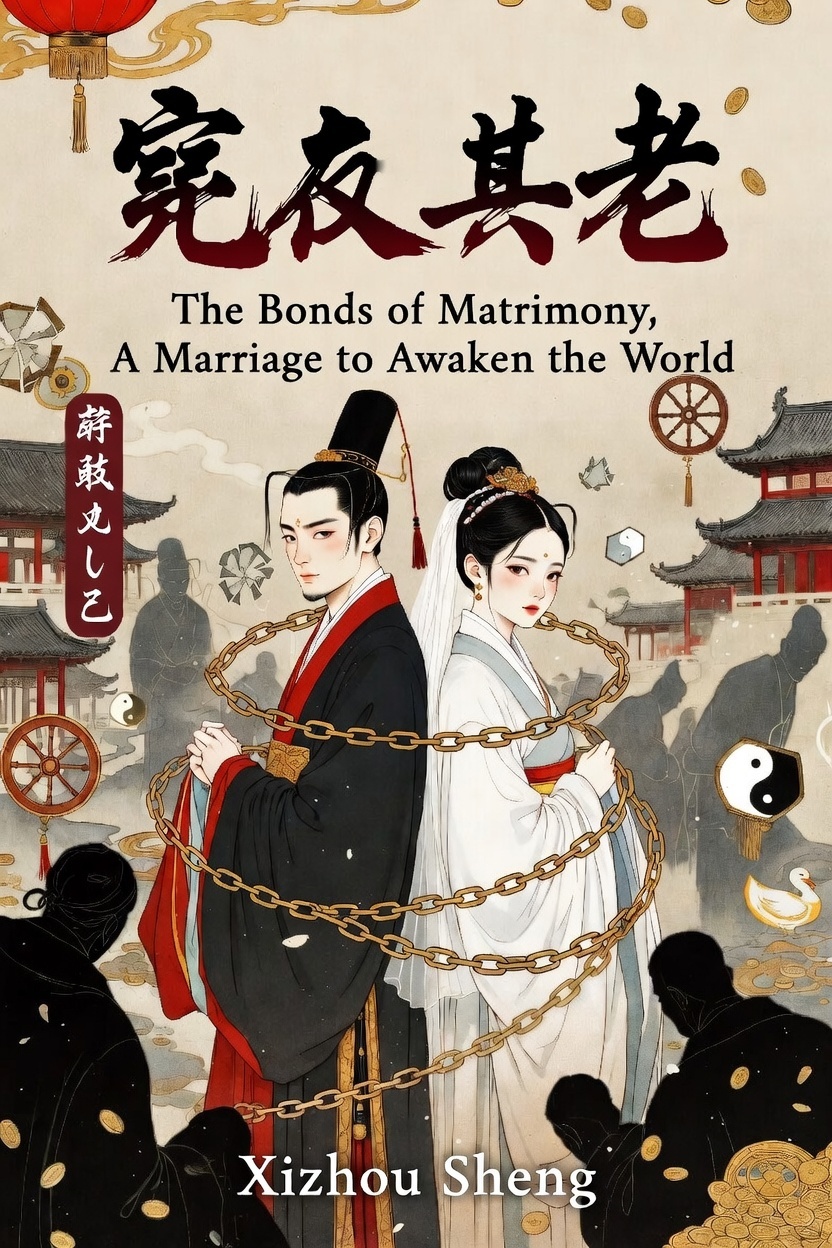
The Bonds of Matrimony, A Marriage to Awaken the World
English Titles: Marriage Destinies to Awaken the World | Marriage as Retribution, Awakening the World | The Bonds of Matrimony, A Marriage to Awaken the World
Author: Anonymous, published under the pseudonym Xizhou Sheng (西周生, “Scholar of the Western Zhou”).
While early 20th-century scholars (notably Hu Shih) attributed it to Pu Songling (蒲松龄, author of Strange Tales from a Chinese Studio), this has been largely discredited by modern stylometric and historical analysis. Alternative suggestions (e.g., Ding Yaokang) have also been rejected. The true author remains unknown, typical of many late imperial vernacular novels.
Composition & Publication: Late Ming or early Qing dynasty (likely composed ca. 1628–1681, published in the 17th century).
Length: 100 chapters, over one million Chinese characters—one of the longest traditional Chinese novels.
Genre: Vernacular novel of manners (shiqing xiaoshuo), satirical domestic fiction with strong elements of Buddhist karma and moral retribution.
Original Text Sources: This translation draws from public-domain editions, primarily the Chinese Text Project (ctext.org) and Wikisource classical Chinese texts.
Synopsis
Xǐngshì Yīnyuán Zhuàn (醒世姻緣傳) is a sweeping satirical epic that explores the destructive power of flawed marriages and familial relationships across generations, framed through the lens of Buddhist karma (yin-yuan, “causal connections”) and retribution (bao). Set against the backdrop of late imperial Chinese society (primarily in Shandong and the capital), the novel weaves realistic depictions of everyday life—official corruption, domestic strife, greed, jealousy, cruelty, and moral decay—with supernatural elements and karmic consequences.
The narrative traces intertwined destinies of characters from scholar-officials to common folk, illustrating how past-life actions manifest in present suffering, particularly through abusive or mismatched unions. It critiques social vices like extravagance, misogyny, and hypocrisy while promoting Confucian virtues (benevolence, duty) and Buddhist awakening. Often described as one of China’s most underrated vernacular masterpieces, it bridges the raw realism of Jin Ping Mei and the psychological depth of Dream of the Red Chamber, offering a grand-scale portrait of a society in moral crisis during dynastic transition.
This translation project aims to make this important but under-translated work accessible to English readers. Chapters are presented with Translator’s Notes explaining cultural references, historical context, idioms, and translation choices.
Further Reading / Resources
- Original Chinese text (public domain): Chinese Text Project edition → ctext.org – 醒世姻緣傳
- Overview and background: Wikipedia → Xingshi Yinyuan Zhuan
- In-depth scholarly analysis: Daria Berg, Carnival in China: A Reading of the Xingshi Yinyuan Zhuan (Brill, 2002)
Cast of Characters
The story features a range of characters from various social strata, including officials, scholars, family members, and spiritual figures. Key figures include:
- Chao Yuan: A prominent figure in the early part of the narrative, representing indulgence and its repercussions.
- Di Xichen: A central protagonist, depicted as a failed scholar who becomes a merchant, navigating personal and familial trials.
- Sujie: One of Di Xichen’s wives, embodying strong-willed traits.
- Jijie: Another of Di Xichen’s wives, contributing to the domestic dynamics.
- A monk: A spiritual guide who appears toward the end, offering wisdom and resolution.
-
Chapter 1: Master Chao Shoots a Fox in the Hunting Grounds; A Fox Fairy Loses Her Life to a Stray Arrow
39,234 Words
-
Chapter 2: Master Chao Kills a Fox and Falls Ill; Physician Yang Practices Medicine with Reckless Abandon
30,938 Words
-
Chapter 3: The Old Scholar Appears Twice in a Dream; The Young Master Decides to Visit his Relatives
39,196 Words