

Chapter 12: Inspector Li Conducts a Circuit and Receives Petitions; Magistrate Chu Upholds the Law and Overturns Confessions
by Angie Bellender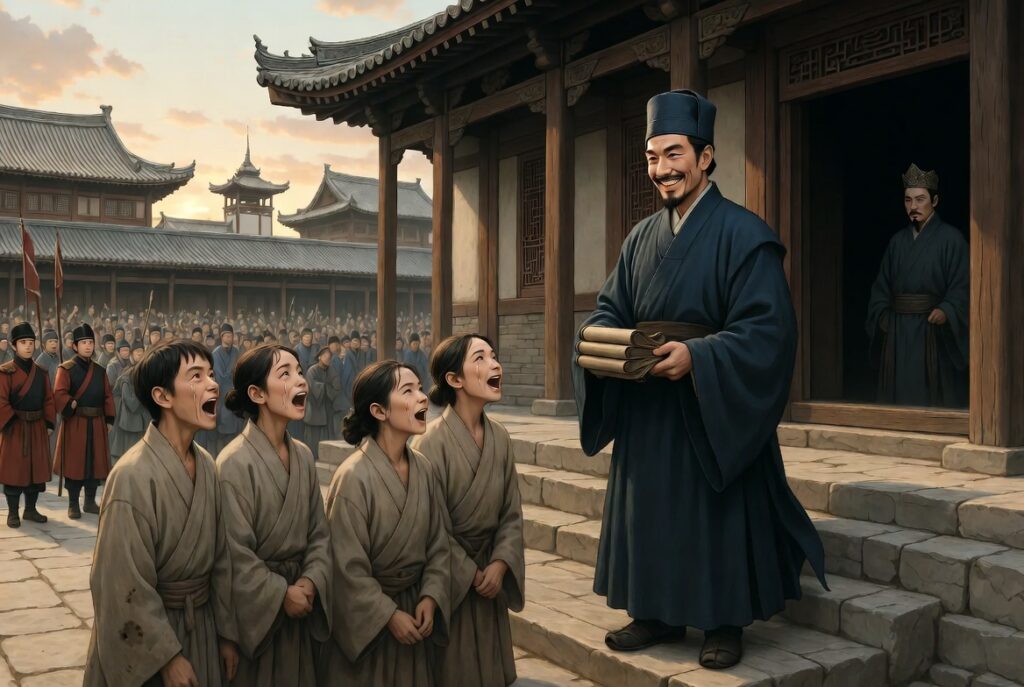
In times of peace, the national destiny flourishes.
Heaven and earth are clear; the seasons are regular.
The winds and rains are balanced; the miasma is cleansed.
Civil officials are incorruptible; military generals are vigorous.
Clerks do not embezzle; the people suffer little illness.
The wicked are purged; the virtuous are promoted.
Scholars cultivate themselves; ministers offer honest counsel.
Bribery is blocked; sycophancy is ended.
Backdoor dealings are sealed; nepotism is strictly forbidden.
Evil men hide; the righteous celebrate.
The strong and violent are trimmed; the arrogant are uprooted.
Building a terrace of spring; leveling the pits and traps.
Such officials are truly venerable.
Pillars of the state, the lifeblood of the people.
Are they mere Gongs or Huangs?
Nay, they are true followers of Confucius and Mencius.
Their deeds deserve the Xian Mountain stele and the Song of the Sweet Pear Tree.
Exhaust the bamboo of the mountains to record their virtuous governance.
Report to Imperial Heaven; pray for the divine.
May their ranks rise and their progeny multiply.
Hinges of the world for ten thousand years, never-ending.
Now, the Emperor Zhengtong was originally a sagely ruler who worked from dawn to dusk, striving for good governance. It should not have been difficult to maintain peace. Externally, there were governors like the loyal Yu Qian; internally, the “Three Yangs” of the Grand Secretariat were all virtuous ministers, and there was even a wise Empress Dowager. It seemed like a golden age!
However, it was all undermined by the eunuch Wang, who usurped power and committed countless evils. He cowed the officials of the court until they were all groveling like slaves, utterly destroying the morale of the literati! That said, those who could be so easily broken clearly lacked “hard bones.” They were like “silver-coated wax spearheads”—shiny and impressive to look at, but the moment they hit something solid, they crumpled into a heap. Consider the diamond: though it is a tiny thing, it can drill through the hardest objects with a whistling sound.
At that time, in Dongchang Prefecture, Shandong, there was a Linqing Circuit Intendant holding the rank of Assistant Surveillance Commissioner. His name was Li Chunzhi, a native of Zhongmu County, Henan, and a jinshi graduate of the Gengchen year. During his first appointment as a county magistrate, he loved good commoners like his own children. He respected scholars who followed the rules and possessed integrity as if they were his mentors or friends. However, if he encountered crooked scholars or unruly commoners, he would never show leniency. If members of the gentry worked for the public good to promote benefits or eliminate local harms, he would sit with them in the Guest Hall all day discussing affairs without feeling weary. But if the kinsmen, children, or stewards of officials relied on their master’s influence to stir up trouble or commit crimes, they could forget about him saving their “face” or granting them tolerance. When letters arrived seeking favors, he remained entirely impartial, treating the cases as if no favor had been asked. He rendered justice where it was due, and even those he punished to the full extent of the law accepted their fate without resentment.
He disregarded specific filing days like the “second and sixth” or “third and eighth,” and he did not worry about the trivialities of how many petitions were accepted. If there was a petition, he accepted it, wrote his judgment directly on the original document, and handed it to the plaintiff to serve the summons themselves—without logging it in registers or comparing duplicate files. If parties agreed to settle privately, they did not need to return the petition or report back. For those who refused to reconcile and insisted on seeing the official, he would hear the case regardless of whether it was the morning or evening session, and regardless of the setting—be it the yamen, a public office, or even at a banquet. He would mediate with reason; for those clearly in the wrong, he might order a few strokes of the bamboo as a warning, but he neither formally convicted them nor extorted “paper fines,” simply sending them away on the spot.
Regarding the “wastage” fees on taxes, which were clearly set at three cents per tael, he would say: “A county official has his own living expenses, needs to maintain relations with superiors, and requires funds for the meals and reception of passing dignitaries. If I take the silver from your county to buy land and build houses for my family, I would be committing the acts of a bandit like Liu Zhe—and that I will never do. However, if you expect me to sell my own land and liquidate my own property to fund the expenses of this county, I will not play the part of a self-sacrificing ascetic like Chen Zhongzi either.”
His personal household expenses were extremely frugal. Rather than wasting local resources, he took the surplus “wastage” funds and, after covering public expenses, used what remained to buy grain when prices were lowest to fill the granaries. During the lean months between harvests, he lent this grain to the poor. While private interest was 100%, the official loan only charged 50%. Even accounting for those who could not repay or had died, the system still maintained a 30% surplus. Within two or three years, the granaries were overflowing. These funds were used to provide grain for the elderly and destitute, rations for prisoners, and assistance for the poor with the costs of coming-of-age ceremonies, marriages, funerals, and sacrifices. His benevolent governance extended far beyond this, and even a hundred mouths could not describe it all. But how can one neglect the main narrative just to speak of this?
A magistrate such as this, if allowed into the central ministries, would surely have promoted the empire’s interests and eliminated its harms, a true “phoenix singing to the morning sun.” But who would allow such a headstrong man into the Censorate or the Office of Scrutiny? It would be like a hall full of monks being joined by a layman who disrupts the group! Yet, because he was a top-tier graduate, they could not easily force him out. They promoted him to a Secretary in the Ministry of Rites, then he moved up to Director. Given his scholarship, he was perfectly suited to be a Commissioner of Education, yet they refused to grant him that post. Instead, they made him a Circuit Intendant. After five years of service, they still refused to grant him the rank of Vice Commissioner, leaving him only with the title of Assistant Surveillance Commissioner.
The Dongchang Circuit Intendant’s yamen was stationed in Linqing. Because Linqing was a major hub, it was filled with slick and polished scoundrels who felt that “the mountains are high and the Emperor is far away.” Fearing nothing, they committed adultery, theft, and acts of tyrannical arrogance day and night. Coupled with the bullying of the weak by powerful officials and bullies, life was extremely difficult for the virtuous.
Since he took office, wearing his censor’s robes, fastening his flowered silver belt, and trailing his official seals, his countenance remained as cold as iron. Why speak of Zhang Gang or Wen Zao? He was exactly like Bao Longtu. He issued proclamations repeatedly exhorting people to reform themselves. Except for outstanding cases of homicide and robbery, all other miscellaneous offenses committed before his arrival were exempted from prosecution; however, for any acts of tyranny or violence committed after his arrival, nine out of ten culprits failed to escape his net. Those few who did escape were surely not yet fully depraved. From time to time, wearing a simple cap and riding a mule accompanied by only one or two attendants, he traveled incognito throughout the eighteen departments and counties under his jurisdiction. This kept those local officials in check, daring not to act with utter abandon.
The Magistrate of Wucheng, relying on his high academic rank and perhaps because his day of reckoning was near, grew more wicked by the day. The Circuit Intendant’s investigations into him also became more rigorous by the day. On the day he heard the Magistrate had died, fearing the predatory yamen underlings would scatter and flee, he issued neither formal notices nor urgent warrants. Unexpectedly, leading twenty or thirty soldiers and runners, he patrolled to Wucheng County. He did not enter the Inspectorate but went straight into the county hall, took his seat, and struck the hall drum three times.
The clerks and runners of the six offices gradually gathered. He called for the attendance registers and checked off every item. Those who were uninvolved were told to stand to the east after being checked; those with matters to answer for were told to stand to the west. Many were absent. He did not bother with those without offenses who failed to show, but for the offenders who were missing, he dispatched soldiers and yamen trackers to capture them immediately, sentencing them to forty or fifty heavy strokes of the bamboo respectively. Wu Xiaochuan and Shao Cihu had hidden themselves most securely. However, the Intendant’s discipline was so strict that no one dared risk their own life to show them favor. Before long, they too were captured. Each received fifty strokes and was handed over to the police officials to be held in secure custody pending further trial; they were permitted neither to die nor to be released. After lecturing those standing to the east, he dismissed them, returned to the Inspectorate, and posted a large proclamation:
The Military Defense Circuit Intendant issues this proclamation to eradicate “yamen tigers” and vent the people’s hatred:
It has been observed that the official of Wucheng County was greedy for bribes and subverted the law, imposing harsh fines and oppressing the people. The people’s resentment is deep, and the gods’ anger is extreme. This office had already submitted reports to the higher authorities and was in the midst of an investigation; unexpectedly, his cup of iniquity became full, and Heaven struck down his soul. Though the wolf is dead, the pack of criminals who feigned his authority to incite evil must, by law, be uprooted and pruned. Aside from those already captured and imprisoned by this office, any household that has suffered his poison should present their case truthfully to this Circuit. Dead ashes shall certainly not be allowed to reignite; the tiger in the cage need not be feared for a counter-attack. Do not lose this opportunity for redress and willingly embrace a lifetime of humiliation. A special proclamation.
The petitioners crowded and jostled, submitting no fewer than several hundred complaints. Ji Bala also wrote a petition and followed the signal into the office, placing his complaint on the table and walking down to the courtyard to await the roll call. The Circuit Intendant read Ji Bala’s petition:
Petitioner: Ji Qice, aged 35, native of Wucheng County, Dongchang Prefecture. Reporting a case involving loss of life:
The petitioner’s younger sister was married in her youth to Chao Yuan as his wife. Chao Yuan, believing the slanders of his prostitute-concubine Zhen-ge, conspired to fabricate a charge of adultery, hounding the sister until she hanged herself. The predatory runners Wu Shengdao and Shao Qiangren facilitated the passing of over seven hundred taels of silver in bribes and sixty taels of red gold to buy Zhen-ge’s exemption from appearing in court, leaving the sister’s life without justice. Evidence: The Red Warrant.
He begged for a personal hearing or for the case to be referred to the “Blue Sky” Magistrate Chu for investigation. The petition listed the following defendants: Zhen-ge, Chao Yuan, Xiao Xiajing, Wu Shengdao, Shao Qiangren, and Xiao Liuqing. Witnesses included: Lady Gao, Haihui, and Nun Guo.
After reading the petition, the Circuit Intendant asked, “To whom were these seven hundred taels of silver and sixty taels of gold delivered?” Ji Bala replied, “I do not know to whom they were delivered. I only have his personal report and the vermilion ink as evidence.” He handed them to the Intendant. The Intendant examined them and asked, “What proof is there for the seven hundred taels of silver?” Ji Bala said, “There is a hidden clue beneath the date on the red warrant.” The Intendant then spotted the words “Five Hundred.” After a long silence, he nodded and asked, “Why does your petition say seven hundred?” Ji Bala explained, “The five hundred was the bribe; the other two hundred was for the labor of Wu Xiaochuan and Shao Cihu.” The Intendant sighed twice and said, “What! Such things actually happen!” He then asked, “Was your sister truly guilty of adultery, or why did she hang herself?” Ji Bala replied, “If she were truly guilty, she would deserve her death. Why then would they pay such a massive bribe? I have named as witnesses the nun Haihui, who is a Taoist with hair, and Nun Guo. Zhen-ge falsely claimed Haihui was a priest and Nun Guo was a monk, accusing my sister of adultery with them and hounding her until she took her own life.” The Intendant ordered him to wait at the Judicial Office. The next day, the petition was officially referred down. Ji Bala went to the Dongchang Judicial Office to submit his claim.
The Judicial Magistrate, surnamed Chu, was a native of Sichuan and a newly minted jinshi. He was quite young and a formidable, upright official—a perfect assistant to the Circuit Intendant. Upon reviewing the submission, he asked questions similar to those of the Intendant, and Ji Bala answered as he had before. Magistrate Chu gave his orders: “Do not go home. I shall settle this for you immediately.” He dispatched runners to Wucheng County to summon all parties involved, specifically demanding that Zhen-ge appear in court. Not a single defendant or witness named in the petition was to be omitted.
At that time, the acting official for Wucheng County had not yet arrived, so the responsibility fell to the granary official in charge of arrests to produce the people within the time limit. The runners from the Judicial Office arrived at Chao Yuan’s house. They did not say they had come to arrest him; instead, they claimed Old Ji and his son were at the yamen to pay their paper-fine and could not be found, and since someone said they were hiding at the Chao estate, the runners had come to search for them. This lured Chao Yuan out to the hall. Meanwhile, three or four stout women and five or six runners charged inside. Chao Yuan was startled. The women ran to the back like wolves or tigers; picking out the one most elegantly dressed and beautiful, they judged her to be Zhen-ge, seized her, and pushed her out.
Ever since Zhen-ge had been possessed and beaten by Lady Ji’s ghost, she had been listless and unwell. This sudden shock sent her spirits fleeing; even the maids and servants were scared out of their wits. Chao Yuan asked, “Tell me plainly, what is the meaning of this?” The two lead runners said, “Magistrate Chu has received a petition from the Circuit Intendant and wishes to meet with you and your lady. Since you, Master, would not come out of your deep courtyard, where else could we find you? We had no choice but to ‘invite’ you this way. This is our duty as runners; do not blame us. We men did not dare offend the lady, so we brought our own wives to escort her out.” Zhen-ge, not knowing any better, assumed the outcome would be the same as before. Though she was frightened, she was not yet in despair.
Chao Yuan was shaken to hear it was a petition from the Circuit Intendant and that the case had been referred to that “eccentric” Magistrate Chu. He thought to himself: “This time, things look grim! No matter how grand the lawsuit, it usually just boils down to a place where one can spend silver—so why fear it? But with these two stubborn officials, if silver can’t get through and influence can’t weigh them down, I won’t have to pay with my life, but I’ll certainly be scared half to death!” He immediately ordered the back rooms to prepare wine and food for the guests. Zhen-ge was escorted by the four or five women into the western inner room of the hall to wait.
The runners produced the warrant for inspection; it still listed Xiao Xiajing, Xiao Liuqing, and the other women, holding Chao Yuan responsible for their appearance. Chao Yuan said, “These are just a few maids and family servants who are all here at home. When the time comes, we shall all depart together.” The runners replied, “Master Chu’s discipline is extremely strict. We dare not even accept a meal; it’s best we depart early so we can submit the documents to the office by tomorrow morning.” Chao Yuan countered, “If one is to go to court, shouldn’t one pack bedding and prepare travel expenses? It’s not as if you gentlemen are traveling with your own cooking pots!” The runners said, “If that is the case, Master, just have your people quickly pack your own luggage. You needn’t worry about us. Given Master Chu’s temperament, do you think we’d dare accept a single copper?”
As they were speaking, six or seven more runners arrived, having summoned Lady Gao, Haihui, and Nun Guo. As soon as Lady Gao entered the door, she shouted, “Oh, my lord! My ancestors! You’ve dragged me into this mess! This is what I get for being neighbors with the gentry and enjoying their ‘care’!”
Chao Yuan said, “Sister Gao, please endure this grievance for a moment. I shall surely compensate you later and ensure you are happy and satisfied in the end. Just please, don’t let that fiery temper of yours flare up. As for these two holy masters, I won’t treat them like common kitchen help either.” Lady Gao replied, “There is no magistrate in the county right now, so it must be the fourth-ranking official hearing the case. Let’s go and get the hearing over with early so I can get back; I still need to go to the farm to watch the grain being threshed!”
The runners corrected her: “It would be fine if it were the fourth official, but this is a Circuit Intendant’s warrant referred to the Judicial Office. We have to make a trip to the Prefectural capital!” Lady Gao cried, “This won’t do! I thought it was just a local matter, so I followed you along; but this is a hundred-mile round trip—I can’t go!” She turned to leave, and the runners moved to stop her.
Chao Yuan intervened, “Let me plead with her; don’t chase her.” He stepped forward and said, “Dear Sister Gao! You are stronger than the rest; this whole case relies on you! What is a hundred miles? If you wish to ride, my house has horses and mules—pick a steady one and I’ll have someone lead it for you. If you’re afraid of riding, I have a mule carriage, or you can take a sedan chair. Zhen-ge is going anyway, and there will be women to attend to you. I’ll send over several strings of cash for your farmhands’ wages, and besides that, I will give you two bolts of silk, ten bolts of fine cloth, and thirty taels of silver—I’ll send them over right now.”
Truly, “clear wine flushes the face, but white wealth moves the heart.” This barrage of flattery and ringing promises caused the iron-willed Lady Gao to soften by half. She said, “Since you’ve promised these things, I’ll make the trip. But I’m sticking to the same words I said the other day; if you want me to tell a different story, I won’t do it!” Chao Yuan replied, “Everything is the truth anyway. It’s not as if anyone actually beat her to death.” With much coaxing, he brought Lady Gao back.
They brought out the wine and food, and everyone ate. Chao Yuan sent word to the farm to prepare mounts for the party and readied two mule carriages to carry Zhen-ge, Lady Gao, the other women, and all the rice, flour, and bedding they would need. He also invited Yu Mingwu from across the street to act as his guarantor, allowing him to go to the back to pack his travel funds and luggage. He prepared gifts for the runners and the yamen staff totaling thirty taels. To the four women runners, he gave four taels each; to the two Judicial Office runners, eighty taels; and for Lady Gao, Haihui, and Nun Guo, he paid out five taels each, totaling fifteen taels. He sent all the items he had promised Lady Gao in full, delivered quietly. Finally, he begged Yu Mingwu to pass word that if they could exempt Zhen-ge from appearing in court, he was willing to pay another hundred taels of silver in gratitude.
The two Judicial Office runners said, “Master Yu, you work in the same system as we do. If we could comply, why wouldn’t we? Moreover, Master Chao has treated us with perfect courtesy and generous hospitality. If we took that hundred taels and split it fifty-fifty, wouldn’t we be happy? But Master Chu has specifically set his sights on this woman. Even if we risked our lives and took the blame, Zhen-ge ultimately cannot hide. It is better to just let her go and face it. Since we have received such a heavy favor from Master Chao, how could we possibly make things difficult for her?” As they spoke, night fell. Chao Yuan ordered the beds to be prepared for the runners to stay the night. Because the runners refused to let Zhen-ge go to the back quarters, she slept in the inner room with the female guards.
Chao Yuan had a younger sister who was married to the grandson of an official named Yin. They originally possessed a million-tael fortune, but within four or five years of the patriarch’s death, the three or four brothers had squandered it until not a tile or rafter remained. Chao Yuan had purchased his brother-in-law’s estate at half-price, using every discount and trick to strip them clean. Because they had become poor, he treated his sister with very little affection. Now that he had to go to the prefectural capital for the trial, who else could he get to watch the house? He was forced to bring his sister home to manage the household.
The next morning, the entire group set out. They first dispatched two servants to the prefectural city to find spacious lodgings. Halfway through the journey, they ate lunch and fed the livestock. After traveling for another half-day, just as the sun was setting behind the mountains, they entered the city and settled into their lodgings. Wu Xiaochuan and Shao Cihu were also brought along, carried on door-planks used as stretchers, and stayed in the same place. Chao Yuan provided for them all equally.
The following morning, everyone ate breakfast and changed clothes, preparing to submit their documents. A scout returned saying, “The Judicial Office has sounded the second drum.” The entire group went to the front of the hall to wait. Before long, the Fourth Magistrate Chu took the bench, and Chao Yuan’s party followed the submission board inside. The original runners submitted the referral documents, and the names were called one by one; not a single person was missing. When they reached Zhen-ge, the hall clerk called out, “Zhen-ge.” She answered with a voice that was truly:
Like the soaring notes of a vertical flute, or the lingering ring of a distant chime. She was like a slender willow swaying in the breeze, maintaining the air of one playing Cui Yingying; like a delicate flower trembling with dew, she possessed the grace of one portraying Zhuo Wenjun. A black kerchief framed her hibiscus-like face, and emerald sleeves shrouded arms like stalks of snow-white lotus. Truly, even I would feel pity for her; it is hard to keep the heart from racing. One wonders if the Magistrate is accustomed to such beauty—for to judge her harshly would be like boiling a crane or burning a zither.
The Magistrate stole a glance at her and ordered the hearing for the evening session. Chao Yuan and the rest of the suspects returned to their lodgings. He again relied on the two runners, providing silver to bribe the various yamen staff. Although those two took a large cut for themselves, they still managed to make everyone happy. Though they were not in Wucheng County, when the time came for the hearing, they were treated with a great deal of flattery and did not lose their dignity.
The Magistrate took the bench and called the first case, which also involved a suicide by hanging that had been referred by the Circuit for a retrial: It concerned a widowed mother-in-law, a fifty-year-old woman of fair and plump complexion, who kept a young lover in his thirties. She had given most of the family property to him, yet she feared the youth might despise her age and that she couldn’t keep a hold on him. Therefore, she desperately tried to force her daughter-in-law to sleep with him as well. The daughter-in-law, a daughter of an old and noble family, realized that obeying her mother-in-law would disgrace herself, yet defying her would incite the fury of that wicked, lewd woman. In the end, she had no choice but to take a rope and hang herself.
The natal family of the deceased woman was useless and endured the situation in silence, but the neighbors were indignant. They reported the matter to the village elders and the local constabulary, eventually bringing it to the county. The county magistrate, in a muddled fashion, imposed various fines and sentences that completely white-washed the true nature of the crime. However, the Circuit Intendant privately discovered the details during an incognito investigation and referred it to the Judicial Office. There, the suspects were interrogated separately and the “marrow” of the truth was extracted. The lewd woman was sentenced to forty “mandarin duck” slaps, one session with the finger-crushers, and two hundred strokes of the heavy pole, then dragged out to await her execution.
The second case was that of Chao Yuan. The Magistrate of the Fourth Office called neither the witnesses nor the plaintiff first; instead, he summoned Chao Yuan as the primary suspect.
“Who was Lady Ji to you?” he asked. “She was this Imperial Student’s wife,” Chao Yuan replied. “And who is Zhen-ge to you?” “She is this Imperial Student’s concubine.” “Which family did she originate from?” “The Shi family.” “She does not seem like a girl from a respectable family?” “I dare not hide it from your Honor; she was originally a prostitute.” “How did Lady Ji die?” “She hanged herself.” “For what reason?” “Last year, I took my concubine to my father’s official post and stayed there until April of this year.” “Why did you not go with your wife, but with your concubine instead?” “Because my wife was ill and could not travel.” “If she was ill, why didn’t you leave the concubine at home to serve her?” “Because my father sent someone to fetch us, I had no choice but to go with the concubine.” “To not fetch the daughter-in-law but to fetch the son’s ‘little one’ instead—your father is a muddled old fool!” the Magistrate remarked. “Continue.” “While I was away, a Taoist nun named Haihui and a Buddhist nun named Guo frequented the house. When I returned with my concubine, on the sixth day of the sixth month, these two nuns came out from Lady Ji’s back quarters. My concubine bumped into them and mistook them for a priest and a monk, questioning why they were coming from the back in broad daylight. I mistakenly believed her and rebuked my wife. She felt ashamed and, unexpectedly, hanged herself.” “If they weren’t a monk and a priest, why would she feel ashamed? Did your concubine not see them enter? Why wait until they were leaving to ‘mistake’ them for men?” “Lady Ji lived separately in the back quarters,” Chao Yuan explained. “And where were you?” “I was in the front quarters.”
The Magistrate then called Xiao Xiajing forward. “What do you call Zhen-ge?” “I call her Auntie,” she replied. “What did your Auntie say when she saw the ‘monk and priest’?” “She didn’t say much, just that a priest and a monk were leaving, nothing else.” “What did your master say?” “Who is the master?” “What do you call Chao Yuan?” “I call him Master.” “What did your Master say?” “He didn’t say much either, just asked where such a monk and priest dared to come from.” “Do you call Lady Ji ‘Grandmother’ (Madam)?” “Yes, I call her Madam.” “What did your Madam say?” “Madam took a knife and wanted to trade her life for the Master’s and the Auntie’s. She stood at the main gate cursing wildly.” “How did she curse?” “She called them ‘thieving bastards’ and ‘filthy whores,’ asking what she had done to deserve being hounded to death.” “Where were your Master and Auntie while she was cursing?” “The Master was hiding behind the second gate peeking out, and the Auntie was hiding in the house with the door bolted.” “Where did your Madam hang herself?” “She hung herself on the door of the Master and the Auntie.”
Next, Xiao Liuqing was summoned and questioned in the same manner, giving similar answers.
The Magistrate spoke: “Zhen-ge claimed they were a monk and a priest, and there were many other ways she tormented Lady Ji—why do you not speak of them? Your account differs from Xiao Xiajing’s. Bring the finger-crushers!”
The bailiffs on both sides shouted in unison for the torture devices. The jailer brought out a pair of thick, heavy finger-crushers and slammed them onto the platform with a bone-shaking thud.
The bailiffs on both sides were about to drag her down. Xiao Liuqing hurriedly cried out, “I’ll speak the truth! Just please, don’t use the crushers on me!”
The Magistrate called out, “Hold! Wait for her to speak. If she fails to tell the truth again, apply the crushers with full force!”
Xiao Liuqing then testified: “It was the sixth day of the sixth month, exactly at noon. Auntie Zhen was watching us hang ropes to air out the clothes. Xiao Qingmei led a nun out from our Madam’s back quarters.”
“Who is Xiao Qingmei?” the Magistrate interrupted. “And you spoke of two nuns; why now only mention one?”
“Xiao Qingmei isn’t just anyone,” she replied. “She used to be Xiao Qingmei, but later she became a nun.”
“Whose Xiao Qingmei was she originally?”
“She belonged to Lady Liu’s house inside the East Gate.”
The Magistrate turned to Chao Yuan and asked, “Which nun is this Xiao Qingmei?”
“She is Haihui,” Chao Yuan answered.
“Continue,” the Magistrate commanded the girl.
Xiao Liuqing went on: “Qingmei walked in front, and that other nun followed behind. When our Auntie Zhen saw them, she shouted mockingly, ‘What a fine official family! What a pure and quiet household! What a high-born young lady! In broad daylight at high noon, a fat-headed, big-eared priest and a white, stout monk come and go from the rooms one after another! I may be low-born, a stage performer who entertains men, but at least I pick decent-looking ones. As for these stinking “ox-noses” and “bald donkeys,” even if I went ten thousand years without a man, I wouldn’t want them!’
“While she was shouting, our Master came up from the pavilion. Our Auntie pointed at the Master’s face and cursed him as a ‘stinking bastard’ and a ‘stinking cuckold.’ She even said, ‘If only the Old Madam were home to see what a “pure and quiet” foundation her daughter-in-law has!’ Our Master said, ‘Is it true? In the middle of the day, what monk or priest dares to come and go without avoiding people?’ Our Auntie said, ‘Look at this muddled bastard! Am I the only one who saw? Who among these people didn’t see it!’
“Our Master called the gatekeeper and asked, ‘Why did you let a monk and a priest in?’ The gatekeeper said, ‘Those aren’t a monk and a priest! It was Liu’s Xiao Qingmei and a nun leaving.’ Our Master asked, ‘Who was that nun? Do you recognize her?’ He said, ‘I don’t recognize that nun.’ Our Master said, ‘If you don’t recognize her, how do you know she’s a nun? That slave Xiao Qingmei is used to acting as a procuress for others; it’s certain to be a monk dressed as a nun in the house!’ He jumped around in a rage and said, ‘I won’t be made a cuckold! Go quickly and call Old Man Ji—tell him I’m divorcing her!’
“A short while later, Old Master Ji and Master Ji came outside. I don’t know what was said; I didn’t hear it. After a while, they came out from the back. Soon after, our Madam came to the front cursing, holding a knife.”
“How did she curse?” the Magistrate asked.
“She screamed: ‘You thieving whore! You muddled bastard! I didn’t invite those nuns; they frequent this house, and everyone knows them! You claim I’m keeping a priest and a monk—if they walked past your door in broad daylight, why didn’t you seize them with your own hands? If you had caught them, you could have killed me and I’d have nothing to say! But since you let them go, even if I really were keeping them, your words carry no weight! You called my father and my brother here to divorce me! You bastard! You whore! Come out! Let the neighbors judge the truth, and once it’s clear, I’ll take the divorce papers and leave!'”
“Where was your Master during this cursing?”
“The Master was hiding behind the second gate, listening.”
“And where was your Auntie?”
“Auntie had bolted the door and was hiding inside.”
“After your Madam cursed for a while, how did it end?”
“Old Mother Gao from across the street persuaded her to go back inside. The next day—no, a day later—at night, I don’t know at what hour, she hanged herself on our Auntie’s door. Early the next morning, Xiao Xiajing opened the door and saw her; she was so terrified she fainted and didn’t wake for half the day.”
“Step aside,” the Magistrate ordered.
He then called Lady Gao. She walked to the bench and bowed twice. The bailiffs shouted for her to kneel. When questioned about the events, every word she spoke was identical to what she had said previously at the county office.
The court then summoned Haihui and Nun Guo.
“When did you go to Lady Ji’s house?” the Magistrate asked. “It was the sixth day of the sixth month,” they replied. “What were you doing at her house?” Qingmei (Haihui) said, “She is my cousin; we have always visited one another.” “Does Zhen-ge recognize you?” “How could she not!” Qingmei replied. “Is this Nun Guo also a relative?” “No,” she replied. “She originally came from Jingzhou in Northern Zhili; she has only been here for a year.”
The Magistrate then called for Chao Yuan. “Do you recognize these two nuns?” “I only recognize Haihui,” he answered. “I do not know that Nun Guo.” “Since you already knew Haihui,” the Magistrate pressed, “even if you didn’t recognize the other one as a nun, how could you so easily believe they were monks? How could you listen to your concubine’s words and immediately seek to divorce your wife?” Chao Yuan replied, “When I first heard they were monks, my heart was truly filled with indignation. Later, when I learned they were actually nuns, I let the matter drop. My wife always had a difficult temperament and could not tolerate the situation, so she hanged herself.” “That is the truth of it,” the Magistrate said. “Precisely because you knew her temperament was difficult, you cast such filthy slanders upon her to drive her to suicide. Your scheme was clever, but you have wasted a human life! Both you and Zhen-ge must pay for Lady Ji’s life!”
The Magistrate then called Zhen-ge forward. “What you saw coming from the back of Lady Ji’s quarters that day—were they truly a monk and a priest?” “I only saw a formidable-looking person wearing a scholar’s cap and Taoist robes,” she replied, “and another large, pale, stout person with a shaven head walking past my door. For a moment, I mistook them for a priest and a monk. Only later did I realize they were two nuns.” “Since you had not identified them clearly,” the Magistrate barked, “why did you go on about a ‘respectable official family’ and ‘a young lady of high standing,’ and claim that in broad daylight, ‘squads of fat monks and priests’ were coming out of her rooms? You yourself said you were a stage performer of no standing who only ‘entertains decent guests’ and not monks or priests; you even cursed Chao Yuan as a cuckold. On one hand, you framed your mistress for adultery, and on the other, you incited your master. Though you ‘borrowed another’s sword to kill,’ you were the one who plotted and struck the blow!” Zhen-ge retorted, “I only said those few words. Who knew Chao Yuan would call his father and demand a divorce? And who could have guessed she would hang herself? When she came to the front screaming and cursing, I even bolted my door; I didn’t even dare peek out. How is this my doing?” “Because you spoke of monks and priests leaving her room with such absolute certainty,” the Magistrate said, “how could Chao Yuan not believe it? Since you spoke it as truth and Chao Yuan believed it as fact, Lady Ji was left with no choice but to die. You say you bolted your door to avoid her when she came out cursing, but that is like giving someone poison: once the victim is rolling on the ground in agony, does the poisoner need to go out and beat them too? The person who took the poison is naturally going to die. You must pay for Lady Ji’s life; even with ten thousand mouths, you cannot argue your way out of this!”
The Magistrate summoned Ji Bala and said, “It has already been decided that Zhen-ge shall forfeit her life to pay for your sister’s. Your petition mentions that Wu Shengdao and his partner facilitated the passing of bribes—where are these ‘red warrants’? Bring them up for inspection.” Ji Bala handed over the original warrant along with the sentencing document.
The Magistrate examined the papers and asked, “How is it that this entire group of people—regardless of whether they were plaintiffs, defendants, witnesses, or merely tangential parties—were all fined such vast amounts? Has it all been paid?” “It has all been paid,” Ji Bala replied. “The ‘Settled’ seals are all stamped upon them.” “Who is Ji Du?” “He is my father.” “And why hasn’t the ‘paper fine’ for the two of you been completed?” “My sister had several mu of dowry land,” Ji Bala explained. “The court ordered it returned to us, and we intended to sell it to pay the officials. But Chao Yuan refused to vacate the land, and the runners wouldn’t pressure him. Instead, they intentionally humiliated me, coming to my door daily to shout and beat me, repeatedly threatening to drag our women off to prison to force payment.”
The Magistrate looked at the report again and asked, “Why does this report have ‘exchange for gold’ written on it in vermilion ink? What is the meaning of this?” Ji Bala said, “Beneath the date of the vermilion judgment, there are also the two characters for ‘Five Hundred’; if you turn it over against the light, they show through. He felt five hundred taels of silver was too little, so he added these sixty taels of gold.” “Your petition claims seven hundred taels, but this shows five hundred. What proof is there for the other two hundred?” “The five hundred was the bribe delivered to the superior,” Ji Bala replied. “The other two hundred was a side-payment for Wu Xiaochuan and Shao Cihu; it was not recorded on the report.” “That explains it,” the Magistrate said. “They wouldn’t take the risk of brokering such a deal for nothing; they wouldn’t have agreed if a single penny were missing. But how did this warrant and report come into your hands?” “Wu Shengdao came to demand our paper-fine silver,” Ji Bala said, “claiming everyone else had paid except for my father and me. He took out the warrant to show me, but when he went to put it back, he missed his boot and it fell into the mud. That is how I picked it up. There is also this warrant-folder.”
The Magistrate took the folder and examined it. Inside were forty or fifty sentencing warrants, totaling no less than ten thousand taels in bribes. He nodded and sighed, “With such a bandit in this region, how could the people not be impoverished to the bone? How could the land not be swarming with thieves and rebels?” He kept the folder on his bench and did not return it.
Then the Magistrate called for Wu Shengdao and Shao Cihu. Two people carried the pair up to the bench.
“Did you deliver the gold you exchanged?” he asked. “And where did that seven hundred taels of silver go?” “We know nothing of exchanging gold,” they replied, “nor do we know of any seven hundred taels.”
The Magistrate handed down their own report and asked, “Which one of you two wrote this?” The two stared with wide eyes, looking at one another, unable to utter a word; they could only kowtow repeatedly.
“The five hundred taels written beneath the date on this report is one thing,” the Magistrate said, “but who among you split the remaining two hundred?” “There was never any other two hundred taels,” they claimed. “Did the Circuit Intendant crush your ankles the other day?” the Magistrate asked. “He gave us fifty heavy strokes,” they replied, “but he did not crush our ankles.” “In that case,” the Magistrate said, “your ankles still need a turn in the crushers. Bring them forth!”
Two sets of leg-crushers were brought out, and both Wu Xiaochuan and Shao Cihu were squeezed. The Magistrate added, “It would also be best to give them a few blows each!” So, each man was struck two hundred times before being released.
The confessions were taken from all the suspects. Zhen-ge was sentenced to death by strangulation; Chao Yuan, being wealthy, was sentenced to penal servitude; Wu Shengdao and Shao Qiangren, being without means, were sentenced to penal servitude; and the nuns Haihui and Guo were allowed to pay a fine to redeem themselves from corporal punishment. The remaining individuals were exempted from providing further testimony and were led out to be escorted to the Circuit Intendant with the official documents.
“Chao Yuan and Zhen-ge really ought to have been crushed and beaten as well,” the Magistrate remarked, “but I shall leave that for the Intendant to carry out.” He then handed them all over to the original runners.
As for Master Chao and Zhen-ge, it was truly a case of: The deeds of the past all come crashing down at once; retribution must come sooner or later, for none can escape the Mirror of Karma.
Translator’s Note
- 惟精惟一 (Wéi jīng wéi yī): “Be refined, be singular.” A phrase from the Classic of History regarding the cultivation of the mind. Here, the author uses it ironically to describe the family being “refined” of all their stolen wealth by bandits.
- 也先 (Yěxiān): Esen Taishi, the Oirat leader who captured the Ming Emperor during the Tumu Crisis (referenced here as the invasion).
- 五七 (Wǔ qī): “Five sevens.” The 35th day after death, a major milestone in traditional Chinese Buddhist/Taoist funeral rites.
- 銀樣蠟槍頭 (Yín yàng là qiāng tóu): “A silver-looking wax spearhead.” A famous idiom (also found in Romance of the Western Chamber) describing someone who looks formidable but is actually weak or useless under pressure.
- 甘棠 (Gāntáng): “Sweet Pear Tree.” A classical allusion to a virtuous official (Shao Gong) who sat under a pear tree to hear the people’s grievances; it represents the people’s love for a good ruler.
- 豸服 (Zhìfú): “Xiezhi robes.” The Xiezhi was a mythical beast capable of distinguishing right from wrong; its image was embroidered on the robes of censors and judicial officials.
- 包龍圖 (Bāo Lóngtú): Bao Zheng, the legendary “Justice Bao” of the Song Dynasty, known for his absolute integrity.
- 衙虎 (Yáhǔ): “Yamen tigers.” Corrupt underlings and runners who preyed upon the common people using their official positions.
- 青天 (Qīngtiān): “Blue Sky.” An honorific for an incorruptible and just official who “clears the sky” for the people.
- 腳線 (Jiǎoxiàn): “Hidden clue” or “trace.” Refers to the subtle markings or codes used in corrupt documents.
- 三魂去了兩魄 (Sānhún qùle liǎngpò): “Three souls and seven spirits” (here “two spirits”). A traditional idiom for being scared nearly to death or losing one’s presence of mind.
- 崔鶯 (Cuī Yīng) & 卓氏 (Zhuó Shì): References to Cui Yingying (from Romance of the Western Chamber) and Zhuo Wenjun, two of the most famous beauties in Chinese literature. The narrator is emphasizing Zhen-ge’s seductive charm.
- 煮鶴焚琴 (Zhǔ hè fén qín): “Boiling a crane and burning a zither.” A metaphor for the heartless destruction of beautiful things.
- 門板 (Ménbǎn): “Door-plank.” Used as a makeshift stretcher for the two corrupt runners who had been beaten so badly by the Circuit Intendant that they could not walk.
- 大鴛鴦板子 (Dà yuānyāng bǎnzi): “Large Mandarin Duck Slaps.” A form of corporal punishment where the victim is slapped on both cheeks alternately.
- 夾棍 (Jiágùn): “Finger-crushers” or “Leg-crushers.” A notorious torture instrument used to squeeze the digits or limbs to extract confessions.
- 槓子 (Gàngzi): “Levers” or “Poles.” Used to beat the prisoner or apply pressure during torture.
- 休書 (Xiūshū): A formal “Letter of Divorce” or “Bill of Divorcement.” In this period, a husband could unilaterally divorce a wife for “seven reasons,” including perceived adultery.
- 孽鏡臺 (Nièjìngtái): The “Mirror of Karma” (or Mirror of Sin). In Buddhist mythology, this mirror in the underworld reveals every sin a soul committed in life, ensuring no one escapes justice.
Proverbs
- 惡人自有惡人磨 (Èrén zì yǒu èrén mó): “Evil men are ground down by other evil men.” The equivalent of “there is no honor among thieves” or “what goes around comes around.”
- 塞翁失馬 (Sàiwēng shī mǎ): “The Old Man at the border losing his horse.” A classic parable meaning that a setback may turn out to be a blessing in disguise.
- 天高皇帝遠 (Tiān gāo huángdì yuǎn): “The mountains (or sky) are high and the Emperor is far away.” A classic proverb describing lawless regions where central authority has little reach.
- 惡貫滿盈 (Èguàn mǎnyíng): “A record of wickedness filled to the brim.” To have committed so many crimes that retribution is inevitable.
- 死灰復燃 (Sǐhuī fùrán): “Dead ashes reigniting.” Used here as sǐhuī fùzhuó—the idea that even though the main corrupt official is dead, his influence or his henchmen might rise again.
- 死有餘辜 (Sǐ yǒuyú gū): “Even death would not expiate the crime.” Used by Ji Bala to argue that if his sister were truly guilty, there would have been no need for a bribe.
- 心猿意馬 (Xīnyuán yìmǎ): “The heart like a monkey, the mind like a horse.” Refers to an unsettled, racing, or lustful mind.
- 藉別人的劍殺人 (Jiè biérén de jiàn shārén): To “borrow another’s sword to kill”—equivalent to the idiom “to kill with a borrowed knife” (借刀殺人).
- 一萬個口也說不去 (Yī wàn gè kǒu yě shuō bù qù): Literally “ten thousand mouths cannot speak it away.” A proverb meaning the evidence is so overwhelming that no amount of explaining can clear the person.
0 Comments