

Chapter 8: The Long-tongued Concubine Bewitches Her Master; The Foolish Scholar Recklessly Divorces His Wife
by Angie Bellender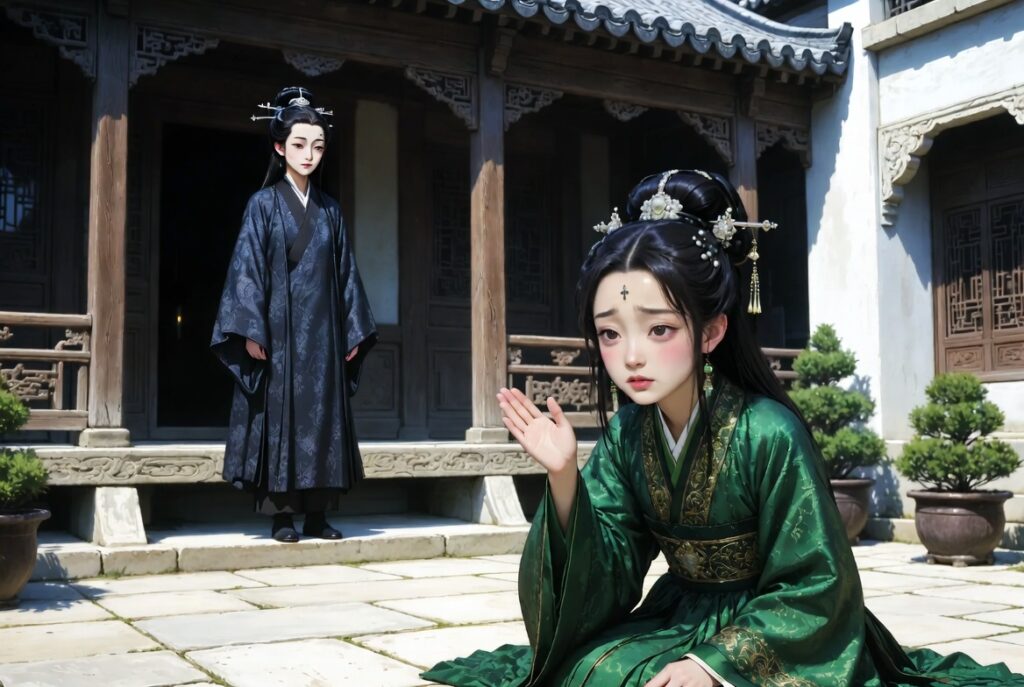
At fourteen I became your wife, with knitted brows I served your parents. Though my family were but reclusive scholars, my husband’s ways were those of a poor student. Our lineages were ancient and matched, our reputations not far apart. I did not complain that my coat was not of silk, nor did I crave pearls for my pendants. Holding the ritual gifts, I approached the ancestral temple; grasping the ladle, I entered the kitchen. Your father and mother were pleased and content; even the chores of laundry brought joy. Who knew that the times would change? Who suspected the heart of the world would turn? A wife’s virtue remains a wife’s, but a husband’s heart is no longer a husband’s! The gold grows long, yet affection grows short; the body is present, but love has withered. In days past I was no great beauty, yet am I truly an eyesore today? Only because your mind is unstable has your intent drifted away. When wood rots, the worms enter; when a man doubts, slander begins to wound. How can you endure to cast out the dove, or let the magpie be driven away? I cry out to the heavens with a great sigh; I strike the ground with a long groan! Fate is indeed cruel to a fair face, and fortune flees from a loyal heart. From this day, we are like spilt water—on what day will the soul-returning coin bring me back? The blue sky offers no answers; the bright sun cannot hear my call. Surely there is a mirror in the Underworld that shall shine upon this black-hearted slave!
Now, when Chao Zhu arrived in the capital, he searched and inquired everywhere until evening before finally locating Hu Dan. At that time, the night patrols were extremely strict, so Chao Zhu stayed the night with Hu.
As it turned out, the eunuch Wang Zhen had made up his mind that the Emperor should lead the campaign personally. The civil and military officials had knelt before the Emperor’s horse, desperately pleading with him to stay, but to no avail. By the time the Imperial carriage reached the place called Tumu, the danger was already extreme. Had they rushed into the city, they might have been safe; however, Wang Zhen had over a thousand carts of his own personal baggage trailing behind. Because he refused to let the Emperor move quickly until his belongings caught up, the Mongol leader Esen’s forces swarmed them like hornets and unleashed a barrage of ten thousand arrows.
Truly, it was only through the protection of the gods that the arrows, falling like rain, all landed in front of the Emperor and stuck into the ground; not a single half-arrow touched his person. Esen’s men were astonished; they approached to identify him and realized it was the Emperor himself. Like a divine dragon losing its water, the Emperor was swept away by the swarming horde. The civil and military officials in his retinue were slaughtered to the last man. Wang Zhen, along with the two Brocade Guard commanders, Su and Liu, were among the dead. High and low, everyone wished they could exterminate ten thousand generations of Wang Zhen’s clan. Consequently, Hu Dan and Liang Sheng were hiding away like dormant insects in winter.
The two men rose at the fifth watch. Hu Dan put on two pieces of ragged clothing and smeared his face with soot to darken it. Since Chao Zhu had frequently visited the houses of the Su and Liu families, he feared being recognized, so he changed his appearance as well. They went to a secluded spot to find Liang Sheng and told him that Master Chao had urgent business and had sent for them. Liang Sheng had no safe place to hide in the capital and was already considering seeking refuge at Master Chao’s post; the timing was perfect. Liang Sheng also changed into tattered clothes and a broken hat, packed a few valuables, and loaded them onto Chao Zhu’s mule. They slipped out of the city gates, hired a donkey, and reached the Tongzhou yamen by breakfast.
When Old Master Chao and his son saw Liang Sheng and Hu Dan in such a ragged state, they were shocked. Upon hearing the explanation, they realized the gravity of the situation. The guests were taken to the study to wash up, changed into modern scholar’s robes, and formal greetings were exchanged over a meal. When the conversation turned to the Huating legal matter, they realized that since their connections—the Brocade Guard commanders Su and Liu—were now dead, they needed a new path.
Liang Sheng said, “This is not difficult. The Hanlin Scholar Xu is currently the most influential official in the capital and is a close acquaintance of Hu Dan. Let Hu Dan write a detailed letter, and if the Young Master prepares a generous gift and goes to the capital to petition him personally, the matter will surely be settled.” Old Master Chao and his son were overjoyed.
After the meal, Hu Dan finished the letter and Chao Yuan took it. He prepared thirty taels of gold leaf and eight large “barbarian” pearls and set off for the capital immediately. The next day, he arrived at the private residence of Hanlin Scholar Xu. He gave ten taels of silver to the gatekeeper, who became so delighted that he moved “like a horse running” to bring him in. Xu read Hu Dan’s letter and accepted Chao Yuan’s gold and pearls.
While entertaining Chao Yuan with wine, Xu wrote two letters: one addressed directly to Inspector Jiang and one to the Judicial Judge of Songjiang. The letters stated: “The crimes of Song and Cao cannot be pardoned, but I ask that you record a smaller amount of stolen loot and spare them from torture. As for Sun Shang and Chao Shu, those are merely aliases; please refrain from issuing formal warrants for their arrest.” In return, Xu presented Chao Yuan with a piece of white silk calligraphy, a folding fan with real gold leaf writing, a family-printed literary collection, and a bolt of “Plum Duke” cloth. Chao Yuan received the letters on the twelfth day of the third month. Under a bright moon, he hurried out of the city gates. By the third watch, he arrived in Tongzhou, had the city gates unlocked, and entered the yamen. Liang and Hu had long been asleep. Chao Yuan went to his father’s bedroom, sat on the edge of the bed, and explained everything in detail. Old Master Chao did not feel the “pain in his flesh” for the wealth he had spent; instead, he was as happy as if he had just found a great treasure.
Liang Sheng and Hu Dan, being well-connected to influential families, were treated by the Chao father and son as esteemed guests with the utmost respect. Old Master Chao addressed Liang Sheng by his courtesy name, Anqi, and Hu Dan as Junchong. Since they had become sworn brothers with Chao Yuan, the Old Master referred to them as his “worthy nephews.” All the servants addressed them as Master Liang and Master Hu, and neither Madam Chao nor Zhen-ge avoided their company. However, when news arrived that Wang Zhen and the two Brocade Guard commanders, Su and Liu, had been killed—and that the families of these “traitorous officials” were being hunted down—the Chaos’ hospitality toward Liang and Hu cooled by half. Even though Chao Yuan had met Hanlin Scholar Xu, they doubted if the connection was as solid as Hu Dan claimed.
But as Liang and Hu chatted with Old Master Chao, mentioning their other acquaintances in the various halls of the Brocade Guard and their relatives among the high officials at court, the two were once again held in high esteem. It was decided that Liang and Hu would stay hidden in the yamen for the time being to monitor the situation in the capital. The next morning, the thirteenth, Song Qiren and Cao Xijian were given six taels each for travel expenses along with the two letters for Scholar Xu’s contacts. After breakfast, they were sent on their way.
On the fifteenth, a banquet was held in the yamen to see Chao Yuan off. He packed a great deal of official gifts and wealth to take home for purchasing property. The Old Madam called Chao Zhu and his wife to the back and gave them strict instructions:
“When you two get home and see the Young Mistress (Lady Ji), tell her this is my message: Now that the Young Master has taken someone into his chambers, it’s a common enough occurrence. Originally, she should have stood her ground and refused to allow it; then the Young Master would have had to let it be. She shouldn’t have been so soft-hearted and given in so easily. Even if he were to look for a concubine, he should have found a daughter from a respectable, quiet family. Why on earth pick a stage actress? With those shifty, flirtatious eyes, she’s quite unseemly! But since the raw rice is already cooked into porridge—like tofu dropped in an ash pit—can you blow it clean? Can you flick the dirt off? She must simply resign herself to it and be magnanimous. Tell her not to get angry over trifles. Be patient in everything, and when I return home, I will settle things.
“Here are fifty taels of broken silver for her personal use; here are two taels of pearls, two taels of gold leaf, two bolts of raw silk, one bolt of Jintan kudzu cloth, one bolt of sky-blue satin, one bolt of rose-pink ‘Ba family’ silk, two sets of skirts, and two catties of silk floss. Keep these safe and deliver every single item to the Young Mistress. When I get home, I will check them one by one. If a single thing is missing, I’ll settle the score with you two! And don’t you dare try to curry favor by telling Auntie Zhen about this!”
Chao Zhu and his wife promised fervently and took the items.
The next morning, the sixteenth, Chao Yuan and Zhen-ge, along with their retinue of servants, bid farewell to Old Master Chao and his wife. Chao Yuan also took his leave of Xing Gaomen, the traveler Yuan, Liang Sheng, and Hu Dan. He and Zhen-ge boarded their sedan chairs in the rear hall, while the others mounted their animals and set off. Truly, for Chao Yuan:
Accompanied by plenty of white silver, With a beauty in red by his side. His traveling style is dashing and grand, Heading back to his home in Yangzhou.
It was only difficult for the elderly Chaos, who were left behind in loneliness and desolation, overcome with emotion at the parting.
Carrying heavy wealth, bringing along his beloved concubine, riding in an official sedan chair the size of half a room, and followed by a pack of fierce servants and seasoned maids, Chao Yuan traveled through the mild spring weather of a bountiful year. The roads were clear, and he felt immensely satisfied. Yet, such is the way of the world: when joy reaches its peak, sorrow often follows; when everything is too smooth, trouble is bound to arise.
Chao Yuan traveled over seven hundred li and reached Dezhou. It was not yet noon when dark clouds began to gather from the northeast, and a fine drizzle grew steadily heavier, forcing them to find a clean and spacious inn to rest. After lunch, the rain poured down even harder. It is an old saying that “spring rain is as precious as oil,” but this year, oil was far scarcer than rain; it poured incessantly for two days straight. Chao Yuan ordered his servants to buy side dishes and good wine to drink and make merry with Zhen-ge to ward off the boredom.
Now, Chao Zhu’s wife was surely the reincarnation of a wooden horse—her tongue, when stuck out, was half again as long as her body. She was also the spirit of a fawning sycophant, habitually diligent in petty service but shallow in loyalty. Because she was a person of poor character, Heaven had granted her a “living retribution,” turning her into a broken steamer—capable only of letting out hot air. Having nothing to do because of the rain, she incessantly interjected herself into Chao Yuan and Zhen-ge’s conversations. This might have been tolerated, but her meddling mouth grew restless; she began to recount, in painstaking detail, everything Madam Chao had instructed and every bit of silver, pearl, and silk she had sent back for Lady Ji.
Chao Yuan tried to signal her to stop by winking and twisting his mouth, but she had worked herself into such a fervor that she couldn’t hold her tongue. Had she merely repeated Madam Chao’s words as they were, it would have been enough to “beat the grass and startle the snake,” but she added her own venomous flourishes. She claimed the Madam said:
“That rotten, stinking piece of trash! Even if a cuckold knelt in the street to offer her for free, I’d fear she’d soil the threshold! She ought to be driven away with a club! Why allow him to waste eight hundred taels of silver on such a slave? I wanted several times to call her out, strip her naked, cut off her hair, and beat her to death or give her away to a beggar—but such things are hard to do in the yamen. Tell the Young Mistress not to be angry; once the old lady returns home, she will settle things herself.”
Consider this, dear reader: back when she was an actress playing female leads, Zhen-ge would let anyone ruffle her feathers, kick her shins, poke her eyes, or tweak her nose; she endured being called a whore or a beggar’s brat. But now she had cultivated the sensitive temperament of a pampered flea—how could she endure such words? She immediately tore off her hairpins, loosened her hair, and began a frantic fit of screaming to Heaven, cursing the Earth, rolling on the floor, and banging her head. The innkeeper’s wife and the neighbor women crowded around the door to watch; the waiters and wine-boys stopped in their tracks to listen from the back of the inn. Thanks to her own loud hysterics, her background and history were made crystal clear to everyone, saving the listeners the trouble of asking around. Chao Yuan and Chao Zhu both turned their blame on Chao Zhu’s wife, who began to feel terrified and ashamed.
Zhen-ge cried and shrieked for half the night. The next morning, though the rain stopped, she grumbled, ranted, and cursed all the way home. Among the returning servants and maids, some went to the inner quarters to see Lady Ji. Chao Zhu relayed Madam Chao’s instructions one by one and delivered all the items she had sent. Lady Ji inquired after her in-laws’ health, read the letter, and wept bitterly to the heavens before taking the silver, pearls, and silks into her room.
The following day, Zhen-ge demanded the items Chao Zhu had brought for Lady Ji. Chao Zhu said, “They were already sent to the back and handed over to the Young Mistress yesterday.” Although Zhen-ge nagged Chao Zhu for a bit, she didn’t want to truly lose face with him. Instead, she turned her heavy scolding and bloody curses toward Chao Yuan.
Despite his infatuation, Chao Yuan felt a twinge of discouragement and said, “You are being quite unreasonable! What is it that we don’t already have? My mother sent a few trifles to her—why are you so obsessed with them?”
Zhen-ge replied, “It’s not about the things; it’s about the insult! Why is it that after I kowtowed my head off with all those ritual bows, the two old ones only scraped together two taels of silver to throw at me? The weather is getting warmer—if you had taken two bolts of that fine gauze meant for windows and let the servants see it, we’d still have some dignity. But now they send all these things to her while I’m right here!”
“Even if I have a thousand taels or ten thousand taels, it’s my own business! If I want it back, I’ll take it back, and I’m not just going to let it sit there! I’ll scatter the gold and pearls to the winds! I’ll rip the silks to shreds and burn them!”
Chao Yuan retorted, “You, Wife of Jiang the Fifth, have such petty courage! Those things were sent by my mother for her. If you scatter them or rip them, it’ll be as if you didn’t have the guts to do it in the first place. That old man Ji and his son are no pushovers; they’ve been talking big outside! And as for my mother’s temperament—don’t be fooled by her kind eyes and gentle face. She only dotes on me; if she truly turned against you, I fear she’d actually carry out those threats Chao Zhu’s wife mentioned. You’d better act like a sensible person and stop banging your head against a stone wall!”
After a few such rebukes, Zhen-ge’s fury gradually simmered down. It is evident that if a husband stands his ground and acts within the bounds of propriety and discipline, even the most wicked or fierce concubine will feel a sense of dread. For a shrew like Zhen-ge, once Chao Yuan spoke a few words that sounded like a man of authority, she could only “swing her arms behind the wall”—letting go for now, but secretly nursing her grudges, lowering her voice, and plotting her cunning schemes.
To continue the tale: In the prefectural city, there was a regional commander named Liu. Commander Liu’s mother had a maidservant named Xiao Qingmei, who was sixteen years old. Suddenly, she fell ill with “dry blood consumption” (amenorrhea/wasting). With this disease, whether it progressed fast or slow, eleven out of ten were destined to die. Madam Liu desperately tried to save her. Qingmei herself made a vow: if she recovered, she would willingly leave the secular world to become a Buddhist nun.
As the saying goes, “Medicine heals the illness that isn’t fatal; Buddha saves those with whom he has an affinity.” A traveling doctor, who rang a brass ring to announce his arrival, happened to be taking shelter from the rain under the main gate. The gatekeeper struck up a conversation with him, mentioning that the girl’s dry blood consumption was incurable.
The doctor said, “This illness has two types. If it’s due to a naturally weak constitution where the ‘Qi’ and blood are utterly depleted, it’s like a dry well—no matter how much you scoop, there’s no water. But if it’s caused by a temporary blockage of ‘Qi’ that has stifled the blood flow, then a little clearing and dredging will naturally fix it. How can you say it’s always incurable?”
The gatekeeper consulted him about Qingmei’s condition. The doctor replied, “Let me take a look. If I can treat it, only then will I dare prescribe medicine.” The gatekeeper went inside to tell Madam Liu, who then had Qingmei come to the inner gate for the doctor to see.
The doctor stood there, took Qingmei’s hand to feel her pulse, and noted that although her face was sallow and yellowish, she wasn’t as thin as a ghost. He concluded, “This is no big deal. One dose of medicine and you’ll see results.”
Madam Liu said from behind the door, “The girl has no father anyway. If you heal her, I will make you a purple cotton robe, a silk cap, and a pair of shoes and socks. Do you have an old wife? If so, I’ll make her a set of cotton clothes and a skirt. We’ll even recognize you two as her adoptive parents.”
The doctor’s face bloomed with joy. Madam Liu brought out two hundred cash as a “good luck” fee to open his medicine chest. The doctor said, “Since this young lady is to recognize me as her father, how can I accept this gift?”
Madam Liu replied, “It’s a small amount, just to start your business today.” Only then did the doctor accept it. He took out a packet of pills about the size of mung beans, counted out seven, and instructed they be taken with a decoction of safflower and peach kernels at a time far from a meal.
While the servants prepared a meal for the doctor in the small front hall, the medicinal base was brewed, and Qingmei took the pills. After about the time it takes to drink a cup of hot tea, her stomach began to ache. Eventually, after two sharp pangs, she discharged two or three liters of foul-smelling, blackish water, followed by a bit of fresh, bright red blood.
When told of this, the doctor said, “The illness is cured. She must avoid cold water, onions, garlic, and raw foods. If she takes ten doses of strengthening medicine from a good physician to restore her vital energy, she will soon be robust.”
From then on, Qingmei’s complexion gradually lost its yellow tint. Her menses returned, increasing from a little to a normal monthly cycle. Madam Liu indeed prepared the clothes and shoes and had Qingmei formally acknowledge the doctor and his wife as her parents. Because of her vow, Qingmei nagged Madam Liu every day about becoming a nun.
Madam Liu said, “Do you think being a nun is easy? You only think there are benefits because you haven’t become one yet.”
Madam Liu said, “If you become a nun and find you don’t like it, it will be hard to return to secular life! It’s better to wait until your health is more robust, then find a husband and live a normal life—that is the proper path.”
Madam Liu spoke with great earnestness, but little did she know that Qingmei had far more “ambitious” ideas of her own. Qingmei said, “I look in the mirror every day, and my looks aren’t exactly stunning; I’m not cut out to be the pampered wife or glamorous concubine of some young lord. Even if I did become a nobleman’s concubine, I’d be at the mercy of the master’s whims—whether he favors me or not—and the mistress’s heart—whether she’s kind or cruel. It would be like Sun Wukong pinned under Taihang Mountain; where would I find a Guanyin Bodhisattva to peel off the seal and let me out? And even if I were released, that ‘golden fillet’ of restraint would still bind me for life. So, the idea of being a concubine is out of the question.
“Next, there’s the life of a courtesan. That actually seems quite worthwhile—wearing the most exquisite clothes, dolled up to the nines, acting coy and charming before young lords. Every day would be fresh. If I like one, we stay together a while; if I don’t, I just toss his headscarf in the water and call it quits. That sounds fun. But there are downsides there, too: if you don’t get guests, the madam beats you; if you get a guest but can’t control him, the madam beats you. And when you go to a client’s house, you have to bow and scrape, calling everyone ‘Madam’ this and ‘Madam’ that, kowtowing like you’re mincing garlic—and they still won’t like you, acting as if the moment you stepped through the door, you’d bewitched their husbands away. So, being a courtesan isn’t great either.
“Aside from those two paths, there’s marrying a servant or a farmhand. But they’d keep you locked up tight, not letting you take a single step out the door. Even if you managed to eye a couple of other men, it would be as difficult as cracking a melon seed with your teeth. Besides, the labor is backbreaking; I fear I wouldn’t even have enough time to hug my own husband for a full night’s sleep!
“Thinking it over, how could anything be as happy as being a nun? It’s like being a bat—when you see a qilin, you say you’re a bird; when you see a phoenix, you say you’re a beast. It’s just like being a high-ranking official in the Six Ministries—no one can restrain you! Any young, strong, handsome monk with a bit of muscle would be my ‘bridegroom,’ over and over again. The ones I don’t like, I’ll put on a rotating shift; the ones who are useful, I’ll keep around for permanent service.
“And that’s just if I’m a Buddhist nun with a shaved head. Secular men have all sorts of superstitions about Buddhist nuns being bad luck, saying you have to step over their bald heads to break the jinx. But if I become a Daoist nun, I can keep my beautiful black hair. At night, I’ll take off that headwrap, and whether it’s a gentleman, an old master, a scholar, a clerk, or a runner—I can take my pick!
“What’s more, when you go to people’s houses and enter the inner quarters, no matter how fierce, wicked, virtuous, or jealous the wives and daughters are, the moment they see a nun, they somehow become incredibly happy! They offer you tea, they offer you food, they let you sit on the warm kang bed, and they beg you to stay for two or three days. When you leave, they give you cash, silver, clothes, headwraps, shoes, and socks. They donate banners, table covers, grain, sauce, and vinegar—it’s busier than the Fourth Master’s place in Wucheng County! Plus, the ladies often trust you to buy gifts or hire tutors, and you can easily pocket ten taels or so on the side.
“Thinking it over, if I don’t become a nun, what else would I do? No matter how much the Madam tries to keep me, my mind is made up: I’m becoming a nun! If she absolutely won’t let me, then I’ll just have to do one other thing.”
Her companions asked, “What else would you do?”
Qingmei replied, “If I can’t be a nun, I’ll just be a ghost!”
Her friends repeated everything she said, word for word, to Madam Liu.
Madam Liu sighed, “Fine, I’ll give in to this crazy girl and let her be a nun! I want to see her try and find her monks and priests—I’ll see if she doesn’t end up in the magistrate’s clips! Tell her to look at all the masters who visit our house—which one of them wants monks or priests? Tell her to point them out!”
Her companions replied, “We asked her that very same thing, using your words, Madam. She said: ‘Of all the masters who come to this house, which one of them doesn’t want monks or priests?'”
“Point them out yourself!” Madam Liu snapped. “Unbelievable, simply unbelievable! This girl has gone mad! Slandering the daughters of the Buddha like this! I won’t have it, I won’t have it! Quickly, get her a Daoist robe and a Tang-style cap. Send her to the White Clothing Convent at the South Gate to be a disciple to the Great Mistress!”
They consulted the almanac and found that the eighth day of the fourth month was auspicious—it was the day of the Buddha’s Bath. On that day, they bought the robes, prepared the offerings, and Madam Liu personally escorted Qingmei in a sedan chair to the convent. The Great Mistress accepted her as a disciple. There was already a senior “brother” there surnamed Gui, whose religious name was Haichao (Sea Tide); therefore, Qingmei was given the name Haihui (Sea Gathering).
As fate would have it, from the moment Haihui arrived at the convent, her “clashing” horoscope seemed to plague her master; the Great Mistress first fell ill and then died, leaving the two “brothers,” Haichao and Haihui, to manage the establishment themselves. Without a master to restrain her, Haihui finally fulfilled her ambition of being a nun. Truly, she was at a Minister’s mansion today and a Grand Secretary’s home tomorrow, coming and going as she pleased.
When the ladies of these great houses saw her, they found her exactly as she had predicted: she needed no introduction. The Liu family’s extensive network of relatives alone was enough for her to “travel through the warring states” and “feed herself among the feudal lords.” As for the Chaos, being a newly wealthy family, her visits were a given. Even Lady Ji’s maiden family, though they had recently fallen on hard times, was still a family of old prestige. As the proverb says: “A rich man turned poor still wears silk for three years.” Thus, they hadn’t yet closed off the “loopholes” that allowed such nuns entrance. Haihui had often visited the Ji family, and in the past year, with Chao Yuan away, her visits to Lady Ji had become more frequent. However, she was only there to swindle a few pieces of clothing or engage in idle gossip; no truly scandalous business had taken place yet.
Later, a new nun arrived from Jingzhou. Surnamed Guo, she was in her thirties—a fair, plump, and neatly dressed woman. Rumor had it she was originally a prostitute before taking the veil. She was clever, sharp-tongued, and persuasive, and she took up residence in Haihui’s White Clothing Convent. Haihui introduced this Nun Guo to all her regular patrons among the wealthy ladies. Because Haihui visited Lady Ji so often, Nun Guo also became very friendly with her.
Who could say if this Nun Guo was a good person? She acted as if every deed she did was virtuous! But this “bald-headed woman” was excessively cunning; she was an expert at reading eyes and “sailing with the wind.” When she entered a house and saw that a lady was of loose morals, she had many clever ways to lead her down a wicked path. But if she saw a lady was virtuous and proper, she would become utterly sincere, putting on the solemn face of the Neo-Confucian masters, talking of “rectifying the heart and making intentions sincere.” She could even lecture on the classics.
Consequently, the “wicked” ladies praised her to high heaven, while the “virtuous” ones declared her a truly devout monk who would surely achieve Buddhahood within a day or two. Now, Lady Ji’s only real flaw was her stubbornness and her desire to subdue her husband. Although she was a “fox spirit” in the sense of her past-life karma, she knew nothing of bewitching men or acting coquettishly to gain favor. This was why Chao Yuan had lost interest in her so quickly. Even though Nun Guo visited her, she couldn’t find a way to plant any wicked thoughts in Lady Ji’s mind.
Meanwhile, Zhen-ge, having heard the gossip from Chao Zhu’s wife, had been forced into a sullen silence, but she was like a pot of beans—just looking for a fire to start roasting. It happened to be the sixth day of the sixth month, and the inner courtyard was filled with laundry lines. As Zhen-ge watched the servants hanging clothes to dry, she saw Haihui in front and Nun Guo behind, walking out from Lady Ji’s quarters toward the exit.
Zhen-ge began screaming and making a scene. “What a fine gentry family! What a ‘pure and quiet’ household! What a ‘well-bred’ young lady! In broad daylight, at high noon, a big-eared, fat-headed Daoist and a fair, plump, sturdy monk come strolling out of her rooms one after the other! I may be a ‘baseless’ stage actress who picks up men and takes guests, but at least I pick decent-looking ones! As for these stinking ‘ox-noses’ and foul ‘bald donkeys’—even if I went ten thousand years without a man, I wouldn’t want them!”
She ranted and raved without end.
Chao Yuan had been napping on the west pavilion. Hearing the commotion in the courtyard, he sat up dazed, slipped on his shoes, and hurried over to investigate. Zhen-ge, naturally, was still in the middle of her tirade. She pointed right at Chao Yuan’s face, hurling curses at him, calling him a “bastard” and a “cuckold” a thousand times over.
“If only the Old Madam were home to see what a ‘pure and quiet’ household her precious daughter-in-law comes from!” Zhen-ge jeered. “If I had done such a thing, my hair would have been shorn, my clothes stripped off, and I’d have been handed over to the beggars while I still had a breath in me!”
Chao Yuan asked, “Is this for real? It’s high noon—what monk or priest would dare walk out of here so boldly?”
“Look at this dim-witted turtle!” Zhen-ge barked. “Am I the only one who saw it? All the maids and wives were out in the courtyard drying clothes—who among them didn’t see it?”
Chao Yuan questioned the crowd. Some remained tight-lipped, while others muttered, “It was a bit blurry, but didn’t a priest and a monk just walk out?” Another piped up, “That wasn’t a priest; it was Xiao Qingmei from Commander Liu’s house.”
Chao Yuan said, “Qingmei is a nun now, but she’s grown so sturdy she does look like a priest. But who was that monk?”
Someone replied, “We didn’t recognize the monk. He was walking with Qingmei, so perhaps it was just another nun.”
“Pah!” Zhen-ge spat. “As if your house has a nun with such a massive frame and a fat, round head!”
“Say no more,” Chao Yuan concluded. “That brat Qingmei is a notorious matchmaker. She must have smuggled a monk in disguised as a nun! Quick, call the gateman!”
It was Qu Jiuzhou’s turn to guard the gate that day. Chao Yuan asked him, “A priest and a monk—when did they go to the back? They just left; did you see them?”
“What priest? What monk?” Qu Jiuzhou replied. “It was Xiao Qingmei from Madam Liu’s and a nun. They went back to the Young Mistress’s quarters around mealtime and just left. If they were priests or monks, why would I have let them in?”
“The priest was Qingmei, that’s clear enough,” Chao Yuan said. “But who was the nun? You know all the ‘bald women’ in this city. Who was the one who just left?”
Qu Jiuzhou thought for a moment. “I didn’t recognize that nun. I’ve never seen her before.”
Zhen-ge spat at Qu Jiuzhou and cursed, “If you didn’t recognize her, how do you know she was a nun? Did you feel her yourself?”
“Could a monk be that fair-skinned?” Qu Jiuzhou argued. “And so well-fed looking?”
“If it were some dark, scrawny, beggarly face, she wouldn’t have wanted him!” Zhen-ge mocked.
Chao Yuan paced back and forth, fuming. “Enough! I won’t be made a fool of! Go fetch old man Ji and his son immediately!”
Shortly after, the messenger tricked the Ji father and son into coming, claiming Lady Ji wanted to speak with them. Once they were seated in the hall, Old Ji said, “Since my son-in-law returned home, I’ve been meaning to visit, but I lacked the face to show up. They said my daughter wanted us to talk, so we’ll go to the back now.”
“It wasn’t your daughter who invited you,” Chao Yuan said. “I invited you here to tell you something.”
“Tell us what?” Old Ji asked. “Surely my daughter hasn’t taken a lover and made a cuckold out of you?”
“If it wasn’t that, what else would it be?” Chao Yuan replied. “You’re a regular diviner—one guess and you hit the mark.”
He then recounted how Xiao Qingmei had led a “fair, plump, neat-looking monk” inside during the morning and out at noon, witnessed by everyone. He added, “Your daughter is unfilial in every way, which is common enough for wives, and I’ve endured it with a plugged nose. But now she’s gone and done this! Though I took a singing girl, she has acted with the utmost dignity since entering this house. As the Great Learning says: ‘Look not at what is contrary to propriety, listen not to what is contrary to propriety…’ She’d never make a turtle of me. But your daughter, my legal wife, does this! I’ve invited you to discuss it. Whether I take this to the officials or let you quietly take her away—that is up to you.”
That old man Ji spoke up calmly and deliberately, saying: “Chao Yuan, calm down. Don’t push your words so far that you can’t take them back. This morning, Xiao Qingmei and that Nun Guo from Jingzhou came out of my nephew’s courtyard and headed east; they were bound to come here. That Nun Guo wears an oil-green gauze robe and a blue vest—is that not so? Is she some kind of hermaphrodite who grew a tail in addition to her female parts? Which of the princely mansions, noble houses, or great gentry families in this city has she not entered? Has Xiao Qingmei smuggled monks into all of their homes too? Since you’ve spoken out, this tile has to hit the ground. If you want to withdraw your troops, do it now. My daughter hasn’t stood in your way of doing anything! These past two or three years, she hasn’t asked you for a single piece of clothing; she’s still eating the grain from the dowry lands my family gave her. If you want to take me to court, I’ll go to court and say three things to you!”
The elder brother Ji interjected: “Father, you don’t see through him. He has completely lost his conscience! He’s calculated this perfectly; if you don’t go along with him, he’ll use any excuse to ruin my sister! If he says he wants to divorce her, let him! We have a bowl of rice for her at our house! We’ll wait at home; Master and Madam Chao are bound to return one day, and we’ll speak to those who are reasonable and educated. What’s the use of arguing black and white with him now? You talk of going to court, but is there a Judge Bao in office today? He’ll just send two or three hundred taels via the runners and submit a letter from the Old Master, and then the lie will become the truth. If a father and son go to court and the son dies, it’s us who are finished! Master Chao, do as you please. If you want to divorce my sister, write the letter. I’ll go home, fix up a room, and take her back. What’s so difficult about that? You gentry families talk about ‘going to court’ as soon as you open your mouths. You don’t realize that us ‘common folks’ get so scared at the mention of an official that we practically piss vinegar!”
Old Ji said, “Come on! Let’s go to the back and ask your sister!” And they went to the inner quarters.
Who would have thought that while the front was in an uproar, Lady Ji in the back was as if in a dream. When the Ji father and son told her the news, she was so enraged she nearly lost her life; her jaw locked and she almost fainted. After a long while, she finally spoke: “So I’m ‘keeping a monk,’ am I? He’s allowed to take a prostitute, but I’m not allowed to keep a monk? Since he caught us, why didn’t he grab the monk with his own hands? Why did he let him escape? Now that there is no monk, never mind if I kept one—even if I kept ten, all he can do is stare and fume! Tell him to write the divorce papers and I’ll go! If I linger for a second, I’m not a good woman! Father, Brother, you go home for now and come back early tomorrow; we’ll talk then.” The Ji father and son then left.
When they reached the main gate, they saw their neighbor Yu Mingwu and the county clerk Yang Taixuan standing there, discussing buying plums. Seeing Old Ji, they bowed and asked, “Uncle Ji, wait a moment! Have you been visiting Brother Chao?”
Old Ji was panting with rage as he explained the long and short of it. “Now he’s written a divorce letter and wants to cast my daughter out. I’m going home now to fix up a room and take her back.”
Yu Mingwu said, “This is like seeing ghosts! What priest or monk? I was just seeing off a guest when I saw Haihui and Nun Guo coming out from across the street. When the two of them approached, I even teased them. I said: ‘Master Haihui, you have hair, so you don’t mind the sun. But Master Guo, you have a bald head; we can’t stand the midday sun, so hurry inside, eat lunch, and wait for it to cool down before you go.’ They are eating at my house right now! This Brother Chao is surely listening to people’s nonsense for no reason!”
The clerk Yang Taixuan added, “It seems the Prefectural Magistrate is a bit displeased with Master Chao lately.”
Yu Mingwu asked, “Why is that?”
Yang Taixuan replied, “If it’s the scholars who entered the Academy through the regular exams, they usually follow the old rules when sending petitions…”
“If you’re a commoner entering the Academy through purchase, the old rule is to use a formal petition (shouben). Yesterday, Master Chao used a common visiting card (tiezi) to pay his respects to the Magistrate. The Magistrate took one look, snorted, shoved the card under the table, and said nothing—he didn’t even accept the gifts.”
As they were speaking, Lady Ji appeared with her hair disheveled. She wore an old sky-blue gauze jacket over a small yellow raw-silk shirt and an old white soft gauze skirt. In her hand, she brandished a glittering white dagger. She came charging out from the inner quarters, cursing loudly all the way to the main gate:
“You bastard! You whore! Come out here! Let’s settle this in front of the neighbors! I haven’t lived here long, but the neighbors surely know my character. Since this bastard took that whore to his post for nearly a year, have I been keeping monks or priests at home? Has such a thing happened? It cannot be hidden from the eyes of the neighborhood! Just because Nuns Hai and Guo stopped by for a moment, he says I’m keeping monks in broad daylight and calls my father and brother to write a divorce decree!
“Listen, everyone! These two nuns—which house in this city, great or small, have they not visited? Are they all ‘monks and priests’ then? I don’t care about dignity anymore! I’ll make this clear to all you neighbors and passers-by so that when I die, you can testify for my poor old father and brother. You thieving bastard! If you caught a priest coming out of my room, come out here and explain it to the street! If you want to kill me or divorce me, at least have a reason—don’t just hide your head like a turtle! I won’t waste my life against that whore; I find her too low! I only want to settle this with you, thieving bastard, even if it costs my life!”
She tried to bolt out into the street. The gateman, Qu Jiuzhou, knelt on the ground, blocking her with both arms and kowtowing as he begged her to stop. Zhen-ge had the inner gate bolted tight as a drum, not daring to make a sound. Chao Yuan hid behind the second gate, shouting: “Qu Jiuzhou! Hold back the Young Mistress! Don’t let her get out into the street!”
Passers-by, seeing a young woman from a gentry household making such a scene, assumed it was some outsider seeking redress, but word soon spread that it was Chao Yuan’s own wife. Nearly ten thousand people gathered to watch.
Yu Mingwu said, “It’s not proper for us men to go forward and intervene. Uncle Ji, Brother Ji, you must persuade the Young Mistress to go back inside. What kind of families are yours? What will become of your dignity?”
Old Ji replied, “Looking at this, it’s clear they cannot coexist. What face do I have left to go and persuade her?”
When Nuns Hai and Guo, who were eating at Yu Mingwu’s house, heard the cause of the uproar, they tucked their tails and slipped out the back door in a cloud of dust.
Yu Mingwu ran to Sister-in-law Gao’s house and said, “The Young Mistress across the street is having a row and has run out into the main road. It’s most unseemly. We men can’t very well go and persuade her. Sister Gao, you must go and get her back inside. No one else can talk her down.”
“I wanted to go out and see for myself earlier,” Sister Gao said, “but I was busy reeling silk from cocoons.” She grabbed a raw-silk skirt, put it on, and hurried out. She approached Lady Ji and performed two deep bows. Despite her rage, Lady Ji felt compelled to return the gesture.
“Listen to me, my dear Sister Chao,” Sister Gao said. “If we women don’t hold the high ground ourselves, how can our words carry weight? No matter how great the Master’s fault is, you can fight him until the sky falls inside your own house and no one will interfere. But for the wife of a gentry family, living in such deep courtyards and grand halls—are you afraid the shouting won’t be heard inside that you have to run out to the street? Men have thick skin; you won’t shame him much, but we women must protect our own dignity! Listen to me, take your grievances back inside. I’ll make sure those two apologize to you.”
“I’ll make him kowtow to you a hundred times! If he only does ninety-nine, and I let him off, I’ll change my family name from Gao! My dear Sister Chao, listen to what I’m saying and get back inside! Officials pass by this main street constantly. If they see this crowd and ask what’s happening, they won’t see how the Master and his concubine mistreated you; they’ll only see you making a scene in public. Officials protect their own—it won’t cost the Master anything, but I fear it will bring trouble to your father and brother, and then you’ll lose even more face.”
Hearing this, Lady Ji—though still stubborn in speech—realized that running into the street was indeed a mistake. She allowed Sister-in-law Gao to guide and push her back into the inner quarters. Once inside, she poured out the whole story from beginning to end.
Sister Gao said, “I understand. Reason with him inside the house, but don’t put yourself in the wrong by going outside.” She then whispered into Lady Ji’s ear, “Just that bit of running into the street to curse him… that’s enough to justify a divorce if he pushes it.” After saying this, she rose, bowed twice in apology for interfering, and left. Lady Ji called a temporary truce for the night, waiting to see who would prevail the next morning.
Translator’s Note:
1. The Tumu Crisis (土木之變)
The chapter opens with a vivid description of a massive historical turning point. In 1449, the Zhengtong Emperor was captured by the Mongols after his army was annihilated at Tumu.
- The Villainy of Wang Zhen (王振): The text blames the eunuch Wang Zhen for the disaster, specifically noting that he stalled the retreat to protect his personal luggage (輜重).
- The Satire: The author uses this national tragedy to explain why Chao Yuan’s “scholar” friends, Liang and Hu, are in hiding. They aren’t patriots; they are just cockroaches scurrying for cover now that their powerful patrons (the Brocade Guard) have been killed in the war.
2. The Symbolism of the “Shoes and Pillows” (鞋枕)
When Zhen-ge first meets the elderly Chaos, she presents “shoes and pillows.”
- Meaning: In traditional Chinese culture, a new daughter-in-law or concubine would hand-sew shoes for her in-laws to demonstrate her domestic skill, humility, and willingness to serve.
- The Irony: Zhen-ge is a stage actress with “shifty eyes” (斬眉多梭眼). Giving these gifts is a calculated performance of “virtue” that the Old Master sees through immediately, comparing her to the legendary “femme fatales” of history (Xi Shi, Diao Chan, and Da Ji).
3. “Raw rice cooked into porridge” (生米做成熟飯)
- Idiom: Shēng mǐ zuò chéng shú fàn.
- Meaning: An equivalent to “the die is cast” or “what’s done is done.” Madam Chao uses this to tell Lady Ji that since the sexual relationship and the purchase are already finalized, she has no choice but to accept Zhen-ge’s presence.
4. The “Dry Blood Consumption” (乾血癆)
The subplot of Xiao Qingmei introduces a medical-cultural concept.
- Context: This was a traditional diagnosis for amenorrhea (loss of menstruation) accompanied by wasting. It was often associated with “repressed emotions” or “stagnant Qi.”
- Narrative Function: This medical miracle sets up Qingmei’s vow to become a nun, which provides the “loophole” Zhen-ge later uses to frame Lady Ji for adultery.
5. The “Nuns vs. Courtesans” Monologue
Qingmei’s cynical breakdown of her career options is a masterpiece of late-imperial satire.
- The Bat Metaphor: She compares nuns to bats—creatures that claim to be birds when among birds and beasts when among beasts. This highlights the “liminal” status of nuns who could enter the private “inner quarters” of wealthy homes (where men were forbidden) while maintaining a scandalous level of freedom in the outside world.
- 父母官 (Fùmǔguān): “Father-and-Mother Official.” Used here to show the patriarchal duty the Magistrate owes his people, which Chao Yuan’s father is failing miserably.
- 隔牆撩胳膊 (Gé qiáng liáo gē bo): “Swinging one’s arms behind a wall.” A colloquialism for a hollow threat or acting tough when the person can’t see you. It describes Zhen-ge backing down from Chao Yuan’s rare display of authority while secretly plotting his ruin.
- 三句甜,兩句苦 (Sān jù tián, liǎng jù kǔ): “Three parts sweet, two parts bitter.” A way of describing the art of persuasion or “tough love” used by Sister-in-law Gao to calm Lady Ji.
0 Comments