

Chapter 7: The Old Madam Dotes on Her Son and Accepts Zhen-Ge; The Great Master Abandons His Parents to Flee from Danger.
by Angie Bellender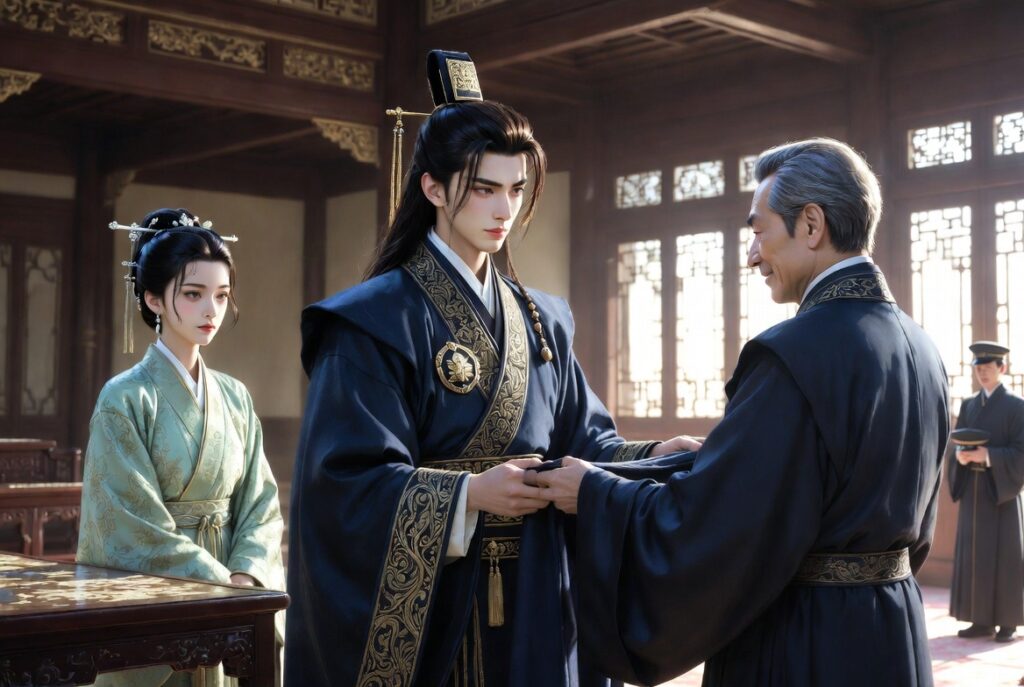
Separated from her son for years, across three thousand miles, Leaning by the gate in longing, the mother gained only a withered face. Now finally reunited, yet he is led astray by another. Her heart hangs in suspense; she helps bring them together so he won’t linger afar. Before their daily routines are even settled, urgent feather-dispatches suddenly arrive, Fierce beacon smoke and battle drums echo from the distant horizon. Claiming he holds no official post, what does he care for loyalty or virtue? Taking his wild fowl as his companion, he abandons his parents and flees for home.
Chao Yuan and Zhen-ge fooled around for a while. In the inner room, a maid set a small low table on the heated brick bed and served their meal. As they were eating, a maid ran in, flustered, and said, “There are several mice clinging to the red cat’s cage stealing its food!”
“Nonsense!” Chao Yuan exclaimed. “How did the cat react?”
“The cat didn’t do much of anything,” the maid replied. “It just sat there with its eyes half-closed, sleeping.”
Zhen-ge mocked, “A ‘Buddha cat’ doesn’t bother with mice under its own feet. It only strikes mice that are ten miles away!” She laughed and continued, “I used to think these red cats were born that way, too! A few years back, at the estate of the Imperial Relative, Lord Jiang, I saw my white lion-cat run past. In the sunlight, it looked as red as a drop of blood—it was the strangest thing!
“Lady Jiang laughed and asked, ‘Are you amazed by this red cat?’ She teased me, saying it was an import from abroad, and I believed her. Later, I saw the household concubines and asked them privately. They told me, ‘The Mistress is fooling you! It’s just dyed with madder. If you don’t believe us, go to the rear pavilion; there’s a whole pack of them!’
“Aunt Zhou said, ‘Come look for yourself.’ When we got to the pavilion, sure enough, there was a whole group—about twelve or thirteen of them—red, green, sky-blue, moon-white, and purple. They looked quite beautiful in the sun. I said, ‘Aunt Zhou, give me a red one to play with.’ She told me, ‘Wait until the Master comes out, and I’ll ask him for one for you.’
“Just then, Lord Jiang arrived. Aunt Zhou said, ‘Zhen-ge wants to ask the Master for a red cat.’ Lord Jiang scoffed, ‘What is this cheap little thing? Just give her one! Would I give away something worth a thousand or two thousand taels? Tell her if she performs twenty thousand plays for me, I’ll give her one.’
“I thought to myself: ‘Never mind then! If I spend two cents on madder dye, can’t I just dye a white cat myself?’ Lord Jiang looked at Aunt Zhou and asked with a smile, ‘Did you tell her the truth?’ Aunt Zhou lied, ‘I have better things to do than talk to her!’ Then she winked at me and whispered, ‘If you really want it, just thank the Master!’ I kowtowed, grabbed a red one, and ran. Lady Jiang even asked, ‘What are you doing, running off with that cat?’ I told her, ‘The Master gave it to me.’ When I got it home, everyone who saw it was amazed! But come March or April, it shed its fur and turned back into a plain white lion-cat. Later, Lord Jiang saw me and asked, ‘Where is my red cat?’ I told him, ‘I traded it with someone for a white one.’
“As for that parrot, I’ve had experience with those, too. I once spent three mace of silver at a flower shop to buy one; its beak hadn’t even lost its fledgling red yet. I hung it under the eaves of my room. Every day, guests would come, and it would hear people saying, ‘Maid, Sister wants water!’ or ‘Brother-in-law, go to the side room.’ It heard it so often it learned to say it. Whenever anyone arrived, it would shout before they did: ‘Maid, Sister wants water! Brother-in-law, go to the side room!’
“It said this every single day. One day, Liu Haizhai visited, and the bird shouted, ‘Maid, Sister wants water! Brother-in-law, go to the side room!’ Liu Haizhai was absolutely delighted and begged me for the bird. I wouldn’t give it to him at first. He said, ‘I’ll trade you my black braying donkey for it.’ I asked, ‘What else will you throw in?’ He added a bolt of raw silk, and I made the trade. He took it home and hung it under his own eaves.
“One day, his wife’s brother came to visit. As soon as the parrot saw him, it screamed: ‘Maid, Sister wants water! Brother-in-law, go to the side room!’ His wife’s face turned beet red with shame. The more she tried to hush the bird, the louder it screamed. When Liu Haizhai returned, his wife yelled, ‘Take that wretched thing and put it somewhere far away! It’s disgusting!’ Liu had to have someone hang it way out by the guest quarters.”
“One day, it was Liu Haizhai’s turn to host a meeting for his association. Whenever someone arrived, the bird would scream its lines, which sent everyone into fits of laughter. Liu Haizhai eventually sent someone to bring the bird back to me, but he actually wanted his donkey back! He said I could keep the raw silk as a gift. I told him, ‘The donkey’s already been sold for cash,’ and I didn’t give it back.”
“What happened to that parrot?” Chao Yuan asked.
“One day when I wasn’t home, no one brought it inside for the night, and it froze stiff,” Zhen-ge replied. “Yang Guyue said, ‘Its body is still a bit warm; let me try to treat it.’ He brewed a small cup of ‘Nine-Ingredient Notopterygium Decoction’ and poured it down its throat, then wrapped it in an old handkerchief and tossed it onto the kang bed. He didn’t think much more of it. By sunset, we saw the handkerchief twitching. We unwrapped it, and the bird had actually come back to life! It stayed with us for several more months until one day, while Yang Guyue was simmering medicinal plasters, the fumes choked it to death.” Having finished her story, they finished their meal and cleared the dishes.
Meanwhile, Old Master Chao had expected Chao Yuan to return to the official residence on the twenty-sixth, once the temple fair on the twenty-fifth was over. When the twenty-seventh arrived and he was still nowhere to be found, the Old Master said to his wife, “I have no idea what business Yuan’er is up to in the capital. It’s the twenty-seventh today, and most likely he’s not coming again! I hope he hasn’t been caught in some scandal or blackmail; that’s no joking matter!”
Madam Chao let out a long sigh. “I don’t think there’s anything worth blackmailing him over. However, I’ve heard whispers in the wind—it seems he’s taken a singing girl as a concubine. Now he ignores his wife completely, and she’s practically dying of rage. It seems this singing girl has come along too, and he didn’t dare let us know, so he’s keeping her in the capital.”
“Where did you hear that?” Old Master Chao asked.
“Who would dare tell us directly?” the Madam replied. “It’s just the maids whispering behind our backs. I only caught a shadow of the rumor.”
“To think such a thing is happening!” Old Master Chao said. “Our daughter-in-law is no pushover; would she allow this? I find it hard to believe!”
Madam Chao said, “You certainly make it sound simple! The Emperor may be formidable, but if the common people are weak, they submit; if the people rebel, even the Emperor is helpless!”
“If it’s truly so,” Old Master Chao concluded, “we might as well just bring her to the yamen. Why have him keeping her outside?”
“You decide for yourself,” the Madam said. “It’s just that our daughter-in-law will blame us.”
“We can’t worry about that now. Have someone prepare a place for her. I’ll send someone to fetch her tomorrow.”
Early the next morning, he dispatched Chao Feng with a letter and one hundred taels of silver, ordering him to hurry to the capital. The letter read:
I have but one son in my old age, and he is far away. I deeply wish for you to be by our side day and night to gladden our final years. What business holds you in the capital? The New Year is almost here, yet you still linger? I have heard that when you came, you brought a secondary wife. Why did you not inform me sooner? Staying abroad like this only causes you the hardship of looking two ways at once. I am now sending someone to fetch you and your concubine. Come quickly to the residence to live together, and I shall not reproach you. Fearing you may have miscellaneous expenses, I am sending one hundred taels of silver for your use. Let Chao Feng return first to report. From your Father to Yuan’er.
Chao Feng took the letter and the money, mounted an official horse, and rode into the capital. He found Chao Yuan’s lodgings just as the gate happened to be open. Chao Feng walked straight in and happened to run right into Zhen-ge. She was wearing an oil-green cloud-patterned padded silk jacket, a sky-blue satin vest, and bright red satin trousers—without a skirt—and was playing shuttlecock in the courtyard with Chao Zhu’s wife. Upon seeing Chao Feng, she flew into the house like a startled bird.
Chao Yuan happened to come out from the back rooms at that moment. Chao Feng kowtowed. Chao Yuan asked, “I was just about to pack up and head back to the residence. What are you doing here?”
Chao Feng said, “Because the Old Master waited and you didn’t return, he sent me to fetch you and Auntie Zhen to go back together.”
Chao Yuan whispered, “How did the Old Master and the Madam find out about Auntie Zhen? Who told them?”
“I don’t know how they found out,” Chao Feng replied. “He just ordered me this morning to come fetch you and said you should return immediately. He told me to stay one step ahead to report back. Here is the Old Master’s letter and two packets of silver.” He handed them over.
Chao Yuan opened the letter and, seeing how affectionately his father had written, felt a twinge of guilt. He immediately ordered a meal and wine to be prepared for Chao Feng so the messenger could head back early to report. He began calculating the costs for hiring porters and horses, planning to set out for Tongzhou with Zhen-ge the very next morning. After Chao Feng finished eating, Chao Yuan gave him a reward of three hundred cash and sent back a reply to Old Master Chao, which read:
Your son, Yuan, reports: I have behaved in an unfilial and improper manner; how could I have let my parents know? Now that you have chosen not to hold it against me, I shall bring my secondary wife to pay our respects to you tomorrow. However, I do not wish to reside in the inner quarters; I would like to stay in the study in the East Courtyard. Could you quickly have someone sweep it out? The one hundred taels of silver have been received. Your son, Yuan, respectfully replies.
Chao Feng arrived back at the yamen by lamplight that evening and reported to Old Master Chao and his wife. He told them that Chao Yuan and the newly taken concubine would arrive the next day and had requested the East Courtyard study.
“Did you see the new concubine?” Madam Chao asked.
“When I went in,” Chao Feng replied, “the new lady had her skirt tucked up into her trousers and was playing shuttlecock with Chao Zhu’s wife. When she saw me, she bolted into the house.”
The Madam asked, “What does she look like? Is she talented?”
“You’ve seen her before, Madam,” Chao Feng said. “She’s Little Zhen-ge, the one who played the lead female roles in that troupe of actresses.”
“There were so many women in that troupe,” Madam Chao mused. “I don’t recall which one she was.”
“On the day Lady Ji saw you off, didn’t she play the role of Hongniang?” Chao Feng reminded her. “Later, during the variety scenes, didn’t she play Chen Miaochang? You even said she sang beautifully and gave her a special reward of two handkerchiefs and three mace of silver. Didn’t she come to give you a separate thanks for the gift?”
“Ah! So it’s her!” Madam Chao exclaimed. “She’s quite a lovely creature!”
Old Master Chao, listening in, cried out, “Woe is me! Woe is me! To think it’s that woman!”
“If it’s her, it’s not so bad,” Madam Chao said. “She’s a lively one! Surely you must have seen her too?”
“I never saw her, but I’ve heard of her reputation,” Old Master Chao said. “Do you know who she is? She’s the one who had a young scholar die right on top of her a few years back! When Fan, the treasury clerk, kept her, his wife hanged herself out of grief—didn’t she file a lawsuit? This woman is hardly a peaceful soul; why on earth did he seek her out?”
“I’m sure she’ll behave herself once she’s under our roof,” Madam Chao insisted.
“A nature like that is set in stone; how can she change in half a day?” Old Master Chao countered.
“The girl is stylish and clever,” Madam Chao argued. “What is there to fear?”
“We aren’t asking her to put on a play!” Old Master Chao snapped. “What use is ‘stylish and clever’? No wonder a mistress like our daughter-in-law couldn’t keep a handle on him—she’s been completely subdued by this woman!” He sighed, then ordered, “Quickly, have someone prepare the East Study.”
They sent for paper-hangers that very night to paste the ceilings and windows, and summoned masons to repair the heated kang beds. The place was a whirl of chaotic activity until sunset the following day.
Meanwhile, after reading his father’s letter, Chao Yuan was hurrying to pack so he could return to the yamen with Zhen-ge. However, Zhen-ge was being slow and deliberate, clearly reluctant to leave.
Chao Zhu, playing the role of the “thunderclap from the side,” began instigating Zhen-ge behind the scenes not to go to the yamen. He told Chao Yuan, “The yamen is a cramped, stifling place. With all these people added to it, how will everyone fit? Even sitting down for a meal will be inconvenient. If you listen to me, Master, you should go by yourself. It won’t be too late to come back for her after the New Year and the Lantern Festival.”
“My talk of it being cramped was just to tease your Auntie Zhen,” Chao Yuan said. “The yamen is actually quite spacious. I fear the East Study might even be too large for our group. As for meals being inconvenient, we can just cook for ourselves. We don’t have that many people.”
Chao Zhu pushed further: “The business with the Imperial Academy isn’t finished yet; you still need to stay in the capital regularly, Master. If everyone goes, you’ll be lonely here by yourself. Besides, once Auntie Zhen goes inside those gates, who knows if she’ll ever be allowed out again?”
Zhen-ge chimed in, “He’s right. Why don’t you go on your own? I won’t go.”
Chao Yuan said, “What nonsense are you talking! It’s the Lunar New Year; even if my parents hadn’t sent for us, we ought to go and kowtow to them. Now that they’ve sent a messenger and silver for travel expenses, what excuse could we possibly have not to go? We’ll stay until the Lantern Festival is over, then it won’t be too late to bring you back. We won’t give up this house either; we’ll lock up all the belongings securely and let the gatekeeper guard it.” Although Zhen-ge and Chao Zhu were unwilling in their hearts, they dared to be angry but did not dare to speak out.
The next morning, the twenty-ninth, two large sedan chairs and many mules and horses arrived in Tongzhou and entered the yamen. Zhen-ge stepped out of her sedan chair wearing a crimson wide-sleeved robe and a white silk skirt with fine embroidery, her head full of pearls and emeralds as she walked into the central courtyard. Old Master Chao and his wife sat in the center. Chao Yuan performed his salutations first. Then Zhen-ge went forward, performing the full ritual of four sets of double-bows, kowtowed, and presented the traditional gift of shoes and pillows. Old Chao looked at Zhen-ge: her form was graceful, light as willow down in the third month; her nature was clever, as translucent as a lotus root. If she wasn’t the legendary Bao Si descended to earth, she was surely the beauty Xi Shi who enchanted the King of Wu; if she wasn’t the reincarnation of Da Ji, she must be Diao Chan who beguiled Dong Zhuo. If you don’t believe it, sharpen your eyes, lift your brows, and look closely at who she is!
Seeing such a flighty, flirtatious young woman whose every movement radiated charm, the elderly couple frowned, kept their faces solemn, and sighed—yet in truth, they were quite fond of her. After Zhen-ge finished her bows, the elderly couple pooled together two taels of silver as a ceremonial gift and sent her back to the East Courtyard. Zhen-ge felt that her in-laws didn’t particularly like her, which she found quite dull.
On the second day of the first lunar month of the following year, Chao Yuan wanted to go to the capital to be there by the third, when the government offices reopened, to pay New Year’s calls to his teachers at the Academy and to the officials Su and Liu of the Brocade Guard. By then, Liang and Hu had also secured their careers and were serving in various ministries; since they were as close to Chao Yuan as brothers, he had to visit them as well. He dispatched horses and men, entered the capital, and stayed in his old residence. Accustomed to the lively company of Zhen-ge, Chao Yuan found it terribly lonely without her or even a single maid or nurse around. He sent Chao Zhu to the front of the Academy to fetch the woman he had met previously to keep him company for a few days. Whenever Chao Yuan went out to socialize, he still left Chao Zhu at home to guard the house. On the tenth, Chao Yuan bought gifts, had two sets of clothes made, commissioned a four-tael pair of gold bracelets, and gave the woman eight taels of silver before sending her back. He then returned to Tongzhou, where he hung lanterns, let off fireworks, and celebrated the Lantern Festival with Zhen-ge. It wasn’t until after the Flower Festival in the second month that he planned to return to the capital to finish his business at the Academy and tour the Western Hills. He chose the nineteenth of the second month to arrive in the capital and once again brought that woman from the Academy gate to live with him.
Unexpectedly, toward the end of the second month, the border reports regarding the Mongol leader Esen grew more urgent by the day. Men were drafted to guard the city, the baojia system was organized, and spies were hunted. The Ministry of Revenue scrambled for grain and pay, while the Ministry of Works prepared firearms, defensive curtains, and rolling logs; they inspected armor, sharpened weapons, and repaired city walls. The Ministries of Personnel and War dispatched civil and military officials to guard the gates, and the military commands drilled the garrison troops. The soldiers of the five city districts and the two counties of Wanping and Daxing cleared the streets and erected barricades. Martial law was strict, with city gates closing early and opening late. The eunuch Wang Zhen, who had started as a mere instructor and had sons and grandsons of his own, desperately urged the Zhengtong Emperor to lead a personal military campaign. He hoped to rely on the Emperor’s divine fortune to repel Esen so that he could claim the merit and have his own descendants enfeoffed as dukes or marquises. Civil and military officials of all ranks raised a clamor of protest to stop him.
Chao Yuan had never seen a true crisis in his life, nor did he have the faintest inkling of what “loyalty” or “filial piety” actually meant. Seeing the state of affairs in the capital—never mind his duty to his Emperor—he didn’t even care for his own parents. Scared out of his wits, he scrambled back to his lodgings, sent the woman from the Academy gate packing, and threw together his most essential luggage. He spent over a dozen taels of silver to bribe his way out of the city gates and flew like a gust of wind toward Tongzhou.
When he burst into the yamen and saw his parents, he was panting and wheezing like a panicked scout reporting to Cao Cao mid-banquet. He couldn’t even get his words out straight, but his sole intent was to abandon his parents, pack up the silver, and flee back home with Zhen-ge.
Old Master Chao said, “If things have truly come to this, what’s the point of holding an official post? I’ll immediately submit my papers for retirement. If they won’t let me go, I’ll just have to risk criminal charges, abandon the office, and flee!”
Now, Chao Yuan’s secret plan was quite different: he didn’t want to stay and protect his parents for fear that if the defense failed, he’d be trapped in the city like a rat. Yet, he also didn’t want his father to actually resign the post, fearing that if the danger passed, there would be no more official salary for him to squander. He simply wanted to get himself to safety and watch from a distance—willing to gamble his father’s old life on a “lone stake”—though he couldn’t bring himself to say it out loud.
Old Master Chao sighed, “I’ve thought it over carefully: of the thirty-six stratagems, fleeing is the best. Even if the Mongols don’t come, if I’m called to account later for desertion, I can spend a few thousand taels to settle the matter. At worst, if the bribes don’t work, sitting quietly in a Ministry of Justice prison is still better than having my head lopped off by Esen. We should all pack up and head back home together.” Chao Yuan readily agreed to this.
The Old Master immediately summoned his clerks to draft the retirement papers and went to the study to consult his advisor, Xing Gaomen. He wanted Xing to draft a formal petition to accompany the documents. However, Xing Gaomen was currently mid-game in a match of Go with a traveler named Yuan. Seeing the Old Master arrive, they paused their hands and sat composedly to discuss the news of Esen’s invasion and the Emperor’s plan for a personal campaign.
Xing Gaomen remarked, “The celestial signs have been very poor lately; His Majesty absolutely should not move. I expect the Imperial Observatory will submit a protest and the ministers will advise against it. Surely, the campaign won’t happen.”
“But the Eunuch Wang Zhen is pushing hard,” Old Master Chao worried. “I fear the Emperor won’t be stayed.”
“If it is heaven’s will, then it is fate, and there is nothing to be done,” Xing said calmly.
“My old chronic illness has flared up these past few days,” Old Master Chao lied, “and I’m worried for my life. I’ve decided to retire and head back. I’ve told the clerks to draft the papers, but I need a formal petition to explain the ‘unavoidable circumstances’ behind it. I need you to draft a copy. This can’t wait; I want to send it tomorrow.”
Xing Gaomen gave a slight smile and quoted the classics: “‘If you leave, whom shall the Lord have to defend him?’ I have studied the heavens carefully. While it is true the Emperor should not venture out, as for the rest of the nation’s affairs, there is nothing to worry about. Moreover, the Planet Jupiter is currently over the region of Tongzhou; this city is as solid as a rock. Why talk of retirement? To shrug off one’s burden in a moment of crisis is not only impossible, it would make everyone look down on your character. Old Master, you can rest easy. Just keep an eye on me—if you see me start to panic, then it won’t be too late for you to pull out.”
But Old Master Chao wouldn’t listen. Seeing that Xing Gaomen refused to draft the petition, he had Chao Yuan write a lukewarm, nonsensical one instead, filled with irrelevant rambling. He submitted it to the Shuntian Prefecture and the various inspecting offices without letting Xing know. When the replies came back from his superiors, most were not encouraging. However, one official—a man from Yunnan named Ji—didn’t have the backbone of a high-ranking metropolitan graduate. His response was quite blunt.
The official reply stated: “The official was promoted from Magistrate of Huating to Tongzhou; what did he see that made him come? He was silent during peaceful times, yet suddenly claims illness now; what does he see that makes him want to leave? Is it not that he sees the nation in trouble and the enemy at the doorstep, and so invents a ‘chronic ailment’ to slip away and hide? If such is his intent, where is his character? He is ordered to return to his duties immediately. Do not think that this office’s censorial brush lacks the power to impeach! Return for filing.”
Old Xing, seeing that the Old Master no longer spoke of retirement, assumed he had taken his advice. He had no idea the Old Master had gone behind his back and petitioned everyone anyway. Having received such a “warm” rebuke from the inspecting official, the Old Master’s dream of fleeing was crushed. He decided instead to just pack up and send Chao Yuan and Zhen-ge back home.
One day, while he was sitting and chatting with Xing Gaomen, the traveler Yuan, and his son Chao Yuan, the yamen drum sounded, and a document from the Military Defense Circuit was brought in.
When he tore it open, he found a document written on a half-sheet of snow-white Liansi paper with an emerald-blue border. The black regular-script characters were bold, slashed with large vermilion markings, and stamped with a square official seal. He read the text:
By order of the Imperial Commission for the Regulation of Tongzhou and surrounding areas, overseeing grain transport, military colonies, and postal relays: Xu, Vice-Commissioner of the Shandong Provincial Surveillance Bureau, issues this reprimand regarding the use of pretexts to evade duty, in order to uphold official discipline.
On the eighth day of the third month of this year, a directive was received from Imperial Censor Ji, overseeing customs and military affairs in Zhili:
“It is observed that the gentleman worries most during times of ease; the sage finds his purpose in times of crisis. Now, as border reports arrive daily and urgent dispatches cross paths, it is the moment for loyal officials to endure hardship for the state—a time when the master and his servants share in worry and disgrace. This is the hour to rise at the cock’s crow and drive out the enemy before breakfast. Yet, Chao Sixiao, Magistrate of Tongzhou, usually scampers about like an ant drawn to the scent of meat, but when trouble arises, he attempts to slip the net like a cunning fox. Yesterday, he had the audacity to feign illness and recklessly request retirement. I have already issued a stern reprimand regarding his initial petition, but further warning is required. This directive is sent to the Circuit to inform said official: he is to pull himself together, purge these delusional thoughts, and devote his mind to the city’s defense. Let there be no negligence. I am willing to overlook his past failings and reward future merit; however, if his sunset lethargy cannot be roused and his weak-willed nature cannot be stirred, I shall first have him arrested and then report the matter to the Throne! These are heartfelt words; do not wait until it is too late for regret!”
Upon receiving this, the Circuit hereby issues this formal reprimand. Said official and subordinates are to act accordingly. In this hour of emergency, one must meet the crisis with strategy; do not again dream of ‘fleeing to the green hills,’ lest you find yourself impeached. This Circuit offers this advice in good faith. Let this command be obeyed.
When Magistrate Chao saw this decree, it was as if “his skull had been split in two and a basin of ice and snow poured inside.” He was so terrified that he collapsed into a limp heap, unable to speak for a long time. Only then did Xing Gaomen realize that Chao had gone behind his back to petition for retirement. While Old Xing was willing to let the matter go, the Old Master felt a deep sense of shame—”ashamed before the words of Mencius.” As for his future, with the Censor watching him like this, his heart was like a bucket dangling in a well, unsettled and full of dread.
As the saying goes, bad news never comes alone. Just as he was helping Chao Yuan pack and readying the sedan chairs and horses for their departure on the sixteenth, the family members of two former subordinates from Huating arrived at the yamen gates. One was Song Qiren, the younger brother of Clerk Song, and the other was Cao Xijian, the son of the runner Cao. They said, “We have come specifically to report an urgent matter.” After some guessing, the Chaos opened the yamen and allowed them in.
After kowtowing, the two said, “In the first month, the Regional Inspector Jiang arrived in Songjiang. Thousands of commoners have filed complaints against Clerk Song Qili, Runner Cao Yijia, your former personal secretary Sun Shang, and your steward Chao Shu. Inspector Jiang accepted the petitions and passed them to the Su-Song Circuit, who in turn ordered Judge Chen of Songjiang to act. Song Qili and Cao Yijia have already been thrown in prison. They are being interrogated every five days, and the court is demanding the appearance of Secretary Sun and Steward Chao. Although those two are trying to take the blame on themselves, we fear they won’t hold out long. Once a formal warrant is sent to your current post to arrest them, the matter will be impossible to suppress.”
Magistrate Chao felt as if frost had been added to snow in his heart. He asked, “Did none of the local gentry or scholars come forward to say a word of justice?”
Song Qiren replied, “The commoners have grown too powerful in their numbers. They say that the reason you were so hard on them in the past was because those very gentry and scholars incited you. They threatened the gentry, saying: ‘If you don’t interfere, we might let things be; but if you step in to mediate or plead, we will include all the ways you have defrauded and harmed the people over the years in our public grievance report.’ Thus, the gentry are hiding away for fear of being tainted themselves—who would dare speak up?”
Magistrate Chao asked, “What about the students? Did none of them come forward?”
Song Qiren said, “At first, the students issued a circular and a public petition to submit to Inspector Jiang. However…”
“Fortunately, the two senior students, the first and second-ranked scholars, managed to dissuade the others. They said: ‘We are, after all, men of letters; we must preserve our reputation. For sons to sue their “father-and-mother official” is a base and wicked thing. Even if the suit succeeds, one’s reputation is already tainted; if it fails, it is all the more embarrassing. Moreover, the former official is the mirror for the current one. If we do this, the present Magistrate will treat us as if we aren’t even human. Besides, the commoners have already filed their public grievances; that should be enough.’
“The others retorted: ‘This is a matter of public outrage! How can your private sentiments hold us back?’
“Scholar Yu replied: ‘I am speaking of the general principle; what private sentiment could I have? If we speak of public outrage—my own land was adjudicated away and given to someone else, and I was forced to pay the taxes on it! While I was away from home, the women of my family were dragged off to prison. How much more outrage do you want? And as for Brother Zhang here, his father was insulted by a scoundrel, yet the Magistrate fined both the plaintiff and the defendant fifteen taels each. That scoundrel bribed the clerks with a few taels to report that he was too poor to pay, so the Magistrate ordered the entire sum to be squeezed from the plaintiff! Luckily, the Fourth Prefectural Judge Ba intervened, so twenty taels were waived. Otherwise, in such a year of famine, Brother Zhang could have sold his own body and still not raised those thirty taels!'”
“Scholar Zhang added: ‘Say no more! Every time it is mentioned, my heart burns with pain!’ Since the two of them spoke in this manner, the others all said: ‘Brothers Yu and Zhang are, after all, mature and experienced; they see correctly. Let us drop it then.'”
Magistrate Chao asked: “I wonder which Scholars Yu and Zhang these are?”
Song Qiren replied: “These matters were hardly ordinary. Surely you haven’t forgotten, Master?”
“To tell you the truth,” Magistrate Chao admitted, “during my time in Huating, there were quite many such incidents. How should I know which ones you mean? But tell me, what is the purpose of your visit?”
Song Qiren said: “Master, you must quickly seek letters of recommendation from high officials. We do not dare ask to waive the crimes of Cao Yijia and Song Qili. They can no longer live in Huating anyway; it would be better for them to be sentenced to military exile to satisfy the people’s hatred and get them out of their sight. We only ask that you beg the presiding judge not to record too much ‘ill-gotten loot’ in the verdict, not to use torture, and to avoid issuing a formal warrant to summon Secretary Sun and Steward Chao.”
Magistrate Chao furrowed his brow and remained silent. Chao Yuan, however, spoke up: “This is not difficult! Even if the sky falls, there are still the Four Vajra Warriors to hold it up! You two go eat and rest while we discuss this carefully.”
Once Song Qiren and Cao Xijian were sent away, the Old Master said: “How shall we handle this? I fear Inspector Jiang might submit a formal memorial to the Throne. Even if he doesn’t, if Song and Cao are exiled and the report reaches the Ministry of War, with us being stationed so close by, the rumors will not be good for us.”
Chao Yuan said: “Father, rest easy. There isn’t a shred of worry! Just let me arrange it!”
He immediately dispatched Chao Zhu, readying his swiftest mule to fly to the capital and urgently invite Hu Junchong and Liang Anqi to come discuss this emergency. Chao Zhu sped off like a shooting star. Chao Yuan’s luggage for the trip home was nearly all packed; he was only waiting for this matter to be resolved before setting out.
Truly: With sails full and the wind in one’s favor, Who would expect a sudden storm to strike head-on!
Whether or not Chao Yuan can successfully depart on the sixteenth day of the third month remains to be seen. Please read the next chapter to find out.
Translator’s Note:
- The Tumu Crisis Context: The “邊報” (border reports) and “御駕親征” (Imperial personal campaign) refer to the historical Tumu Crisis of 1449. The eunuch Wang Zhen is a real historical figure who convinced the Zhengtong Emperor to personally lead an army against the Mongols, leading to a disastrous defeat and the Emperor’s capture. This sets a backdrop of national chaos that contrasts with the Chaos’ petty corruption.
- The “Father-and-Mother Official” (父母官): This was the standard term for a local magistrate. The students’ argument—that suing a magistrate is like a son suing a father—highlights the Confucian social hierarchy where the official was the patriarch of the district.
- The “Mirror” Metaphor: “前官就是後官的眼” (The former official is the eye of the successor) implies that current officials watch how their predecessors are treated. If the people are allowed to successfully sue one magistrate, the current one will fear he is next and will treat the people even more harshly out of self-preservation.
- Satire of “Confucian Duty”: The students pretend to be “moral” by not suing, but the text reveals their real reason is a mix of cynicism and the fact that they’ve already been sufficiently extorted/abused to the point of exhaustion.
0 Comments