

Chapter 6: Little Zhen-ge Secretly Entertains a Servant in the Residence; Master Chao Goes to the Capital to Purchase a Title
by Angie Bellender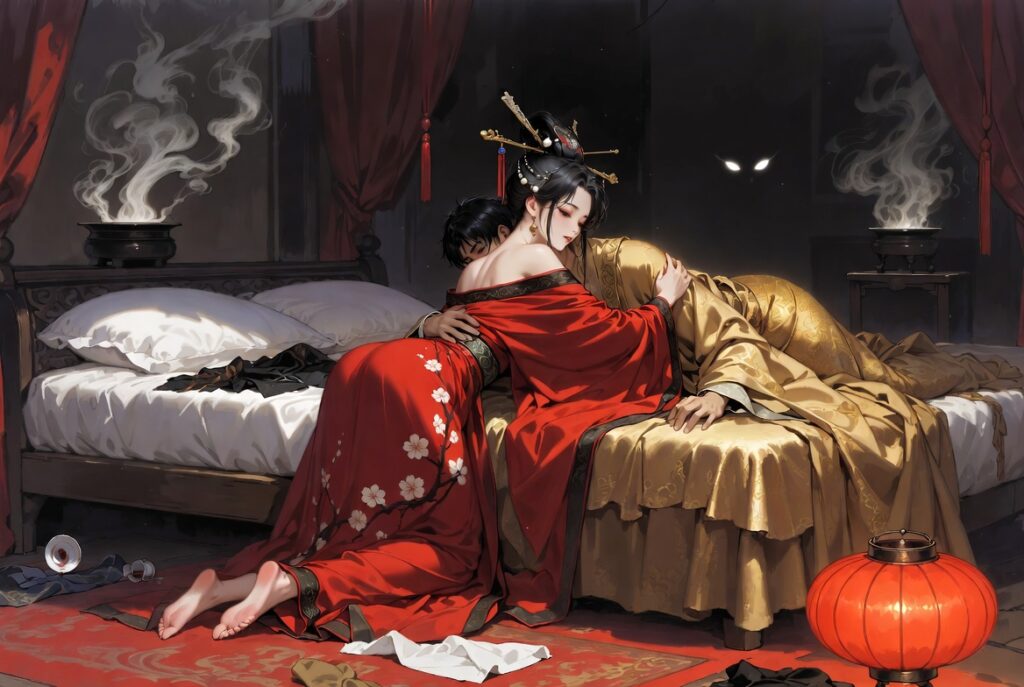
If you have wealth, do not abandon the wife who shared your chaff and bran, In times of poverty and hardship, you relied upon each other. Why surround yourself with jade hairpins and pearls? Better to be full on home-cooked meals, and brave the cold in coarse cotton. Do not envy the beauty of a glamorous concubine, For guarding against her wiles will exhaust your mind. Given half a chance, she will slip away for secret trysts. How could she ever be content to stay by your side? She only knows how to fly into the sky. (To the tune of “Immortal at the River”)
A foolish man loves the wild pheasant, for the wild pheasant’s feathers are fine, But given a gap, she longs to fly away, never satisfied with the grain she’s fed. The domestic chicken is a clumsy creature, but she guards her master into old age, She does not greedily sleep through the night, and at the fifth watch, she announces the dawn. The wild pheasant’s feathers are as lovely as fresh flowers, But since ancient times, seductive looks have often ruined homes. The domestic chicken crows to wake you early, While the plain wife sits in the inner chambers, quietly spinning hemp.
Chao Shu and his companion received the good news. They packed their luggage and, from the two hundred taels of travel money they had brought, left fifty taels for Hu Dan to use for managing affairs in the capital. After saying goodbye to Su Mianyi, they hired long-haul mules and joined their traveling companions to head back South.
Meanwhile, the nineteenth day of the second month was the birthday of the White-Robed Bodhisattva. Zhen-ge had been recovering and was gradually feeling better. She had made two pairs of shoes and bought incense, candles, and paper horses, intending to send Chao Zhu’s wife to the temple to offer them.
Just as the woman was about to leave the house, a massive commotion erupted outside. Chao Yuan was in the middle of combing his hair, and both he and Zhen-ge were startled.
Servants rushed in to report: “It’s those same seven or eight runners who came to announce the good news years ago! They’ve come to report that the Old Master has been promoted to Magistrate of North Tongzhou!”
Chao Yuan was overjoyed. Suddenly, a thought struck him: “No wonder my grandfather appeared in my dreams twice, telling me to head North to find my parents! I thought to myself, ‘My parents are currently in the South, so why does he keep saying to go North?’ It turns out my grandfather already knew!”
Chao Yuan went out to meet the men bearing the good news. He sent someone to a shop to buy eight bolts of bright pink cloth to drape over them in celebration, and then settled them into the study in the East Courtyard to rest. The next day, he threw a banquet to entertain them and offered a reward of one hundred taels of silver. The runners complained it was too little, so he gradually added another fifty taels until they were satisfied and sent them on their way. Friends and relatives came in an endless stream to offer their congratulations, though Chao Yuan did not dare escort any of them as far as the main gate.
Meanwhile, back at Magistrate Chao’s post in Huating, the servant Chao Shu and his companion had not even arrived home yet, but the official gazette messengers had beaten them there by ten days. The Magistrate housed the messengers in a local temple and rewarded them so generously that they left completely satisfied. He gathered his official documents, prepared the handover registers, formally took leave of his superiors, and chartered two official boats. He decided to leave his post on the first day of the fourth month and head straight to his new post in Tongzhou without returning home first. True to his previous promise, he handed over one thousand taels of silver to Scholar Liang, instructed him to resign from his local duties, and brought him aboard the boat to travel to the capital together.
On the day Magistrate Chao departed, a few local gentry and scholars came to see him off, doing just enough to maintain basic etiquette. But the students of the two county schools and the common people of the surrounding countryside hated the Magistrate like snakes and scorpions; they couldn’t wait to smash vinegar jars to cleanse the air the moment he left. The schools hadn’t prepared any farewell banners, and the commoners certainly weren’t planning to perform the old custom of “removing the magistrate’s boots” to keep as a token of their love.
The local gentry discussed the matter among themselves: “This ‘father of the people’ will never admit how cruelly he treated the scholars and citizens; outsiders will simply assume that Huating lacks proper customs and manners. We must make a farewell banner ourselves. We’ll have our own sons lead the way, forge the names of the entire student body on it, and ask the school instructor to present it. Then, we’ll set up a decorated pavilion, find a pair of boots, and have our tenant farmers dress up as commoners to pretend to lovingly remove his boots.” Having orchestrated this elaborate charade, they managed to usher him onto his boat when the day arrived.
Meanwhile, the actual citizens of the county were busy buying meat offerings to fulfill vows to the gods, pooling their money to hold celebratory rituals, burning paper offerings, actually smashing vinegar jars, and chanting Buddhist prayers—many of which were laced with bitter curses against him.
Once Magistrate Chao departed, he traveled in grand style, enjoying favorable winds and smooth waters. Just before the Dragon Boat Festival in the fifth month, he arrived in Jining. He docked the boat early, planning to go ashore to buy twenty or thirty catties of rouge to use as gifts at his new post, and to send a messenger ahead to his home to announce his imminent arrival.
That night, just as Magistrate Chao fell asleep, he saw his late father walk into the cabin. His father said, “Yuan’er has committed grave sins recently. For no reason at all, he took a prostitute hunting and shot a demon fox. The fox has tried to take its revenge twice now, and both times I intervened to protect him so he wouldn’t lose his life. But I fear that when your family’s luck begins to wane, he will not be able to escape its grasp. You must take him firmly in hand and bring him with you to your new post. First, this will get him far away from his hometown; second, your post is near the Imperial Capital, and the demon’s soul will not dare to follow him there.”
Magistrate Chao woke with a start, realizing it was a dream, and roused his wife. She immediately said, “I was just speaking with your father, and you woke me up!” They compared their dreams and discovered they were exactly the same, which left them deeply astonished.
Early the next morning, he wrote a letter to Chao Yuan. It read: “Although Wucheng is situated along the river, I have been away so long that if I return home now, the constant stream of visiting friends and relatives will cause endless delays. Therefore, I will not stop at the house. I will simply take a detour to the family tombs to offer sacrifices to the ancestors and burn the yellow imperial decree to announce my promotion. Once finished, I will return straight to the boat.” He added: “Your grandfather appeared to us in a dream, which was incredibly strange, especially since your mother and I shared the exact same vision.”
“…You must quickly pack your bags and bring your wife, Lady Ji, with you to my new post. While you are there, you can use the opportunity to secure an official title for yourself. Do not delay!”
What the Magistrate did not know was that Chao Yuan had completely cast Lady Ji aside and spent eight hundred taels to take Zhen-ge as his concubine, keeping the two old fools entirely in the dark. Although servants constantly traveled back and forth between the household and the Magistrate’s post, none of them dared to breathe a word of the truth. They all reasoned that their days serving the old master were numbered, while their days serving the young master would be long.
Now that his father’s letter explicitly ordered him to bring Lady Ji to the new post, how was Chao Yuan going to cover his tracks?
He quickly packed his bedding, hired eight sedan bearers, and took the grand sedan chair his father had bought in the capital. Carrying the Diamond Sutra and accompanied by six or seven servants, he traveled up the river to intercept his parents’ boat. After two or three days, he met them. Amidst the endless family chatter, he lied smoothly, claiming that Lady Ji had suffered a miscarriage and was unfit to travel. He insisted that his parents go on ahead, promising that once she was fully recovered, they would follow.
Chao Yuan stayed on the boat with his parents for a few days until they reached Wucheng. After they offered sacrifices at the ancestral tombs and formally burned the yellow imperial decree announcing the promotion, Magistrate Chao finally learned that Yongshan Manor had been burned to the ground, taking tens of thousands of measures of grain with it. He sighed heavily over the loss, then ordered the boat to set sail for the North. Chao Yuan escorted them for two more stops before reiterating his promise to bring Lady Ji—either by boat or by land—as soon as she showed signs of improvement, and then headed home.
Upon returning to the estate, Chao Yuan spun a completely different lie to Zhen-ge: “When my parents heard that I had married you, they were absolutely overjoyed! They wanted to bring you onto the boat immediately to travel with them to the new post. I had to tell them you were still bedridden from your miscarriage, so we had no choice but to delay. As soon as you are well, we will both set out.”
By the end of the fifth month, the dog days of summer had passed. Chao Yuan chose the seventh day of the seventh month to begin their journey by land. He hired mules and sedan bearers and had all the luggage packed and ready.
But on the afternoon of the fifth day, Lady Ji led four or five of her maids to the front hall. They grabbed the official sedan chair her father-in-law had bought for her—curtains, armrests, and all—and dragged, pulled, and hauled it all the way back to her own inner courtyard. As she hauled it, she loudly declared, “My father-in-law bought this for me! What cheap, base-born slave dares to sit in it? If anyone steps forward to say a word about it, I’ll smash this chair to splinters and fight them to the death!”
When the servants reported this to Chao Yuan, Zhen-ge was so furious she was left staring blankly, unable to speak.
Chao Yuan sneered, “Let her make a fool of herself! Let’s see if we can’t travel just because we don’t have that one chair! I’ll buy a new one that is ten thousand times better!” True to his word, he spent twenty-eight taels of silver to buy a fully equipped, second-hand grand sedan chair from a local gentry family. Only then was Zhen-ge happy.
Chao Yuan then sent a maid to gloat to Lady Ji: “The Master just spent fifty taels to buy a magnificent new sedan chair. He invites you to come take a look.”
Lady Ji glared at the maid, gathered a mouthful of thick saliva, and spat right in her face. “Absolute nonsense!” she cursed. “Even if he spent five thousand taels on a chair, I wouldn’t waste the ache in my legs to go look at it! As long as he doesn’t touch my worn-out chair, I don’t care if he spends fifty thousand taels!” The maid fled like a gust of wind.
On the seventh day, with everything packed and instructions left for the house-sitters, the group set off toward the North. Traveling from dawn till dusk, they eventually reached Beijing.
However, Chao Yuan didn’t dare bring Zhen-ge straight into his father’s official residence. He knew he needed time to use his glib tongue to coax his parents into accepting her first. Therefore, just inside the Shawo Gate of Beijing, he rented a medium-sized courtyard house for three taels a month. He bought furniture, utensils, coal, rice, and all necessary provisions, settling Zhen-ge there comfortably. He left all the traveling maids, along with the servant Chao Zhu and his wife, to attend to her in the city.
Chao Yuan stayed in Beijing for two days before taking a few remaining servants and heading to the official residence in Tongzhou alone. When he arrived, he told his parents that Lady Ji’s miscarriage was still not healing properly, and fearing they would be anxious with waiting, he had come ahead by himself.
Lady Chao was full of complaints. “The house is right by the river!” she scolded her son. “You just step onto a boat and sail directly to the yamen gate. How could you not bring her along and leave her at home? Who is there that truly cares for her and will serve her diligently? It’s a wonder you could be so heartless! Besides, there are excellent doctors in the capital who could treat her properly.”
She scolded her son endlessly and wanted to send a messenger back immediately to beg the Ji family to send their daughter. Chao Yuan managed to temporarily deflect her demands.
On the twenty-fourth of the seventh month, Chao Yuan said, “Tomorrow, the twenty-fifth, is the market fair at the City God Temple. I want to take a stroll there to buy a few things and look around. I’ll need to stay for a few days before returning.”
Old Master Chao agreed and gave him sixty or seventy taels of silver, offering to dispatch two yamen runners to accompany him.
“With so many servants of our own, what use are yamen runners?” Chao Yuan replied. He took eight sedan-bearers, boarded his sedan chair, and headed straight into the Shawo Gate to Zhen-ge’s residence.
“It’s a good thing you didn’t go in!” he told Zhen-ge. “That yamen is tighter than a turtle shell—you can’t even turn your backside around, and there isn’t even a decent place to relieve yourself! We’re used to living in spacious mansions; if we were stuck in that cricket box, we’d suffocate in two days! Thank goodness I had the foresight not to bring you in immediately. Once you enter the yamen, with all its strict rules, you can’t just leave whenever you please. Then my Little Zhen would really suffer!” Zhen-ge was successfully coaxed.
On the twenty-fifth, he took an armrest full of silver and actually did go to the temple fair, buying a few inconsequential items. He stayed at the residence in the capital for seven or eight days before bidding Zhen-ge farewell and returning to Tongzhou.
Now, let us speak of that servant, Chao Zhu. He had not served the family since childhood. He had been a gatekeeper and a soldier, a sturdy, dark-complexioned young man of about twenty-four or twenty-five. After Old Chao was selected for his official post, a friend had recommended Chao Zhu, and he had come to pledge his service. Chao Yuan liked his cleverness and entrusted him with a hundred tasks. Hiring prostitutes, booking actors, managing incoming and outgoing money, and handling gifts—Chao Zhu took care of it all single-handedly.
Back when Zhen-ge was still an actress, Chao Zhu spent all day bantering and flirting with her. When the time came to buy her, the haggling over the price and the skimming off the top were all arranged by him from start to finish. You could say the two were as thick as thieves from the moment they met. Yet, this foolish “Great Master” intentionally left him in the capital to watch over a house full of women!
Chao Zhu’s wife breathed out of the same nostril as Zhen-ge; no two people were ever more perfectly in sync. Gradually, the clothes and shoes worn by the Chao Zhu couple became inappropriately luxurious, to the point where the scandalous affairs occurring within those women’s quarters were too shameful to speak of. Yet, the foolish Great Master seemed deaf and blind to it all. The lovers barely even tried to hide from him anymore, while the gossip of outsiders grew so thick you couldn’t fish it out with chopsticks.
How could Chao Zhu ever repay Great Master Chao for such profound kindness? He worked desperately hard to scrape together some money and bought Chao Yuan a brilliant, parrot-green “Ten Thousand Character” headscarf. Fearing it wasn’t quite grand enough, he went to Gold Leaf Alley, bought an entire sheet of gold foil, and took it to the gold-gilding shop in the East River Rice Lane. He had it gilded with an intricate pattern of intertwining lotus branches—it was remarkably beautiful—and presented it for Great Master Chao to wear.
In truth, having such a fine (green) headscarf to wear should have been enough for Great Master Chao. But he completely squandered Chao Zhu’s “good intentions.” He wanted to wear a different kind of headgear—the “Upper Scholar” cap.
He spoke to his father, preparing documents, filing petitions, and relying on precedents to buy his way into the Imperial Academy. Sure enough, his father humored him. They submitted a petition to the Ministry based on past examples, pulled a few strings, and secured him the nominal title of an affiliated student. By citing the precedent set by capital officials, he even managed to shave twenty or thirty taels off the cost. For less than three hundred taels of silver, the purchase was complete.
He found guarantors among capital officials from his hometown, avoiding the need for an investigation in his native county. Picking an auspicious day, he entered the Imperial Academy, paid his respects to the Chancellor and Director of Studies, was assigned his quarters, and formally greeted the registrars and assistant instructors. Every day, he followed the crowd, wearing a scholar’s square cap, the round-collared robe of a provincial graduate, a long dark-blue silk sash, and white-soled black boots. Mingling in the ranks, he attended the morning roll call in the main hall. But alas:
All his life he hasn’t read a single book, how could he know the characters ‘Zhi’ or ‘Hu’? Drifting into the palace walls in a scholar’s blue robe, he ought to feel truly ashamed! The moment he steps into the Hall of Great Perfection, Confucius and Mencius both retreat. They scramble to ask, “Who is this man? And why has he intruded so lightly?” (To the tune of “Divination Teller”)
Using his enrollment at the Imperial Academy as an excuse, Chao Yuan stayed on in the capital. All his daily expenses and living costs were delivered every few days by messengers from Tongzhou. Recently, he had also hooked up with a secret prostitute living near the Academy gates. Having spent money to win her favor, he frequently used the excuse of having “night duty” at the Academy to spend entire nights away from his rented house. Fortunately, Zhen-ge was not the least bit lonely. She was quite happy that he was out having “night duty,” as it gave her the perfect opportunity to have her own “night duty” at home with Chao Zhu. Thus, she made absolutely no effort to control him.
Sometime after the twentieth day of the twelfth month, Old Master Chao sent a messenger to say, “Even young schoolboys are let out for the holidays by their teachers. Now that the New Year is upon us, what are you still doing in the capital?”
Chao Yuan replied, “Go back first and report to the Old Master that I will stay to catch the temple fair on the twenty-fifth. Once I buy a few things, then I will return.” The messenger left.
From then on, he focused entirely on buying New Year’s goods for Zhen-ge. From her head to her toes, from what went into her mouth to what filled her belly, he prepared absolutely everything. At the temple fair, he exchanged silver for four taels of snow-white pearls for her, bought jade flowers and knots, acquired several sets of gold-thread garments, and purchased a bolt of crimson “Ten Thousand Longevity” palace brocade.
On that particular day at the fair, someone was selling a bizarre, living treasure. A large crowd had gathered around to look, though no one could afford the asking price. Chao Yuan ordered his men to push the crowd aside so he could get a closer look. Inside a large, square cage painted with gold lacquer sat a small, vermilion-lacquered table. On the table lay a miniature Heart Sutra written in gold ink on dark blue porcelain paper. Beside it was a black-centered rush mat with woven borders, and sitting on the mat was a fat, crimson-haired lion-cat. The cat had eaten its fill and was sleeping with its eyes closed, facing the sutra and purring loudly.
The cat seller was announcing to the crowd, “This cat belongs to the Tathagata Buddha of the Western Paradise! Because it broke a Buddhist precept by biting to death a mouse that was stealing oil from the glazed lamps, the Buddha was furious and wanted the cat to pay with its life. Only after the Eight Vajra Warriors, the Four Bodhisattvas, and the Eighteen Arhats pleaded repeatedly for mercy was its life spared. It was handed over to tribute-bearers from the Western Ocean to bring to China, condemned to be raised by mortals for fifty years before it can be taken back. If you listen closely, it isn’t just purring—it’s chanting the Buddha’s name! It is endlessly chanting ‘Bodhisattva Avalokitesvara.’ It knows that the Goddess of Mercy saves those in distress, and it hopes she will rescue it and return it to the Western Heaven!”
Chao Yuan cocked his ear to listen. It truly did sound just like chanting sutras! “How truly bizarre!” he exclaimed. “A coat of long crimson fur is already a rare and strange sight in this world, but to know how to chant sutras as well? But where is the foreigner who originally brought it? I’d like to meet him and ask for the details.”
The seller replied, “Once the foreigner finished delivering his tribute, he couldn’t wait around to sell the cat. I gave him two hundred and fifty taels of silver on the spot, and he has already returned home.”
Chao Yuan was shocked. “Why does it cost so much silver? What special benefit does it have?”
“Listen to what the Master is saying!” the seller countered. “If it didn’t have special benefits, wouldn’t people just spend thirty or forty copper coins on an excellent, purebred mouser instead of handing over two or three hundred taels for this one? That it catches mice goes without saying. But wherever this cat resides, mice will flee for ten miles around. You wouldn’t be able to find a single trace of a mouse even if you tried!”
“The rat poison sellers are so anxious they jump in frustration, and they go hungry until their teeth are yellow and their breath stinks! But that’s not what makes it rare. If a family keeps this Buddhist cat, there are countless heavenly gods and divine generals who will protect them! Whatever demon, ghost, fox spirit, or monkey goblin there is—no matter how powerful it has become—if it catches even a whiff of this cat, it won’t be able to die fast enough. Even Celestial Master Zhang would only end up frustrated.
“Yesterday, a young daughter in a household right outside the Hanlin Academy gate was possessed by a fox spirit. The demon was fierce, and she was on the verge of death. They invited two famous Daoist masters from the Temple of Heaven to catch it, but the fox spirit nearly tormented them to death. Later, they pasted up a talisman drawn personally by Celestial Master Zhang. When night fell, the talisman started making strange swish-swoosh noises. People thought the fox spirit had been caught by the Celestial Master’s charm. But that wasn’t it at all! It was the talisman itself squirming around. When people went to check on it, the talisman spoke with a human voice, saying, ‘That fox spirit is sitting right outside the door; my bladder is bursting, but I don’t dare go out to piss!’
“Early the next morning, as I was carrying this cat to the market, I passed by there. A large crowd was gathered around talking. I stopped to listen, and that’s exactly what they were discussing. Who would have thought the fox spirit didn’t know this cat was outside? It ran out, saw this cat, let out a ‘shriek,’ revealed its true form, and dropped dead on the spot! That family invited me in, treated me to a grand banquet, and rewarded me with five taels of silver. I skinned that fox, tanned its hide, and made a wind-collar out of it. It’s the very one I’m wearing!”
The crowd listened carefully to his long story. One man finally spoke up: “This is a joke! He’s just making fun of Celestial Master Zhang’s talismans for not working!”
The cat seller stiffened his face and retorted, “How is it a joke? The family lives right across from the Hanlin Academy; they’re runners for the Academy. There are witnesses to corroborate it!”
Hearing that the cat warded off evil and terrified fox spirits, Chao Yuan was already quite keen to buy it. He asked, “Let’s make a long story short. Whether it’s true or false, tell me exactly how much silver you want for it. I’ll buy it.”
“Listen to what the Master is saying!” the seller replied. “If I weren’t actually trying to sell it, would I be standing here gulping cold wind and blowing hot air just to sell ‘cold ginger’? It’s the end of the year, people are coming around, and I owe a lot of debts; I’m relying entirely on this cat. Do you think the two hundred and fifty taels I spent on this cat the other day were all my own money? I had to borrow half of it just to scrape enough together to buy it. Now my other goods won’t sell quickly, people are coming to collect, and I just want to make three or four taels of profit and be done with it. I originally wanted three hundred taels, but I’ll knock off ten for you, Master. Let’s make it two hundred and ninety taels.”
“Nonsense!” Chao Yuan scoffed. “That won’t do! I’ll give you twenty-nine taels of pure fine silver, weighed on the scale. Whether you sell it or not is up to you.”
The seller cried out, “Good Master! Even if you were haggling in Suzhou, you’d at least offer half! Yet you’ve knocked off ninety percent!”
“I’ll add another three taels, making it thirty-two taels total. Will you sell it?” Chao Yuan asked.
The seller hesitated. “It’s only because I’m desperate at this time of year and have no silver to spend. If I could just get past the New Year, I’d keep this cat to ward off evil and catch ghosts for people, and I’d earn countless coins with it.”
Hearing the words “ward off evil and catch ghosts,” how could Chao Yuan be willing to let it go? He increased his offer to thirty-five, thirty-eight, forty, forty-five taels, but the man still refused to sell. The bystanders, afraid that Chao Yuan might lose his temper and that others might refuse to help smooth things over, stepped in. With a mix of coaxing and clever mediation, they finally settled the price at fifty taels of silver, and the cat was sold.
Chao Yuan took a large silver ingot from the armrest of his sedan chair and handed it to the man. The man said, “Although this is a single solid ingot, I don’t know if it’s a full fifty taels. Let’s find a place to weigh it.”
The bystander who had mediated the deal scolded him, “You really have no eyes! Would such an honest and generous master deceive you? Even if it’s short a tael or two, you aren’t losing out to a stranger.” One took the cat, the other took the silver, and everyone dispersed happily. Before leaving, the seller even knelt on the ground and kowtowed twice to the cat, saying, “My living Buddha! If your disciple wasn’t in such desperate need, I would never bear to part with you.”
Chao Yuan was just about to leave when another man selling parrots called out, “Master, please come back and look at my parrot! Do me a favor and give me some business. I’m also desperate for money as the New Year approaches and need to pay off my debts.”
Chao Yuan stopped, took a look, and said, “I already have several at home; I won’t buy it.”
The man turned to the bird and said, “Parrot, the Master won’t buy you. If you don’t beg the Master yourself, I won’t have any beans to feed you.”
The parrot actually fluttered its wings and said, “If the Master won’t buy me, who dares to buy?” It spoke so clearly, it was no different from a human voice.
Chao Yuan scratched his ears and rubbed his cheeks in delight, saying, “My trip to the capital truly wasn’t in vain! How can there be such rare and wondrous things in this world!” He then asked, “How much silver do you really want for it?”
The man replied, “This isn’t like that cat that can catch evil spirits and is worth a fortune. This is just the cost of my labor to train it. When wealthy masters buy them to take home, they just use them like maids or houseboys to pass messages, so how much could I dare ask? If the Master likes it, reward me with a few extra taels; if you don’t care much for it, give a few less. I am, after all, a parrot trainer from inside the Imperial City. It takes me a full six months to train a flock, and I only brought three or four out with me. Just reward this lowly one with thirty taels of silver, Master, and take it home to play with.”
“I’ll give you twelve taels,” Chao Yuan said. The man refused to sell.
Chao Yuan pretended to walk away. The man took out a handful of mung beans and said, “The Master is leaving and won’t buy you. You’ll just have to starve to death!”
The parrot fluttered its wings and repeatedly cried out, “If the Master won’t buy me, who dares to buy? If the Master won’t buy me, who dares to buy?”
Chao Yuan turned his head and said, “This is truly extraordinary! Even if I spend two extra taels, I won’t be losing out.” He opened his armrest, took out one packet of ten taels and one packet of five taels, and handed them to the man.
The man untied the packets, looked at the silver, and said, “These fifteen taels… isn’t the Master’s reward a bit too little? Ah, fine! Fine! I see the Master is an impatient man, so I will sell it to you.”
With the transactions complete, Chao Yuan mounted his horse, his servants hired donkeys, and they all hurried back to their residence in a cloud of dust. When he brought the items before Zhen-ge, he presented them as proudly as if they were rare treasures offered by foreign envoys. But Zhen-ge acted aloof and ignored them completely; instead, she endlessly fondled and played with the clothes, brocades, pearls, and jade flowers he had bought.
Chao Yuan scoffed, “You village girl! You ignore two living treasures to play with a couple of pearls!”
Zhen-ge retorted, “A ridiculous lion-cat and a parrot—living treasures? They’re more like dog bezoars!”
Chao Yuan said, “You village girl! Do you have such a bizarre lion-cat and a talking parrot in your home?”
“Bah! What have you ever seen?” Zhen-ge scoffed.
“You’re just being stubborn!” Chao Yuan replied. “Never mind anything else, is there such a massive lion-cat anywhere else in the world? Doesn’t this weigh a good fifteen or sixteen catties?”
“What do you know!” Zhen-ge retorted. “In Beijing, there are countless cats as big as dogs and dogs as small as cats!”
“Well, we have plenty of parrots back home,” Chao Yuan argued, “but have you ever seen one that can talk like this?”
“Then why hasn’t it said a word this whole time?” Zhen-ge asked.
Chao Yuan turned to the bird. “Parrot, speak to the lady of the house, and I’ll give you beans to eat.”
The parrot indeed spoke with crystal clarity: “If the Master won’t buy me, who dares to buy?”
“It really does speak clearly,” Zhen-ge admitted. Then she leaned in. “Parrot, say another sentence, and I’ll give you beans to eat.”
The parrot repeated: “If the Master won’t buy me, who dares to buy?”
Zhen-ge looked at Chao Yuan and burst into laughter. “My silly boy! You’ve been had! Can you get it to say a second sentence?”
Chao Yuan tried again. “Parrot, the cat is coming!” He called out several times, but the parrot only repeated the same phrase: “If the Master won’t buy me, who dares to buy?”
Zhen-ge shot Chao Yuan a look. “You foolish grandson! What did you buy this stupid thing for? You would have been better off saving those few mace of silver to buy melon seeds to snack on for the New Year. You blind fool, throwing your money away!”
“A few mace of silver!” Chao Yuan protested. “That was fifteen taels of silver!”
Zhen-ge sneered. “Fifteen taels! You could have bought at least forty of them for that!” She turned to Chao Zhu. “How much silver did he really spend?”
“It truly was fifteen taels,” Chao Zhu confirmed, “not a penny less!”
“Pah! You stupid bast—” Zhen-ge caught herself before she finished the curse. Then she asked, “And how much was this cat?”
“The cat cost that entire large silver ingot,” Chao Zhu said.
“I don’t know what kind of nonsense you master and servant are up to!” Zhen-ge exclaimed.
“Could we have been tricked about this cat too?” Chao Zhu wondered aloud. “Since when do we have red cats around here? And since when do they know how to chant sutras?”
“Red!” Zhen-ge mocked. “They come in green, blue, black, and purple too! It’s obviously been dyed; did you really think it was born that color?”
“My stubborn lady!” Chao Yuan snapped. “If you don’t know what you’re talking about, keep your mouth shut! Wet your finger with spit and rub it—see if the color comes off or not!”
“Does madder dye fade so easily?” Zhen-ge countered. “Do felt rugs, goatskins, and tassels lose their color?”
“Nonsense!” Chao Yuan said. “How can you dye a living creature?”
“Old men dye their beards black—do they have to be dead to do it?” Zhen-ge shot back. “Did you ever see that white lion-cat we had back home? It started out as a red cat, even brighter and more vibrant than this one!”
“Then how did it become white?” Chao Yuan asked.
“It shed its fur in the spring and turned white,” she replied flatly.
Chao Yuan stood frozen for a moment, then looked at Chao Zhu. “Let’s hope we weren’t scammed by him!” He turned back to Zhen-ge. “But it really can chant sutras, isn’t that strange?”
“Make it chant a sutra for us to hear,” Zhen-ge challenged.
Chao Yuan scratched the cat under its chin a few times. The cat narrowed its eyes and began to purr loudly. Chao Yuan smiled triumphantly. “Listen! Listen! It’s clearly chanting ‘Bodhisattva Avalokitesvara’! ‘Bodhisattva Avalokitesvara’!”
“I can’t even bring myself to laugh at this,” Zhen-ge sighed. “Whose cat doesn’t know how to chant this ‘sutra’? Maid, bring our little tortoiseshell cat here!”
The maid brought over a tortoiseshell cat. Zhen-ge held it in her arms and scratched it under the chin a few times. The tortoiseshell cat also narrowed its eyes and began to “chant” ‘Bodhisattva Avalokitesvara’ with a loud purr.
“Listen!” Zhen-ge said. “If your cat is worth fifty taels, my little tortoiseshell is worth sixty! All cats purr like this, whether you want to call it chanting or not! If the city of Beijing didn’t have silly boys like you, those swindlers would starve to death!”
Chao Yuan was left completely speechless and suffocating with embarrassment, while Chao Zhu slinked away, looking utterly humiliated.
“Well,” Chao Yuan finally muttered, “it wasn’t our money anyway; we’ll just put it on my father’s tab. We’ll say this cat is good at keeping mice away, keep it as a regular pet, and let it catch mice.” He then ordered a maid to grab some mung beans and put them in the parrot’s feeding jar.
Translator’s Note
- 糟糠妻 (Zāo kāng qī)
- Literal Meaning: “Chaff and bran wife.”
- Context/Meaning: This comes from the opening poem. It refers to a wife who has shared in her husband’s hardest, most impoverished times (when they could only afford to eat the husks and bran of grain). The traditional moral is that a man who gains wealth and success must never abandon the “chaff and bran wife” who suffered with him. Chao Yuan’s treatment of Lady Ji is a direct violation of this deeply held cultural value.
- 打個醋壇 (Dǎ gè cù tán)
- Literal Meaning: “Smashing a vinegar jar.”
- Context/Meaning: In traditional Chinese folk belief, boiling or splashing vinegar was a way to fumigate a room, kill airborne diseases, and dispel foul odors or bad luck. When Magistrate Chao leaves, the citizens hate him so much that they want to “smash vinegar jars” to spiritually and physically cleanse the county of his toxic presence.
- 脫靴遺愛 (Tuō xuē yí ài)
- Literal Meaning: “Removing boots to leave behind love/legacy.”
- Context/Meaning: This is a historical custom. When a highly beloved and righteous magistrate would leave his post, the local citizens would playfully block his path and beg to keep his boots as a relic of his good governance and to symbolize that they wanted him to stay. The author uses this ironically: the local gentry have to fake this custom with hired actors because the actual citizens despise Magistrate Chao.
- 傾蓋如故 (Qīng gài rú gù)
- Literal Meaning: “Lowering the carriage canopies as if old friends.”
- Context/Meaning: An idiom used to describe two people who hit it off immediately upon their first meeting, as if they had known each other for years (the imagery is of two carriages passing, the drivers lowering their canopies to chat). The author uses this sarcastically to describe the immediate, sleazy rapport between the corrupt master (Chao Yuan) and the conniving servant (Chao Zhu) when they were buying Zhen-ge.
- 翠綠鸚哥色的頭巾 (Cuì lǜ yīng gē sè de tóu jīn) / 綠帽子 (Lǜ mào zi)
- Literal Meaning: “Emerald/parrot-green headscarf.”
- Context/Meaning: This is the most crucial cultural pun in the chapter. In Chinese culture, a man wearing a “green hat” or green headwear means his wife or concubine is cheating on him. By gifting Chao Yuan a beautiful green headscarf, the servant Chao Zhu is secretly mocking him, as Chao Zhu is having an affair with Zhen-ge behind the master’s back.
- 之乎字 (Zhī hū zì)
- Literal Meaning: “The characters Zhi and Hu.”
- Context/Meaning: Zhi (之) and Hu (乎) are the most common grammatical particles used in Classical Chinese text. Saying someone “doesn’t even know the characters Zhi and Hu” is a colloquial way of saying they are completely illiterate and uneducated. It highlights the absurdity of Chao Yuan buying his way into the prestigious Imperial Academy.
- 冷風淘熱氣,圖賣涼姜哩 (Lěng fēng táo rè qì, tú mài liáng jiāng li)
- Literal Meaning: “Gulping cold wind to blow hot air, just trying to sell cold ginger.”
- Context/Meaning: A Northern colloquial proverb used by the cat seller. It means “wasting my breath and energy for no reason.” He is telling Chao Yuan: Do you think I would stand out here in the freezing cold talking until I’m blue in the face if I wasn’t seriously trying to make a sale and a profit? * 狗寶 (Gǒu bǎo)
- Literal Meaning: “Dog bezoar” (a stone found in a dog’s stomach/gallbladder).
- Context/Meaning: Chao Yuan proudly calls the cat and parrot “活寶” (huo bao – living treasures). Zhen-ge ruthlessly mocks him by replacing the first character to make it “狗寶” (gou bao). While a dog bezoar has some use in traditional medicine, in this context, it’s a vulgar pun meaning he just bought a pile of dog crap.
0 Comments